








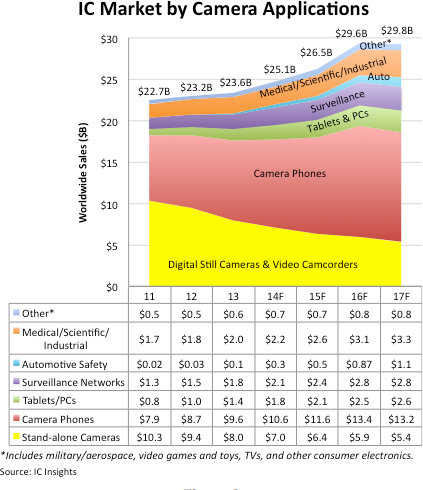
ICinsights (found via MirrorlressRumors) posted an analysis of what could happen with the camera market till end 2017. The overall camera turnover will shrink to a half by end of 2017 compared with the peak reached in 2011. But the good news for the camera companies is that the System Camera Market is expected to growth. And that’s where companies usually have higher profit margins. As we know from previous Panasonic/Olympus financial reports both companies will focus more on that high-end camera market.
Interesting: If you look at the non conventional camera market the future looks bright. Medical cameras (where Olympus leads the market), Surveillance cameras, car cameras, tablets and smartphone cameras sales are expected to growth further.
77 Responses
The world has got to the stage where image quality is “good enough” and further improvements are for artistic purposes. The camera is now small enough to be integrated into everything, it looks like all the people saying why build a camera with all these integrated features like a phone or coffee maker was stupid. But instead they are integrated in the opposite direction, adding a camera to phone, to a tablet, to a car, to security gate. They never thought a camera would be the commodity instead.
Sometimes I wonder if Canon and Nikon added phone capabilities to their cameras instead of trying to keep the camera pure, market share might have held steady, as no one wants to carry two devices, even a dumb phone might have been okay with only phoning and sms. Only Samsung are willing to risk making camera phones with real optical zooms and that is why they are successful due to their risks they take making new products filling niches no one else tries or even wants to attack because they are a “Camera company”.
make ALL cameras under 500 and see how amrket explode 😉 And ALL compact under 100
The communism of cameras? 🙂
Yes. Modell-Lineup:
– Stalin-T1
– Lenin-P5
– Cruschtschow-A6000
Bodies in red.
Hahaha but they should look the same, and have the same sensor and software. Only focal lenght of fixed lenses would change. Focus light assistant would be red but there would not be any red eye remove option 🙂 ok, I’ll stop now, enough bs from me
A Gh4 for example out of factory has a value of 3-400$ 😉
To give the customers exactly what don’t want: lower end?
Don’t ask the slaves work any cheaper. You’ll have to take it from the toppers.
Explode or implode? I think it would be the latter. Remember the Netbooks? Almost killed the manufacturers.
Top graph shows D-SLR sales increasing; whilst bottom graph shows Digital Still Cameras sales decreasing – ??
The bottom graph is combining DSLRs with P&S and camcorders. People aren’t going to be buying cheap cameras or video cameras when they have a smart phone or tablet that meets their needs.
People’s needs change or evolve over time. Go to a little league game or soccer match and see all the mom’s and their “cameras”. Just from last year to this year I have noticed a marked increase in the use of cameras compared to smartphones.
There is hardly any room between the mobile phone and the digital system camera. The days of the consumer compact camera are running out. Maybe a market niche will remain for superzoom compacts, but even there I am not so sure.
Agree. I see no future for m43 at all, sadly…
Lets not forget google glasses followed by image sensor implants into your brain ……coming soon!
I can’t wait to see someone taking a selfie at the mirror with those ridiculous-looking glasses, trying to look cool.
People who take selfies at the mirror usually fail to look cool anyway.
Sure, but wait to see their pretending “I’m cool” look behind those ugly glasses! 🙂
I remember a cover of Wired magazine, some years ago: there was a portrait of Brad Pitt, and he was wearing a bluetooth earphone. The title was something like: “If he does not look cool wearing this thing, how cool do you think you can look?” 🙂
Leaving apart the disturbing issue of privacy, I find google glasses more ugly than bluetooth earphones.
What’s the difference between privacy issues related to google glasses and those related to regular cameras? I mean, if it’s allowed to take pictures in the public space, then should it be specified which type of picture making devices you are allowed to use? Or should certain ways of taking pictures be made illegal?
I don’t think we can set rules for that. I mean, if you are wearing that device and enter a place where it’s not allowed to take pictures, you have to put them away. Be sure that if someone ring at my door and ask to enter, I won’t welcome him in if he’s wearing that device.
Generally I don’t like at all voyeristic use of a camera, and google glasses seem made for that.
I don’t know. Maybe we need to get used to this kind of future. Surveillance cameras everywhere, people can’t be without googleglassing for more than 2 seconds…
It seems to me as though sensor performance has kind of plateaued at this point, so there’s little real need/desire for people to upgrade their cameras as often as they did even a few years ago. Sensor size seems to be the main differentiation now and even that isn’t as dramatic as it was in the recent past.
The last couple of generations of M4/3 cameras have only had minor improvements in image quality, aside from minor improvements in dynamic range and marginally better high-ISO performance. There’s pretty much image parity from low-end to high-end at this point, so camera manufacturers are using feature-itis, with marginally useful and fluff features (wi-fi, panorama, HDR, etc.) to lure customers into upgrading. Skipping one or two generations, or even more, seems to be more the norm today.
Maybe with the introduction of Holy Grail features like global shutter and organic sensors we’ll see a furious upgrade cycle. Maybe, maybe not. For most folks, good enough is good enough, so why agonize and prognosticate?
Good post Jeff. it will be interesting to see what the camera makers will do to cope.
I have reached the point where I feel satisfied with my camera and I can’t be the only one.
Great Post. I have a full frame and numerous Zeiss lenses- use the Olympus more but enjoy them both. As you stated, the improvements in quality have gotten so good in both smaller and larger sensors that for most uses people can’t tell the difference. To make matters worse, I’m finding that for what I do larger equipement is pretty much a no go. Global shutter, curved sensors, organic sensors- these are the future.
I’ll buy a mirrorless full frame once someone releases a mature one, technologically speaking. Then I can use all my adapted film lenses without a sensor crop. Second generation Sony A7 carries the most hope.
Of course, I represent a sliver of the marketplace, so I won’t be saving the camera industry alone. 😉
Just give me that mythical Digital Film I can stick in my film cameras and I’d be a happy man.
LOL!
Oh yeah, I hoped for that, too!
Disagree. My map of sensor performance shows that we’re still pretty much on the same lines as we’ve been for well over a decade. We haven’t hit technical limits, so I’d expect to see continued gains. Thing is, those gains come slower than most realize. I like to use the rule of thumb that a clearly observable gain takes about three years, which tends to be about two generations of sensors in the big cameras.
My contention is that we’ve gotten past the point where most people can see those gains. 90% of the camera market wouldn’t know how to look for 13 stops of DR versus 11, for example. This is the same problem the PC makers had several times along the way, when clock speed got faster but most people didn’t see their word processors speed up ;~). When that kind of thing happens, you have to either market better or come up with a truly different feature that disrupts.
Map it against the IT market and I think you will see a similar trend happened in desktop PC shipments. At one point the frequent technology updates leads to market fatigue and once they discovered that lesser devices could do what they wanted to do with a PC, they started buying these gadgets instead. First they moved to laptops and even that stalled eventually when people started using tablets and smartphones instead. Unless you are using one for work, you don’t really need a “proper” PC or laptop when a gadget would do.
Same thinking in cameras, it seems. So what’s the solution? Niche gadget-type products that do what the consumers want to do with their cameras yet are “invisible” enough that they would want to take it along in their bags or pockets with their smartphone cameras. It will need to also be seamless to use with social media and cloud storage because transferring photos to a PC is also a nuisance for many users, some of whom wouldn’t even have a PC or one with an SD card slot (like tablets, for example). Just point and click and your photos are automatically uploaded to a storage site ready for processing or sharing.
Maybe. back to scrubbing now, marsch!
You need to step up your game. You’re just as boring as you are in real life. Seriously. I’m telling you this as a friend.
I am way out of your league, but you can be friends with Zeikon(a), and maybe something more than friends…
You sad creature. I imagine you say “Gollum! Gollum!” a lot.
Don’t talk to me, talk to Zeikon, she is right for you.
You’ve used that one before SD. Out of material?
Oh, dear. If so, he is quite pathetic. Haha. I almost feel sorry for him. He must be lonely.
What’s the with the third person SD? I thought we were friends.
Continuing the IT market analogy, in many of today’s homes you will typically find just one PC and maybe a couple of laptops for the household, but each family member will have at least 2 gadgets with them. So that’s a ratio of 1:4, 2 (typically) PCs against 8 (or more) gadgets.
I think the model holds for cameras: where each household will own just one big “serious” camera. For many people a “serious” camera has to be a DSLR. That’s one challenge for m43 when they want to go upmarket — how do they make people take them seriously. More pros have to be seen using m43 cameras at more events. I remember Minolta had some success with their Maxxum cameras because people started seeing them on wedding photographers and were impressed by the then-new thing called AF. Alternatively, m43 could go instead after the “gadget” market and come out with things like the Leica T, which are really consumer devices that take photos rather than “another camera”, hence less of the psychological barrier.
Dammit, I can’t seem to make paragraphs.
Cheaper prices would help. Olympus 45 and 25mm 1.8 are reasonable but plastic. I own them so no knock on the image quality. However, they are a bit expensive for what they are including the zooms. Some of them aren’t much less than what you’d pay in FF. I think this is the biggest hurdle- cost and faster lenses.
I don’t know for sure, of course (otherwise I would be the CEO of Olympus haha), but I’d be wary of that strategy, as I posted lower down. Low cost Netbooks were the IT market’s answer when laptop sales started tapering off, but it almost killed the manufacturers. Low profits, yet no one wanted them because they were not functional enough. And then Apple swanned in with their take on the Netbook — the Macbook Air — and managed to make people buy what was basically a premium priced Netbook. I think in consumer gadgets, image and branding matters more. It’s why the OMD ads are what they are — stylish. But I think they should have used that for the Pens, and targeted OMD ads at professionals.
PS, I work in advertising, so I like to follow these trends and speculate in my free time. Haha.
You know, it just occurred to me that a line of small but stylish m43 boutiques might just work in some markets.
That would be a great idea. I just can’t imagine anyone buying a SLR if they had the option of trying out an M43 or PEN camera. The problem is they are virtually non existent and Fuji is even worse. I see Olympus commercials on TV which is great, but if anyone wants to buy the product you better hope they navigate over to your website.
That’s true. Half of the camera shops I frequent don’t stock Olympus and even fewer carry Panasonic. Fuji and Sony are beginning to get picked up, though. What use is good advertising when people can’t buy it.
For professionals that are hired, I think they must have a big camera for appearance’s sake.
I hired you to shoot my wedding for $8,000 and you show up with a tiny camera that looks like my son’s?
Yet I see profesisonals with low-end Canons all the time. Big, with worse images than the EM1, but big.
That’s not always true, as the pros who actually shot m43 have been finding out. It depends on how much the client is paying, I would guess. For a big scale advertising shoot you wouldn’t turn up with anything less than medium format. Unless you’re Mario Testino, who sometimes uses something other than medium format because he can. But for typical weddings, events or smaller scale portraits, I’m not so sure. My guess is it depends on how you sell yourself and the results you bring in at the end of the day. If the images are lacking then yeah, the clients will probably hold your camera against you.
They cannot be worse, unless the photog is crap. Oddly, crap photogs tend to use junk formats, like m43.
This is called “household penetration.” It’s one of the things that caused me to predict in 2003 that the DSLR market would peak in 2011 (I was off by a bit over a year). Big camera household penetration never went above a certain percentage in the film age, so if you calculate current growth and a curve that gets you to the penetration limit you can fairly predict sales, short of any complete disruption or economic disaster.
So you’re right on the mark: while a house might have had many cameras in the 80’s and 90’s (instant, compact, disposable), it only had one film SLR. The same thing has happened with digital, though the penetration level is a little higher.
So what’s the solution(s), Thom? Following the IT analogy, the “Big Iron” market will tumble before it flatlines at a far lower optimum level, while the gadgets market will explode. So we will see lower Big Camera sales, but exponential sales of smaller margin gadgets that can take photos and videos in several niche segments?
As I’ve mentioned elsewhere, this is precisely one of the things I studied in my PhD program (New Technology Economics and Management).
Adaption of technologies comes in many forms and curves. Some explode for short periods and then plummet back; what I call the Nova Effect. Some have long runups with gentle rounding into maturity and long tails of decline. Some of it has to do with how mainstream versus how faddish something is. Some has to do with competition. Some has to do with reaching technical barriers. It’s a very complex subject, though it has distinct patterns.
Your choice seems a reasonable one, especially considering how far the DSLR market has fallen so quickly: big tumble to a far lower maturity level because something different and cheaper suffices for most customers. It’s not the only possibility, but it certainly is a very likely one.
Imagine for a moment if Instagram made a camera, basically Instagram in hardware. (Not that I’d suggest that they do or that this will happen.) That type of gadget might have short term traction. The problem for the camera makers is that they’re not posed to make such things, as they’re not in the mainstream of where things are happening. About the only exceptions to that are Samsung and Sony, both of which have smartphone groups. Canon, Nikon, Olympus, Panasonic, Pentax, they never really got out of the old idea: they’re still iterating dinosaur hardware ideas. I leave Fujifilm out because of their instant camera crossover, which is more the fad/gaget thing.
As for solution, I told it to Japanese executives back in 2009 and 2010 in a series of meetings: you have to disrupt your own market enough so that every one who bought a film SLR and then decided they had to buy a DSLR now thinks they need to buy a FSLR (future SLR for lack of a better term). That something about FSLR is as disruptive to DSLR as DSLR was to SLR.
You can imagine the reaction. They’re afraid to disrupt the market they’re slowly losing sales in because if they don’t succeed, they have nothing. It was clear to them what the disruption was to film–Sony was early in with sensors, and Nikon was tinkering for a decade prior to going all in. Everyone knew that digital was coming because it was sort of an outgrowth of what they were doing: electronics.
The problem this time is that the disruption will almost certainly be software. Which tends to be outside not just their expertise, but outside their view of the world.
Thought provoking, thanks. I suspect just like IT we will need a champion like Apple to create a new market category that makes photography-based activity sexy again. Someone who understands that it is no longer about the tech, it is about the experience — not about what you can capture, but what you can do with it.
Classical photography will still have a niche, but for the mainstream I think it won’t be photography as we have known it. I have a feeling one of the “saviours” would be from newtech-savvy startups like Lytro. To us it will seem gimmicky, but to the younger generation this multimedia aspect would be normal for them. I see a lot of my younger cousins who shoot photos not because they enjoy the hobby part of it, but simply to capture memories to be uploaded and shared, and are then as quickly forgotten.
Another potential saviour would be to market gadgets as brands rather than the actual products, selling “the brand experience” rather than the technology behind it (which, to be honest, is more than good enough for most people. Never mind the EM5 — I find even my Nikon V1 is more than good enough these days!).
“I suspect just like IT we will need a champion like Apple to create a new market category […]”
But this is precisely the thing Thom is talking about.
Apple hasn’t “created” a new market category, it has effectively disrupted existing one, along with few adjacent ones: they took mobile phone and made it into a small, yet full featured, personal computing device. They disrupted it so well, that now nobody even recalls the later Palm Pilots with integrated phones or smartphones based on MS Windows Mobile OS.
The problem is, this analogy prophecies that we need an established and large market player in the market to drive this disrupting innovation. Because only large and established company has resources and penetration to effectively promote and sell something radically new.
Size-wise, only Canon, Sony and Panasonic are in the league. IMO Pana simply doesn’t have enough sales channels, leaving Canon and Sony. … We can already start the betting who it would be. 🙂
So I am not alone to think that yes, photography will be affected. Selling cameras is really a different business, better left in the hands of companies.
Young people produce images, and they way they do is the interesting part.
New developments in hardware now come from crowd funded projects. They have no hang ups about what a camera should look like.
The decline of dSLR is no concern of mine. Just keep your old equipment and experiment new ways of shooting, by changing the accessories.
In fact I even go a bit further than what you have just said to say d-SLR must die for good better future. The dSlr is not ideal real 100 percent digital camera design ,but more like half digital camera design with 20 th century old analog tech anyway. The mirror and ovf must die very soon for all better fully digital camera design.
There’s no solution because there is nothing to solve.
This is a reversion to mean. The real aberration was 2004-2010, with rapid technology growth. Now we go two generations of flagship models without an appreciable difference in image quality.
Add to that people are tired of high prices and bottom of the barrel residual values of their used equipment 18 months later, mix that with a decidedly aging demographic, and this is just the current situation.
Brands may survive, but not manufacturers. Someone buys the Contax or Voigtlander or Kodak name for retail marketing, but there is no factory with that name. Olympus has given up its US distribution and support channels to Sony. Hopefully they can survive as a true manufacturer.
But look. The dwindling hobbyists of hi-fi, motorcycles, and now photography gear are up there and getting older and older.
Images are getting easier and cheaper to produce, hence have less value.
It’s just the reality.
For those who are old enough, the same happened fo film dSLR. There was a definite lack of interest in the last phase as people stuck to their old models.
That is why I took an interest in what could be the next phase in digital. Here.
http://amalric2014.blogspot.it/2014/07/wearable-glass-and-360-vision.html
Traditional photo might or might not take a hit, according to how consumers might react. The more affluent will start replacing their phones, followed by. others. 360° photo might become the norm, but that is now available also with iPads. Cameras will slowly fade as predicted. Pro cameras won’t be affected but photography, ways to shoot , will certainly do.
You have some pretty interesting articles in your blog.
I thought they were right up your alley. Note: this is not a compliment!
Wow! TWO self votes. My my, what a good troll you are.
I think most of us on line discussing photography now have no film experience ,or at least we have never seriously used it.
Do you think current 3x or 4x people have actually shot film of any kind? I am a 34 yo guy but I never touched film and I am proud of being 100percrnt on digital.
Not sure what a film dSLR is, but a cheap Nikon N60 SLR with a given lens delivered the exact same photo quality, dynamic range, resolution, as a Nikon F5 costing ten times as much. Hence people kept their SLRs for 10 years, easy, and never felt inadequate.
Moreover, there was a healthy used market for SLR equipment, and better models retained their value year after year, quite unlike today’s residual value of digital gear.
Additionally, film camera retailers were free to set their own price, and could discount as much as they liked, and not tied to a royal mandate of one national price for all by the manufacturers, as digital cameras are today.
The aberration was the digital camera adoption of 2004-2010. Rapid changes of models and formats had enthusiasts churning their cameras and systems, driving up sales of new products as they chased incrementally better image quality with each release.
The SLR consumer model and the early digital camera model were different because the with each generation the latter delivered measurably better results.
The rapid bettering of results with each generation has plateaued, with some manufacturers now delivering multiple generations of flagship models with no discernible image quality enhancement.
Consequently, digital camera uptake is becoming more like that of film cameras; with no significant increases in results why keep spending more good money? And without consumers willing to constantly buy the latest iteration with only minor feature changes, manufactures will lengthen product life cycles. Which will enhance the residual value of used cameras.
Yes, I agree. In film there was a rock foundation, which was film itself, changing v. little.
In digital it’s more about ease of use and expediency, That is why iPhones have such a hold.
The historical figures are reasonably interesting (although nothing new). But the projections for 2015-2017 are just plucking numbers out of the air IMHO.
And the forecast levelling off in camera phones starting mid 2016 – what’s that about?
Possibly about wearable glass beginning to expand, as I mentioned.
Wearable analprics would be fun, too.
The “leveling off” is in dollars. The long-held assumption in the smartphone market is that there is a limited market for high-priced smartphones that is now relatively mature and mostly a replacement market, and a larger one for lower priced smartphones that is still relatively untapped, especially in emerging markets.
You do realize that there are over 4b cell phone contracts in existence already, right? On a planet with 8b people. Either you have to believe that people will have multiple cell phones, or that growth will taper as we get closer and closer to 100% deployment.
The saturation argument was what initially occurred to me. But it does not produce a shape like that!
Excellent observation. Which tells us that we didn’t just get to a “mature market” where replacement sales drive it, but something else disrupted the market entirely.
I call b.s. Nobody can see into the future.
1. Digital cameras are now mature, the latest model isn´t much better than the previous one.
2. Smartphones take over from low end compacts. Why have two things if you only need one?!
Development is logical and from the buyer viewpoint rational.
Makers look more and more to enthusiasts – great for us. Will all makers survive? No. Over time, profit is a prerequisite. How many make money on their camera making adventure? CaNikon yes? Leica?? SoFuOlPanRi – no. Nikon is just a camera maker and is vulnerable. Many of the others are small operations in large enterprises and may survive on the margin if it is felt the brand “need” camera making.
Do I care much which brands survive? No – existing cameras in my bag can be used for a decade or two.
This applies to Sony’s new FF offerings as well. Sure, the A7R is great for cropping and the A7S can take pictures in the dark- but most of these advantages are way overstated for what even a lot of “professionals” do these days. It’s what sells niche market products though. I’ll skip the premium and go for more versatility.
Yeah I agree Nikon is the most vulnerable one indeed, despite of all current d810 df temporal success. They are in deed cameras of dinosaurs.
I see nothing wrong with expensive, dedicated enthusiast devices. Audiophile industry shows that many “high end” brands can survive on myths and placebo effects alone. But it is a very niche and almost cult market – certainly not what camera makers want – but I guess they’ll have to learn to live with rather small but stable fan base. The problems I see with cameras is that they, being electronic devices, deprecate too quickly. Nobody is going to buy a camera equivalent of a sports car every couple of months. Not even every year. Even Apple doesn’t do that. So, the problems I see are: 1) you can only force enthusiasts to pay premium so many times, 2) if you want to sell to non-enthusiasts, make workflow seamless – at least as good as smartphone. They didn’t buy compact cameras because of image quality but because there was no more convenient way of taking pictures. Now there is one.
I see nothing wrong with expensive, dedicated enthusiast devices. Sadly, these are overpriced plastic toys…
No takers and one self-vote. Well, well, you are an examplary creature!
Generally these types of figures are based on models from today and generally fail as the foundations of their assumptions change.
For example, Asia represents a massively growing market, the speed a middle class with disposable income fleshes out is very difficult to predict but will have an inpact on these numbers.
Also the fact that compact cameras are included in these statistics… the overall profit margins of companies like Olympus who have not generally done very well in those product lines will only improve.