









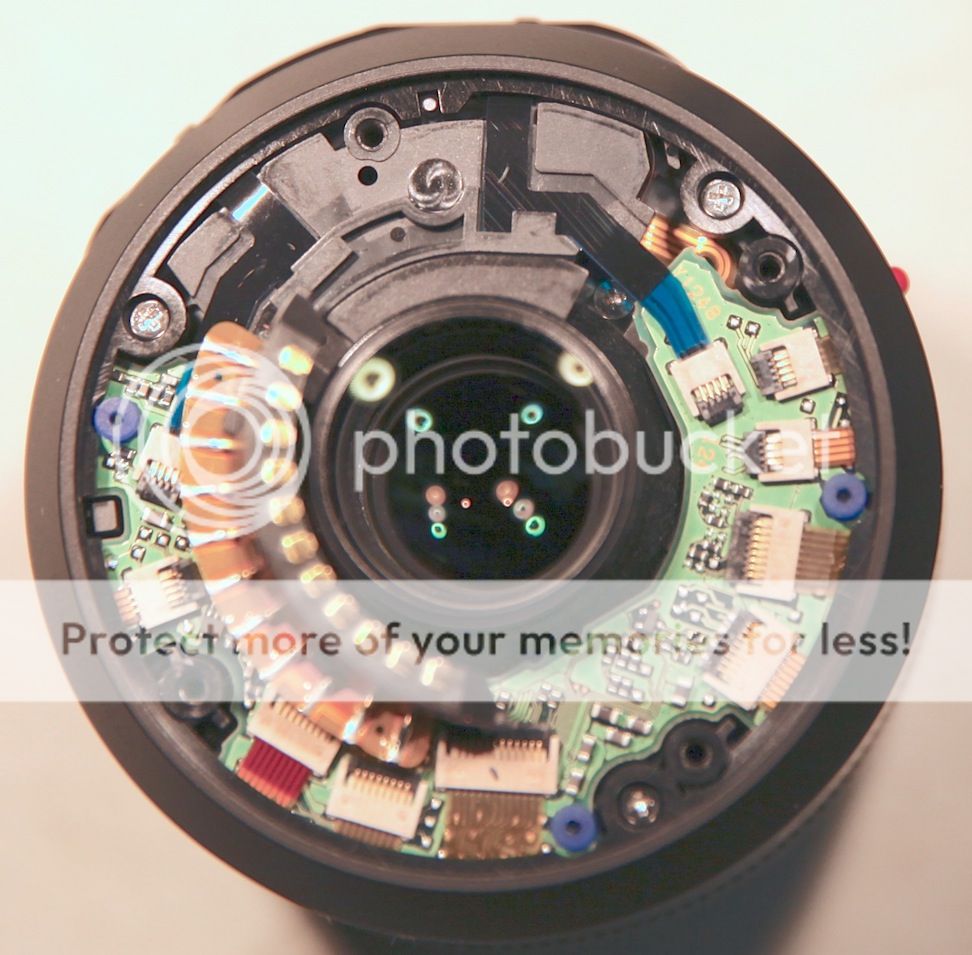
- Image and text courtesy Lensrentals:
- “Panasonic-Leica 45mm. The 4 empty plastic holes are where the lens mount attaches. The 3 screws still in place attach this plastic piece to the next plastic piece in the lens barrel.”
- –
As you know some people are arguing about the Olympus 12-40mm internal pastic mount. Well Roger Cicala from LensRentals debunks the myth saying “metal mount is better” or “professional lenses have always metal mounts”. With many pictures he shows how famous lenses like the Canon 35mm f/1.4 L, Panasonic-Leica 45mm, Canon 24-70 f/2.8 L Mk and so on do actually have a plastic mounts:
Looking at 7 years worth of data involving around 20,000 lenses I can’t find any suggestion that plastic mount lenses, in general, fail more than metal mount lenses. Sure, there are certain lenses that fail more than others, but not because they have a plastic mount.
Obviously a few Olympus 12-40mm lenses have broken at the mount. It may be there was a batch of badly molded mounts. It may be a design flaw. It may just be random chance – a few of everything break. But it’s not just because the mount is plastic.
Interesting read!
98 Responses
Thank goodness – finally some substantiated opinion.
opinions don’t prevent badly designed lenses from braking
I sent an email to Lens Rental about two weeks ago asking about this…and I got a somewhat positive answer that accounts for the condition of their “exact” stock:
Joey Miller, Dec 19 09:30 AM (CST):
Bob,
We haven’t experienced any issues like that with our 22 copies. So far they all seem to be holding up pretty well. The only issue I can find online was someone on the mu-43.com forums dropping the lens while it was still attached to the camera. That’s just a recipe for disaster. And it looks like that post is making the rounds. Almost all m43s lenses are built like that on the inside, with the Oly 75 being at least one exception. The Voigtländers are also solid like tanks, with their all metal construction. Lots of Canon and Nikon lenses are also mostly plastic inside. One theory is that since plastic has more flex, lens manufacturers may be hoping for some little bit of shock resistance, and in the event of a break, the plastic is cheaper to replace than a lens element. Bottom line, though, is it’s not an issue under normal circumstances. Hope this sheds some light on things!
Joey Miller
LensRentals.com
I read the whole lensrental article and also this site on DPreview forum. http://www.dpreview.com/forums/thread/3597539?page=3
Lensrental doesn’t deny that there could be a problem and it seems Olympus itself admitted that there is a problem with that lens. All pictures I saw clearly show that platic broke apart like just so many of the plastic toys or housings I have seen in in my life. The same thing would never happen to a metal part that’s not cooled down to -30 degrees and trown out of the window from third floor. All the lens interior is made out of platic and the fact that other manufacturers also use plastic is not a good excuse. I don’t say that plastic (there are 1000s of different types) must be bad but I’m very sure that almost any metal, even a light aluminium or magnesium is far better. So this lens broke several time at the same point. In the car industry this would mean a car lost it’s wheels because it’s mounted with plastic. Every manufacturer had to get all of their sold cars back to the factory and fix the problem with better parts. If I where Olympus I would do the same now as soon as possible or bring a new series of this lens to the market and replace the old models for free. Otherwise they loose their reputation, especially because of putting a “PRO” label onto this lens. (whatever that means, see lensrentals comments on that)
In fact, it might be favorable that the screw mounts are the weakest parts of the lens. They may be easily replaced for repair. If you drop a lens with metal screw mounts, there is a big chance that by deformation (rather than breakage) the lens cannot be repaired.
If you’d really have read and understood the article, you would not insist on that opinion.
I did and understood. I’m still the opinion that the lens has a problem and that these things wouldn’t happen if the part would be metall and not plastic. Everybody wants the camera body to be magnesium, so how come suddenly plastic is as good as magnesium?
The problem with the 12-40 seems to be not the use of plastics, but the design of the plastic part not being able to handle the stresses involved.
you seem unable to understand what Roger or many others have been saying about metal vs plastic in use for camera lenses , really.
no one except you love metal as much as you do for no realistic reasons. Seriously, I obviously prefer plastic for many of my lenses since plastic is durable enough and at the same time very elastic.
if you understand what Roger has been saying many times, you already know the metal barrel and mount things are extremely overrated, in fact plastic is more durable in many many ways.
plus, some others also said , metal mount easily deformed rather than simply broken up from the barrel, so it is more complicated to fix when it damaged.
plus some European brand lovers love metal barrel of Zeiss but it is in fact in real life use not as durable as most of cheaper plastic barrels, the Zeiss design is very prone to scratches, deformation and it is really cold to even touch in a really cold winter day.
so not all people just love silly old 20 century metal barrel crap.
Roger Cicala does not deny that there may be a rogue batch of this lens.
But he does say that lenses with a plastic mount cause significantly less damage when the do break and are far easier to repair.
So you have not understood the article.
Hans disregard (and just spouted off his own angry “expert” opinion), or did not understand a word that Roger wrote. (I consider Roger to be a very thorough, responsible and highly regarded source for this type of imformation). That all being said, A reasonable person can see that there is the “possibility” that we have a design or manufacturing flaw here. Since the lens is being sold for $999, it also does say “Pro” on the side of it, and also because Olympus misinforms us (in the lens description on their website calling the construction “All-Metal”…clearly Voitlander and Olympus have different opinions on what that means), think that they need to address this problem to us. We, as the supporters of these products do deserve something here.
Hans states that “Olympus itself seems to admit that there is a problem with the lens”…Has anyone seen or heard any evidence of that????
I was going to buy this lens, but I am going to wait now until something is addressed here or simply buy the Panasonic, which is not experiencing this type of failure.
Hi Bob,
I don’t wish to disagree with you on this point but over time many people have made a point of saying that Olympus stated ‘All Metal’, now if my memory serves me right the words actually used were ‘All Metallic’. Now there is the possibility that both may have been used but looking up the lenses description now no mention is made at all, so who knows what is correct. Other than that I must have a specially reinforced version as more often than not when I get in my car to go out on a shoot, my bag is usually chucked onto the back seat of the car, invariably with lens attached, I guess I’m lucky or as has been mentioned only a few have actually broken and they will be the ones which are talked about.
Right now they write: “this lens features all metallic construction”.
-> http://www.getolympus.com/us/en/lenses/pen-omd/m-zuiko-digital-ed-12-40mm-f2-8-pro.html
According to this, they claim that the lens is build as sturdy as if build from metal(this is what “metallic” means), but this does not claim that the lens is build from metal alone(optical lenses made from metal are not possible IMO).
Hi,
This is indeed an interesting point as the official UK and Ireland site has a different description. http://www.olympus.co.uk/site/en/c/lenses/om_d_pen_lenses/m_zuiko_pro/m_zuiko_digital_12_40mm_1_2_8/index.html
Most intriguing.
it was a big mistake of Olympus to describe the 12-40 as an all (or full) metalic lens.
I agree. It is an outright lie. Currently on the Olympus USA website Olympus states “this lens features all metallic construction”.
All metallic to any intelligent, educated person means that the lens is entirely made of metal and glass. LIke a Voigtlander or a Zeiss. So that statement is an outright lie, for all of us to see. They could have stated “metal barrel construction” or any other type of “other” description. Also..as Roger at Lens Rentals states..there is nothing wrong with high quality plastics being used in the construction of a “pro” grade lens as long as the lens is designed and manufactured well. I am on the same page with him..I have some great pro lenses that are made for my FF and they are constructed of high-grade plastic and work well.
I personally have not seen any other reports like this regarding a MFT lens. It seems that there is a problem here and that at the very least it is a design, material or batch problem of some sort. …but I think that Olympus needs to address this situation to its customers, they have lens mounts snapping off and a lie right on their website. I love there products and have paid a lot of money for them….as far as I am concerned..I am not going to buy this lens for $999 with these reports. Olympus owes us a statement.
There is no lie in the description on the (US) web site. You and some other buffoons simply do not understand the word “metallic”
-> see: http://www.oxforddictionaries.com/definition/english/metallic?q=metallic
#quote
relating to or resembling metal or metals
#endquote
There is no metal needed to be of metallic construction.
yeah Hans is in denial , he does not want to admit some cheap plastic lenses are actually great.
“but I’m very sure that almost any metal, even a light aluminium or magnesium is far better”
Funny, going around among mechanical engineers here, they do not agree with you on that, as in that its not a clear cut case, but rather one closely related to the actual design.
Or as one put it: metal? no piece of tin foil would survive the normal use of mounting/unmounting the lens.
I’m “only” a civil engineer, so on metal and plastic maybe an mechanical engineers opinion is better. Plastic breaks, that’s why for some parts that get tension in civil engineering at least fiberglass is beeing used instead of metal. Plastic is more like concrete, without reinforcement it’s not stable enough to withstand tension.
You’re talking about “tin foil”? Tin foil seems to be the material that seems to be wrapped around the plastic lens and allows Olympus to call it an “all metallic construction”. See the point now? You can close your eyes and ignore the problem. But if you accidently hit the wall with your camera bag with the closed eyes chances seem to be high your lens will break. I don’t care what you do, just don’t hurt yourself.
Metal breaks, that is why in airplane engineering, its often used in a sandwich with other materials such as fiberglass.
Maybe Hans you could look at the article once more, see that there are a gazillion lenses that use plastic for the exact same purpose without any such trouble. So this can mean one of 2 things:
– design problem
– production issue
It also means that in itself the use of plastic for this is not an issue. You can like metal more, good for you, but all evidence points at it not being needed here at all.
Which badly designed lens are you talking about?
Interesting how we’ve gone from “No, it’s metal” to “It’s ok if it’s plastic.”
Hey, dude. It’s ok for you. It’s not ok for me, and no number of references to a certain percentage of prior lenses that have had plastic will make it ok for me.
But I do, sincerely, thank all involved for raising my consciousness on the issue. I’ll check before I buy the next lens.
@Dandy Don
You won’t buy many MFT lenses then 😉
The only metal mount MFT lens is the Oly 75mm f/1.8
wrong, voigtlander lenses are metal mount
Yep. The Voigtländers are ALL METAL (and glass, of course), too!
The SLR Magic lenses are all metal, too.
I think you’re quite mistaken. Most m43 lenses have a metal mount. Having a metal mount and being totally constructed of metal are to very different things.
That’s why I haven’t bought any Olympus lenses other than the kit lenses. Pro=plastic–please, stop the nonsense. Metallic-oooh, shiny object from Olympus, it must be good.
Plastics are a cost-saving measure, pure and simple. That’s why high-end bodies, whether from Olympus, Nikon, Canon, Leica, etc. have either aluminum or magnesium frames. It’s the CHEAP cameras that use “thermoplastics”, not because it’s better, but because it’s a COST-SAVING measure (emphasis added). And coating plastics with a “metallic” finish doesn’t make it “metal”, despite the attempts at alchemy (but does create lots of fools’ gold it seems). That so many here have bought into the Olympus rationale is telling of how little critical thinking is actually being done, and how much fanboy-ism is simply being exercised.
You’re right. Now that you say it, I can see it clearly: Corporate fraud Olympus is cutting costs by using plastic mounts and gets filthy rich utilizing its monopole position. They don’t care about damaging their public profile and will utilize Yakuza to silence you soon 😉
DonTom linked to the Maitani story and the ideal on the inception of the pens was to have a camera at 50% weight of the competitors, utilizing titanium shutter blades to cut weight. If you look at the D800e, the EM-1 weighs about half and the 12-40 weighs about one third of the 24-70. I don’t say we love plastic but we accept plastic to save weight and make the lens cheaper.
Now if you and enough others demand a military grade ruggerized version, irrespective of weight and cost, I’m sure someone will make it. But be warned, it may still contain plastic parts as they do have their purpose.
I think you missed the point of the article.
Silly.
I’ll take the plastic on most lenses. As Roger said, break a plastic mount, it’s a small easy repair. Break a metal mount and it will likely damage other parts as well as require a much more costly repair. Give. That there is no higher incidence if failure with a plastic mount, that’s a big win for plastic.
I don’t mind plastic lens barrels either as long as they are tightly assembled and high quality plastics. The cheap stuff isn’t good, but the same can be said for flimsy metals.
“No, I won’t let any proof get in the way of my prejudice!” Congratulations to such a strong faith in yourself.
You’re going to be a bit limited if you only use 70-200mm and above professional lenses and Voigtlanders on your cameras though.
Or maybe you can find some Zeiss lenses that are all metal mounts as well.
If you look at the lenses that Roger used as examples and then look at the Olympus 12-40mm you will instantly notice something, they are not made the same. For me this isn’t a plastic verses metal issue but a reinforced plastic verses an UNreinforced plastic. All the lenses that Roger shows us in his article have some sort of reinforcing to the plastic tab the screws attach to. The Olympus lens has NO reinforcement and thus shear off under pressure. For instance look at the Panasonic 45mm, it has brass thread inserts that prevent thread failure and add strength. Add to this that several of the Olympus mount failures were not due to being dropped but simply sitting in a bag. There is something wrong with the Olympus lens, either design or quality control at the factory.
If you really believe that anything is going to break just from sitting in a bag, then 100% of the mobile devices should have failed already.
I’ve seen plenty of people claim that nothing happened to their devices, while the insides show anything from a mere bump to an impact from being tossed.
Wow… More drama on this garbage subject… Don’t like the lens? Buy the 12-35… You would think olympus has a gun to people’s heads.
Very interesting indeed… Finally some proof that would put an end at speculation and myth.
Myself, I own a Pany 12-35 2.8, so I’m not really interested in the lens…
Nevertheless… good to know!
the “myth” that this lens seems to have a design problem just seems to get a fact, no matter if plastic or not.
Or the truth that there was a faulty batch.
Unless you think we’ve all had this lens disintegrate in our bags and are keeping quiet so as not to offend Olympus
I’m also a little bit concerned, but you can’t say it’s a bad design because of 4 or 5 broken lenses 😉
They’ve only sold 4-5 lenses. It’s Olympus. That’s why they’re losing money as if there was a prize for first place.
You should visit some troll school, your current attempts are a bit lame.
You take things so personally. Why do you feel so challenged by counter opinions? Do you prefer that people only hold your shallow view on every topic? Let’s assume so.
lol, opinion.. yeah, I suppose you can call it that, through there are better ways to describe it.
Hahaha!!!!
Oh really? So what is the Percentage failure rate that you base this opinion on?
LOL. The bit about the weather sealing is very entertaining.
zzzzzzzzzzzzzzzzz somebody paid by Olympus to defend their corner….zzzzzzzzzzz
Roger Cicala is anything but what you described.
Roger’s comments are sensible and refreshing. Plastic materials are used in many applications and are often superior to metal. I would be more concerned about the manufacturing process first and then scrutinize the design which may also be at fault. Having plastic material in the lens construction is not in and of itself a reason to condemn the engineering of the product.
heavy metal outside and cheap plastic inside may kill the lens further than plastic outside.
may be the lens is design with plastic outside and then someone from marketing wants it to have metal construction (outside) and call it pro.
Then the overloaded mount just tear off from internal ……
Sounds plausible. Thats the way products are developed. Designers and engeneers designes the products and then some D.H : ) from marketing tries to commercialize the products.
Using plasic is not an issue. The issue is where and how plastic is blended into the structure of lens.
Canon 24-70 also uses plastic but its significant structure is metal and thus is well-known among Canon’s professional users in terms of durability. Nikon 24-70 is also used plastic but the critical frame inside is also metal. Here is the case that D3 + 24-70 was dropped 60-feet onto concrete floor. Of course, nothing survived. Pieces of glass inside were damaged, but the chassis and structure of lens remained virtually okay.
http://photo.net/nikon-camera-forum/00XYyW
If one is so averse to plastic then one should return most of their household goods and their car as well. Out must go the electric drill, the juicer, the slicer and all those things with sharp blades wizzing round at high speed. And the vac cleaner, don’t go there. No more trail biking. the pressure washer has plastic lugs. Hey, stop using the microwave and the dishwasher.
That old TV, the big massive CRT screen one. You remember? The one that lasted for ever and got thrown out because of the new panel. That old CRT tube was mounted to the front and or bottom by plastic lugs. Or didn’t you know that?
Plastic is used as a mounting for many things with metal screws. As long as the plastic is the correct type and the screws are torqued correctly (electronic driver with torque control as minimum and set correctly) there will be no problem in normal use. I am happy using plastic lugs on things. Though I would be unhappy if mine broke. But that’s what warranty is for.
Now don’t go tightening the screws “just in case” that’s what will really causes a problem. It will probably also void your warranty.
To me,the only real issue seems that Olympus suggests its all metal, while it clearly isn’t.
Agree there, one can’t call a part plastic lens all metal. When one can, but its a lie. Then people start to look at other claims and it just goes on and on……… Being part this and part that, is not a big issue, claiming its something else is.
If some people realized how much of their cars are glued together (yes glue, not welded, but actual sticky stuff not welded metal) they would be freaking out.
Also, things break — all things can be broken or defective. If you drop something, it can also break.
I will happily continue to use my 12-40
Photographers tend to scurry faster than ducks during ducks season at the slightest sound of something being perhaps, maybe, kinda, who knows bad!
What? My chevy sonic is glued together!
Many modern airplanes are partially glued together.
I really don’t understand why this plastic should be the issue. We have two choices Oly 12-40 and Pana 12-35.
If you’re not satisfied with Oly, then go choose Pana. It’s made in Japan with Japanese highest QC standard. IQ outputs from these two lenses are also in the same league. OK?
I recentely switched to m4/3 from canon for two big reasons: 1)after the 350d shutter broke several year ago also the shutter of my beloved 30D broke. 2) I noticed in ALL my pro and semipro canon zoom lens were dust particles. The worst was the overpriced 70-300DO, closely followed by 100-400IS, also the 24-105 and 70-200f4is and the 10-22 were affected with dust. Only the old 200 f2,8 was with not dust inside. Note: The 2 tokina zooms I owned, the 80-400 and the fisheye 10-17 were without dust particles. Way to go, Tokina.
Anyway I sold everything Canon, losing a lot of money because of the dust. Never again I will buy Canon.
Now I am happy with Oly and Pana lens, I found them are good value for the money. All those internet hysteria are due to the fear of CaNikon to lose a slice of their customers, so they pay some trools (fanboys) for going around the web to denigrate a less expensive and more lightweight photo-system.
p.s. no, I don not own the 12-40, but I am dreaming on this fantastic lens 🙂
Just remove the plastic wrapping. Its not part of the lens, its probably just the wrapping of the camera. Most products have plastic wrapping when you get it from the store.
No matter what Mr Cicala said – even if he is one of the most competent people on this planet to speak about it – trolls, haters and drama queens will go on.
Just choose who you trust : a very knowledgeable pro or obscure anonymous internet posters?
Well, for me this is an easy choice 🙂
We should all trust people who say that absolutely nothing happened to the equipment. It just broke apart while sitting idly. It makes sense. All those lenses is boxes are probably breaking, as we wait, just from sitting there.
/s
LOL 🙂 Self Destructing Plastics?
Of course, because NO ONE would carelessly set down their equipment or mistreat it in any way. NO ONE would put a phone in their back pocket and sit on it and they wouldn’t put their camera in a cheap bag and drop it in the car without care. People are never distracted.
/s
+1000
Look like Roger Cicala just slapped the trolls and put sour grapes into their mouths.
Olympus, cheap china made, not enough QC, overpriced, bad plastic design. Not up to par when comparing with other mount.
Look at the way the four plastic turrets are the sole contact points to the mount, contrary to all the mentionned so called plastic mounts. It’s not plastic the problem with the Oly PROFESSIONNAL zoom, it’s its design…
http://www.mu-43.com/showthread.php?t=56256&highlight=oly+ouch
+++++
Exactly. There’s nothing wrong with plastic. The molded standoffs where the screws attach seem to be too thin. Were the designers cutting corners?
Unfortunately, “PRO” is often just a marketing buzzword. Stuff that really is professional level shouldn’t have to prove it with advertising spin.
Seems to me that the plastic screws are there for a reason.
I am a structural engineer.
If you drop or bump the camera with lens attached, it is far better to have break away tendency to absorb impact and save the camera from damage. Lens replacement is far cheaper than camera replacement.
I would bet that Olympus engineers designed 12-40 with this scenario in mind. Just sayin.
Is so then it would be better to design plastic mount that can take an impact and can be easily replaced. I don’t mind the plastic but current screw holes are definitely too short and too easy to break for lens of this size and weight that supposed to be PRO line.
Olympus professional lenses are metal. Well, wait, I guess they are plastic.
But plastic is good, so it’s ok if the lenses break.
In fact, it’s very good if the lenses break, because it was expertly designed for them to be fragile enough to break only a little bit.
Well, ok, when they break at the mount the rest of the lens also falls and breaks. And you have to get them fixed at your expense, because we designed it that way for your benefit.
But it’s all good. And because it is good, we will charge full price, and laugh at lenses with mere non-breaking metal mounts.
If my understanding of english is correct, then an product of metallic made is not made from metall alone. But is similar/equal to an item made from metal in its properties.
See: http://www.thefreedictionary.com/metallic
From my limited understanding of construction, the way plastics are used in this lens is OK. IMO it is a good sign tat the screw thread was not reinforced with some metal, because in all products that do it, the reinforcement comes loose first.
but Olympus wrote about a full metallic (or all metallic) lens before, now it seems, they removed that at their website in the last few days 😉
I’m not thinking that plastic is bad, but I have to say that the lens mount of the 75mm looks better then the lens mount of the 12-40.
No, they did not. But the text on US and UK site are different.
Link to US side: http://www.getolympus.com/us/en/lenses/pen-omd/m-zuiko-digital-ed-12-40mm-f2-8-pro.html
yes, there is still written “this lens features all metallic construction” – for me that means it is made of metall, without plastic….
I am not a materials scientist but as I see it moulding parts out of plastic has more potential failure points than manufacturing/drilling something out of metal: with both materials, design is an issue but the moulding of plastic parts adds another variable. In that respect, saying that plastic lenses do not have a statistically higher failure rate than ‘metal construction, is not the same as saying as this lens does not have a problem arising from the use of plastic (whether it is design, manufacture or all round quality control)
Roger’s post is rational, providing some deep insight into the whole plastic vs metal construction discussion and he shares way more experience than most of us will ever have with a wide variety of lenses and brands under heavy use. Really interesting stuff.
His point is that the apparent spate of Olympus 12-40 mount breakages are not due to plastic as a component per se. He shows that plastic is extremely prevalent in “pro” lenses of all makes, and that plastics are, in his opinion, are often easier to repair and less prone to bad breaks than metal.
People jumping to blame “plastic construction” (possibly erroneously) for the reported breakages is a separate issue. It is just concerned consumers wanting explanation for a blemish on a highly anticipated, premium priced piece of gear. What we don’t know is if these are isolated incidents and a relatively low percentage of problems (inevitable with ANY product) or if there is a relatively high percentage of problems with the lens. As the lens just started shipping and not probably not in large quantity, I would imagine that the percentage of issues we’re hearing about is relatively high, and worthy of some statement from Olympus. Personally, I have delayed purchase of this lens until the issue becomes clearer.
I wouldn’t buy this lens, nor anything from Olympus. Service is non-existent here in the United States, and considering the ever-increasing odds that Olympus is going to fold in the near future, it’s just not worth that risky investment.
“Service is non-existent here in the United States”
Not so, Doug Nash, in my experience. I had my OM-D E-M5 repaired under warranty a month ago at their Connecticut facility. (For the ‘screw crack’ on the LCD screen, which is actually a very minor issue). Turnaround time was 4 days; they also replaced, for free, the viewfinder surround and updated the firmware, cleaned and tested everything. No charge. Pretty fine service.
But by all means don’t buy–no one is forcing you to do so.
In this discussion of metal versus plastic there are several other factors which should to be considered. I have been using primarily metal construction and mount lenses since the mid 60s with SLRs and DSLRs and my cameras with lens attached have taken several falls to concrete in my haste to take a picture and surviving with no more damage than shattered filter or dent to body. In Africa years ago after very rough useage my Nikon tele fell apart into two pieces as screws came loose but I was able to hand hold the pieces together and still take usable pictures. More recently with the newer lenses I recently accidentally dropped one lens out of its box falling to soft carpeted floor and it was ruining unusable before I had even taken a single picture.
I am a civil engineer by profession and one factor to be considered is while plastic can be made very strong, for some situations like lens mounts it is not a good idea to mate materials with drastically different coefficients of expansion or contraction. Otherwise with the lens mounts you are more likely in certain temperature considerations to get your lens stuck and the mount brake off in the camera metal body attachment depending on the model. For me I would never recommend a plastic mount over a metal one one unless the lens was very light and seldom likely to be removed. No problem of high grade plastic being used for lens barrels and other parts etc to reduce the weight but don’t forget the principle reason manufactures are using more and more plastic is the substantially lower cost to produce.
The frequency of repair statistics quoted of no difference may be misleading as no indication of the use the lenses has been subjected to and the 12-40 lens in question has only be available for use for only a week at most? The metal lenses have likely been subjected to thousands of pictures by serious and pro photographers are more likely to use their cameras and lenses many times more and subject them to much harsher treatment, one of the reasons they bought and paid for the higher quality construction in the first place. Note the author did not show a single picture of a basically metal lens construction that had failed while plenty of plastic lens examples.
The lens has been available for over a month (I first saw one in a shop in late november).
Also, there is a difference between an all plastic mount/bayonet, and a metal one that is attached to the lens by screws going into plastic struts.
“Note the author did not show a single picture of a basically metal lens construction that had failed while plenty of plastic lens examples.”
The pictures do not show any cracked plastic mounts either. They just show examples of plastic designs, used in so many well regarded lenses over time. In fact, Cicala says the stats are, if anything, marginally in favor of the plastic mounts.
Funny that people here are defending plastic construction as acceptable when in other products it would simply mean budget/cheap. Using plastic is a cost-saving measure. That’s why Olympus (and most other camera makers) hide the plastic behind something else, whether it’s plastic coated to make it look metallic, or plastic molded to look like cast metal (a la Nikon). Nikon tried the smooth plastic exterior in its first generation of AF lenses, only to be soundly criticized by its customer base (and changed it to the crinkle finish).
If plastic was so great, why do all pro bodies, whether the EM1, EM5, or any of the pro Nikons, Canons and Leicas, all have metal frames and metal parts in high stress areas (exteriors, etc.). It is the cheapo consumer bodies that use plastic for their frames, not for strength but for cost-cutting (otherwise pro bodies would use it too). That’s also why Zeiss and Leica still use metal in their lens bodies (at a substantial cost, however).
A quick test–drop a plastic kit zoom (any brand) and an old cheapo metal 50mm normal lens (the original kit lens) onto concrete and compare (it’s happened to me). Likely, the plastic kit lens will self-destruct and be rendered inoperable, while the metal-bodied lens will keep going (although the helicoid may need adjustment). I’ve seen and used old AI and AIS Nikkors that looked like they went to war and still worked well–and I’ve seen kit zoom lenses that got bumped and broke. But lens and camera companies want us to accept plastic, because they get repeat customers (when the lens breaks).
What irks me is the coy marketing speak from Olympus–this lens is “PRO”, this lens has “metallic” construction–again gross hyperbole, the overpromising and underdelivering so common with Olympus.
I have the 12-40 and the 12-35. The feel of the 12-40 is much nicer in the hand. The manual pull/push ring is fantastic. The metal on the Panny is thin and dents easily – the Olympus feels much more robust. The zoom is also smoother and better damped. IQ wise, there isn’t much practical difference (as most of the tests bear out). The macro reproduction ratio is very good on the Olympus, rather like the 12-60. Given the choice, I’d go for the Olympus. I would not hesitate to buy the lens – I do not believe the issues debated are symptomatic of a bad design or production failure, rather just the normal issues you get with any lens.
What I find amazing is the 8 flex connections on the lens circuit board – radio communications equipment doesn’t even have half that many. The good news is that Japanese versions of flex connections never seem to fail or come apart spontaneously.
You do realise that the picture shown is the LEICA 45mm F1.4 and NOT the Olympus 12-40mm!
45mm F2.8 ofcourse
New user here. What lens is a must have folks. Need to get my first Olympus prime- first lens. Tell me, what should it be? Plastic, metal…I don’t care. I just want great optics.
Get a Zeiss or Voigtlaender made in Germany or Japan and not in China. They are all optically good, just pick you focal length.
And manual focus, which is not what everyone wants, likes or can use (due to application) even if that isn’t in your book 🙂
I think Roger misses the point. It’s not that the lens is plastic that upsets people, it’s that Oly claimed it was all metal, and lied. And that at least three samples have broken in exactly the same place.
Plastic is fine, properly engineered. There is a legitimate question as to whether this lens was properly engineered. But there is no question the lens is not what Oly claimed it to be.
another problem: somebody wrote that af of the 12-40 isn’t quiet enough for movies, but Olympus writes it should be quiet. Anybody tried this? At the end I have to walk with 12-40 and the 12-50 for movies, instead to replace the 12-50…
and another broken one, and now I wonder, why is the plastic so porous? For me it doesn’t looks good, but I’m not an expert… at the pics of the other broken lenses it’s not possible to see it clearly, but a least at one other broken lens the plastic looks the same. http://www.mu-43.com/showthread.php?t=56256&page=53&p=575762#post575762
The plastic seems to be of very bad quality. There are air bubbles inside it that make the construction very unstable. The 4 plastic mounts around the little screws also just seem to be too small.
Yes, it is better to have the plastic broken rather than the whole lens. But this is clearly a design flaw. Not worth the 1000 bucks like this, no buy for me.
They should call back all the lenses and check them or replace them with an improved version. Otherwise this could get a fiasco for them.
“metallic” does not mean real “metal”, lots of non-metal parts are having metallic finishing. some are only for cosmetic purpose and some provide real metal characteristic such as wear resistance, for example.