








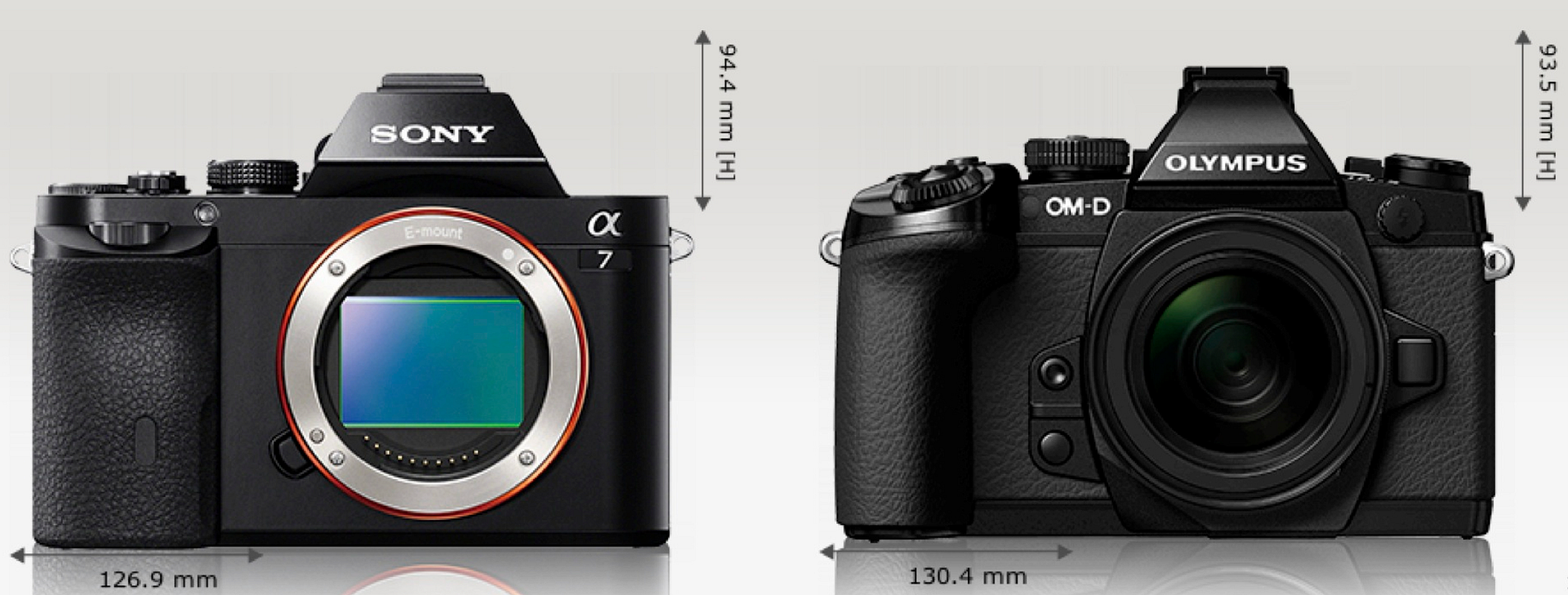
Size comparison image via Camerasize.
–
I know we have to take the Amazon mirrorless ranking (Click here) results with a grain of salt. That said I noticed something I didnt’ expect. The Olympus E-M1 has never been surpassed by the so praised Sony A7-A7r cameras. The E-M1 constantly ranks above them even now that the A7r is in Stock for the first time.
Olympus has done it right with the E-M1. Hope they can repeat the success with the new OMD camera that is going to be announced soon!
70 Responses
FF and tiny sensor worse than peers priced the same. Ridiculous.
The only thing that is ridiculous is YOU.
Why? A camera is more than just a sensor in a box. If that’s all you want, just buy the sensor and wire it up yourself. 😉
Head of Sony USA has just been replaced due to poor sales…
Really? Can you give me a source of this info? Thanks!
http://bgr.com/2013/12/18/sony-us-management-president-michael-fasulo/
Hardly fair to fault their camera division though – since the he’s the president of the Consumer Electronics division – which is a very wide umbrella.
I’m not a Sony advocate: I’ve been burn repeatedly by Sony with a series of abandoned product lines in the past. In fairness, the 7 and 7r do look like great cameras. I’m just a little gun-shy about previous practices on the part of the company. In the end, the race to make better products benefits all consumers.
You seem to be just the type for these cameras. Go for them. Buy both, and then some M43s.
Yeah Sony didn’t even include a freaking battery charger!! What! are you serious they want me to plug the camera in and wait for 5 hours before i can take another picture?
No wonder why people are upset
thanks!
Well, the Sony TV division continues to get eaten alive by Samsung. There is no mystery there. Go to a showroom and compare two comparable HDTVs from these companies. Most of the time, the consumer picks the Samsung. It is not just about Sony cranking up their marketing in the US. They are facing stiff competition in this market segment. It’s not just about cameras.
Things aren’t looking too pretty for Amazon either see “international business times” today…
Yes, give us a source so I can post it in Sony forums. :p
Wall St 247 predicts (may 2013) that Olympus will leave the US market in 2014 along with Volvo and Mitsubishi, following Suzuki who pulled out last year.
http://247wallst.com/special-report/2013/05/23/ten-brands-that-will-disappear-in-2014/3/
I said earlier I thought they should do that. Sinking money in a big US hole can go on forever with costs increasing and no profit. As noted for Mitsubishi in the listing they seem to have a perceived poor reliability. That’s strange I have 2 and there are others in my street that seem to be as good as and mostly better than other cars for reliability. It seems that once one bangs their head against a wall in the US they are for ever to continue doing so.
But Sony can’t pull out. They have to tough it through.
Yep He should have put a battery charger in the box with the A7
E-M1 is simply a better camera (by this I mean AF speed/accuracy, ergonomics, controls, buffer, customizability, IBIS, etc, etc, etc) and M43rds is a much more mature camera system that offers lenses and accessories to cater to a much larger and diverse market.
A7/r has a better sensor no doubt, but its not a better camera from a functionality standpoint, plus it has barely any lenses available. If Sony builds out the FE lens lineup and a camera system to go along with it, their Mirrorless FF cameras will probably be very successful. Until then its just a neat concept.
+1
At the moment the Sony A7(r) system is hardly a stand alone solution for anyone. Most buyers own a classical DSLR system and use their lenses with an adapter on the Sony A7.
That´s ok, but not enough to make it a success. I hate to switch systems and wait and be strategic about buying decisions because it complicates everything. I could buy a Sony A7 and use Canon lenses with adapters, then when Sony fills the gaps in it´s lens lineup I could sell the Canon lenses and buy native ones. Or Oly goes FF till then or Pentax or Nikon brings something great or even Canon poops out a FF mirrorless cam.
For me, it´s best to stay with mft (I really like my E-Pl1 and it´s output), buy some more lenses and shoot more instead of wasting time online.
At least Sony actively supports the use of third party lenses and adapter. Olympus could well improve their position by active support.
You Know that’s only because of the few native lenses they have. Else they wouldn’t sell many.
I think it depends on your needs, too. I have the GH3 and I’m in the process of reviewing the E-M1 (e-mail me for teaser pics – fotosiamo@gmail.com). I’ve shot a lot of fashion/commercial images with the GH3 (www.fotosiamo.com) also, so I’m very well aware of the good and the bad w/ the system.
That being said, I spent a week with Sony in Tennessee reviewing the Sony a7R and it just blew me away, IQ wise. It’s a really capable camera overall as long as you’re not trying to do sports or high-action images.
For what I do, which is shooting in a more controlled environment with strobes, the a7R is fantastic. It’s like having a D800 or medium format, but in a smaller package. And yes, adapting other lenses works, too.
So now I’m at the cross point where I’ll be selling my mu4/3 system because I do want that extra edge in image quality. But if the a7R wasn’t available, the E-M1 would have been my next choice. That camera is much better in IQ than the GH3, and works well with 43 lenses.
– Joe Gunawan | fotosiamo.com
Oh, and here’s my review of the a7R: http://www.slrlounge.com/history-making-sony-a7-a7r-field-review
Looking to get the E-M1 review done this week, too.
Joe – Get real. The E-M1 is feature-rich (including the 5-axis IBIS)and the Sony A7 is not. That is a fact. The E-M1 is a great camera. If you really are just interested in IQ, then take a look at the Sigma DP series. Foveon IQ can be spectacular.
Like I said, it depends on what and how you shoot. I’ve had time extensive time to shoot with both camera on different types of shoot. Have you?
I like the E-M1 enough that I would sell my GH3 for it. The IQ and dynamic range is much better, and the 5-axis IBIS is great.
The E-M1’s EVF is definitely better than the GH3 and is even arguably better than the a7R’s.
If you see my portfolio, I shoot either mu43 or digital medium format. That’s why the a7R is the best marriage of the things I like about both systems. Portable AND high image quality.
But if I’m not going to buy the a7R, the E-M1 would be my choice, too.
And BMWs are more popular than Ferraris. How can you really be surprised?
And BTW, in the TOP 20 I can see the E-M1 once and the A7/A7r three times.
Those Amazon charts change all the time. Some days the A7 is on top, sometimes it is not. I don’t find them very reliable.
the gm-7 at rank 20, I thought it would end up much higher, being the mft camera so many people here waited for.
oops I mean GX-7 , and its rank 17 now.
Here’s one reason:
I have an E-M1 on order, with 12-40/2.8 and 75/1.8 for $2,946. It will accompany my PM2, which has the same sensor size and will accept these lenses (plus the two I already have for that PM2).
I can’t duplicate that system with Sony. I can’t even come close for under $5,000, much less under $3,000.
Meanwhile, I’m satisfied that the E-M1, like my PM2, will meet or exceed my image quality expectations.
Expectations: that’s what it’s all about. You have low expectations and pay a smaller sum to meet them, with a lesser product. You probably take lesser photos, too. everything is fine.
That’s an interesting comment, since you know nothing about me, my photographic experience or skill. I won’t bother to defend myself, but another expectation I have is that I could shoot rings around you.
Spoken like a true pixel-peeper. It has nothing to do with high quality photography.
Don’t tell me you can’t find a 24-70 F 5.6 or less and a 135 F 3.6 in the Sony / Minolta lineup. I am sure it’s also cheaper than your M43 stuff.
Where I live, the A7 costs just 5% more than EM1. On the other hand m43 is a system – A7/R being at very early stages in that respect. I tried both recently. The Sony is a very nice camera. Major flaw is slow AF on R version. Missing is image stabilization. – and above all lenses.
No surprise theOly sells better. My take is FF mirrorless may make it possible for me to go from two systems to one system. Decided to wait til 2015 and evaluate what’s on the table then.
It IS early, as far as the Sony A7-series goes. 2 years seems like a reasonable timeframe.
And as with pretty much anything in the computing and electronics world… NEVER buy a version 1.0 product!
It will be interesting to see how it’s evolved as system by the time the second generation bodies arrive. Lenses, focus speed, accessories, third-party support, etc..
For me it holds the promise to use all my 135 format lenses (Nikon AI-S, Pentax SMC Takumar, Olympus OM and Voigtländer M/L mounts) on a modestly sized, modern, mirrorless body with a 35mm sized sensor. Even though I was a long time Nikon user, I’ve never had any interest in their (or anyone else’s) DSLRs because of the ridiculous size, bulk and weight.
Even with that, M4/3 is a great, sized right system with an amazing range of body styles… GH, GM, GX, OMD… and some incredible lenses. PLUS the ability to adapt virtually any lens on earth!
I checked out the a7r the other day and I was extremely disappointed. My finger on my right hand hits the lens and the lens button is between the grip and lens. WTF!!! No lenses available and the lens they did have was a 3.5-5.6 junk
I checked out the A7 and A7R the other day too. I was vexed trying to handle it. Either I’m getting finicky or it’s user interface is just no fun. Same goes for the RX1 series.
Sony should REALLY have someone design nicer photographer friendly software to go inside that nice camera with the great sensor. I wanted to select focus within the frame and i was shown how to press two buttons and then toggle a tiny spot around the frame. Every time I wanted to do this on successive shots I had to start from scratch again. The fact that Sony wouldn’t make selective focus an natural function is the beginning. Too many menus to change little things , too much customizing is necessary for everything and anything.
Hey Sony, glad you made a nice small mirror less but it really helps if it’s designed for a photographer to use.
Same here Rico: I held the 7 and find its built a liitle bit disappointing. When I held Em1 I decided to buy it and I did it the day after at my fav store.
Talking to a friend, who was interested like me in the Sony, I asked an opinion, and he answered: “ni”. That means No and Yes. He was not convinced at all and given the fact that he already owns a FF, a nex7, 2 Fuji XE2 and a x100s, he’s not going to buy it.
I won’t deny IQ of the 7, but I will wait for a 2.0 version, or at least I’ll wait and see if Sony will dump the product as usual..
Marco – Smart move. You won’t be disappointed with your new E-M1. Love mine. That’s Amore.
I was wondering if you sprang for the a7. If they can’t win *you* over, I guess full-frame is doomed… 🙂
The FE is all-around more expensive system, so I would expect µ43 to sell more in terms of number of units. But, I was surprised how quickly a7 sales faded down the rankings. I’m also really surprised with E-M1’s persistent top ranking; I thought it would be a niche model.
Tells you what I know. 😉
JShin 🙂 I won’t question A7(r) IQ output, they are powerhouses. But I see them more as an early experiment, perhaps because of that feeling that “something is missing”.
It was not love at first sight.
I would have put a Voightländer 50mm T1.4 on it, and that would have been enough for my street photography, but I needed also another m43 body to use in theaters, and the clunky shutter of Sony 7 is a relevant issue to me.
As we can see here, “FF” is becoming the new obsession, as Megapixels were years ago.
FF pictures have their own signitures, but this does not mean they look better.
When I’ll fall in love with a different system I’ll let you know! 🙂 (consider that my forbidden love is Monochrom though)
The A7 is in a different price range. Not sure if it is a useful comparison.
What is important is that this week NEX has 4 of top 10. Oly has 3/10. Pany zero.
In any case, not a single MILC is in the top 100 digital cameras.
That’s because my fellow Americans have this mindset that the only cameras worth buying are Canons and Nikons, and that the pictures they produce are the best (they are not), and that it will make them feel like pros (yeah, right). Delusional thinking, but that’s the mentality here. Of course, Olympus’ and Panasonic’s terrible marketing in the U.S. (translation: lack of marketing) doesn’t help.
You’re entitled to your opinion.
Ha ha. The mainstream consumer makes a judgement on how to spend his hard-earned dollars, and decides the best price/performance sweet spot is the DSLR. They are happy with their purchases and use it for their intended purposes. They spend a lot less doing so.
Yet somehow because they don’t spend more money and make the same choices I do, they are delusional, and I’m not. More, for some reason I am compelled to keep telling everybody how delusional everybody else.
I don’t think it is “your fellow Americans”, but rather “people with a clue”.
Whoever picks an OMD kit against a 6D kit for the same price? Right,a prick.
The reason for comparing it is because we keep hearing how tiny and light micro 4/3 is, hence its reason for being.
Comes the A7 with the same tininess as the EM1, for not that much difference in price. And two formats bigger. So the sacrifice of image quality in exchange for ease of carrying is no longer a valid justification.
A user just starting out with a system to build over the next few years has a real choice to make.
Well, no wonder why it is more popular, just from looking at them, the one on the left looks like a Lego construct.
News that Olympus and other Japanese companies are leaving the US are quite impressive, if confirmed.
There seems to have been a long disconnect . but I wonder if that is not the final effect pf the smart phone wave.
So this means again that the choice between cropped and FF mirrorless will be made in Asia. Perhaps we should wait Second Quarter 2014 to know how Sony is really doing.
Subjectively I am underwhelmed. The Assumption that the Alphas could liftoff with adapted lenses is not very serious. They will need native wide angles, possibly costing twice a m4/3 of a Fuji, and other lenses in the same bracket.
It must be sated again that FF35 has some advantages, but certainly not all the advantages. In the end the question is how much you want to spend in lenses, for what results, and which system covers better your day to day choices, be it in the field or in the studio.
Reactiveness is certainly a v. important factor of choice, once a certain IQ is achieved, and that is where m4/3 excels. That’s probably a tangible advantage, when you hold a camera in your hands.
This is simply because full frame mirrorless makes no sense, unless you’re a forum measurebator – its size advantage disappears as soon as you stick on a lens. Micro 4/3rds is a much better compromise between quality and size as a system (there’s no point in a small camera if the lenses don’t match), particularly with current and future sensor tech. With the GM1 on the one hand and the E-M1/GH3 on the other, Micro 4/3rds has shown itself to be the most universal camera system, scalable to pocket size at one end and pro performance at the other. Combined with the huge and growing and lens collection (far bigger than any other mirrorless system), I think Micro 4/3rds has the brightest future of any camera format.
Yes, being scalable is certainly another highlight of the system, but being the closest to the ‘decisive moment’ is another. These are two features that come across in Kai’s reviews, and might be decisive in S Asia.
American reviews are more fixated with the FF dilemma and infinite pixel peeping. V. different selling points.
“Full Frame” cameras weren’t always the massive, heavy, overly complex bricks that they’ve become in the digital era.
“Full Frame” 35mm film cameras, like the Nikon FM2 or Pentax Spotmatic (I own both), are pretty much the same size as a GH2 or EM1, so getting a “full frame” mirrorless camera like the A7 isn’t such a strange thing. It actually returns the “full frame” camera body back to the reasonable size it once was! If you shoot with primes, then the lenses aren’t outrageously sized. Zooms are a different issue, of course.
No, what we have is an entirely kettle of fish, thankfully:
http://theonlinephotographer.typepad.com/the_online_photographer/2013/12/panasonic-gx7-notes-responsiveness.html
We have ‘decisive moment’ machines – if it matters for some 🙂
So, some bloke on the net wrote that some expensive toy is faster than its previous version… One day, mirrorless will be as fast as DSLRs, maybe even faster. Feel free to quote this as well, and have no fear, I am a better photog than that bloke.
I agree, but it’s also nice to have alternatives. I’m loving my GX7!
That’s an excellent series of observational articles on the GX7, BTW.
I wouldn’t say mirrorless digital cameras are yet at their “reasonable size”. An m43 E-PM2 without lens (110 x 64 x 34mm) is still larger than a 35mm Minox 35ML (100 x 62 x 32mm) for example.
You might hope that the sensor and electronics in a digital camera would take up less room than the film canister and winding mechanism, but that doesnt seem to be true (yet).
1) The Nikon FM didn’t have autofocus (that requires space below the mirrorbox and space for the AF motor.
2) The FM didn’t have a flash.
3) The FM had a tiny battery because it didn’t have power the image sensor, AF, metering system, rear display and flash.
That comes on top of the volume of the sensor, electronics and display.
If you want to get real, take a F90 (and add between 10 to 15 mm of thickness for sensor, electronics and display). Add flash. And add a larger battery to drive digital imaging and the flash.
One can make the same exact same argument that say APS is the right compromise, or the Nikon 1 series is the right compromise…
Every camera system is a compromise. You just have to choose wich one suits you the best and respect other people’s choices… Hopefully, we have choice 🙂
That’s not true, I use old FF SLR lenses all the time. I have a Canon 5D Mark I but rarely use it. I use 99% of the time the Nex 5 with the same lenses I would use the Canon FF with, because the Nex is so much lighter and has space in the camera bag. So yes, the camera weight alone makes a difference. BTW, there are more lenses for FF than f2.8 AF zooms (which I also wouldn’t want to carry around).
Call me old-fashioned, but E-M1 is definitely prettier than the a7.
I’ve used MFT since the GF1 came out but I recently bought an A7 to use my Rokkor and Zuiko lenses on and the image quality is simply outstanding.
To me the A7 makes sense if you want to use legacy lenses or need the best image quality at higher ISO’s or for very large prints. If you don’t want or need those things MFT makes sense and there are some very nice lenses but they’re fly by wire no marking and no feel lenses and I just don’t enjoy using them.
Choise is good and now and for the first time since the world of cameras went digital we now have a 35mm camera which is about the same size as 35mm cameras used to be and that’s been a long time coming.
That’s the reason why I wanted to buy an a7. I wanted to use that system during my walks in the nature, using manual lenses, but wide angle issues were (to me) another con to face with.
At the moment the only 35mm I would consider is RX1(r) or a Monochrom. The latter being too expensive for me now, the former looking more appealing compared to a7 (read silent and “complete”)
Same here as far as manual lenses are concerned.
But isn’t the A7 wide-angle problem restricted to Leica mount lenses with their shorter flange to sensor distances? Isn’t it’s soft corners or something? Even then, lenses that are wider than 35mm are the ones that exhibit the problem.
My beloved Nikon 20mm f2.8 AI-S, I bought in 1989, is begging to be used as a wide angle again! It was such a bummer when I used it on my GH2! 🙁
If Sony is really serious and committed to the A7-series, then I think they’ll somehow manage to work out that problem with version 2. We can only hope. The A7 really is a work-in-progress at this point and I gave up my guinea pig status long ago. 😉
I’m not worried about the problems that some rangefinder lenses exhibit on the A7 as my lenses are Zuiko and Rokkor SLR lenses and they all seem to work just fine. The widest lens I have is a 24mm f2.8 Rokkor and the corners look good enough to me.
PS.
” The A7 really is a work-in-progress at this point and I gave up my guinea pig status long ago.”
So fare I haven’t found any issues that stop you taking good pictures with the camera and any issues are certainly not extreme when you look at other cameras that have their little… issues, Fuji perhaps? People who see the benafit will be taking pictures and enjoying them despite the odd niggle.
I think that reports of the A7 being a work in progress for users to develop are maybe just the usual other brand fanboy nonsense we see on the net… 😀
My 35mm was always alightly OOF, and that is one of the arguments which is made against Sony too.
What use is to have twice the resolution (well…) if it is OOF?
That is also the meaning of ‘ decisive moment’ machines: that they are IF, exactly when needed.
IBIS BTW works exactly to the same purpose, handshake problem being compounded in FF35.
I doubt this has much to see with the E-M1 being better (although feature-wise, I believe it is). That would imply cross-shopping and while some people might do it, these are two very different systems.
When people decide to spend in the vicinity of 2000 $ even if dentists I doubt they don’t compare or document.
Sony has been overhyped but the sales are not in proportion, or at least the reports. Yes, the IQ is there but it so difficult or expensive to extract that there are much easier ways to achieve it. These things have trickled down from the reports, so tough luck. Try again.
So, these cameras are comparable because they cost the same? Strange logic. It is not that people don’t compare, it is that the cameras are not comparable. I would personally be interested in having both,
And I do not see any sales reports. Try again.
In my experience, the OM-D E-M1 (along with the excellent new 12-40mm f/2.8 lens) has been the hardest camera to keep in stock and find. I’ve personally had to try at least 5 different sources before finding one that could reliably deliver on a timely basis. It’s hot, and rightfully so. I don’t think any other new camera for 2013 has had such high acclaim and made it to a “best of 2013” list or some kind or another. Yes, the A7’s are pretty damn sweet for the price and IQ, but ultimate IQ isn’t ultimately everything.
Do most of us need or can even tell what is above 16MP? I doubt it. How big a print do most of us need to print? But, for those who can and really need the extra rich files, then sure a little powerhouse like the A7’s would be great to get the most out of whatever image you may want to take.
The E-M1 is a very well rounded efficient camera that has exceptional functionality with design and form to follow. Not too big, not too small. The buttons and dials are plenty and finally placed right where you can comfortably access them. There are many lenses and you can also adapt a lot of other lenses.. very good quality for both the camera body and any mid to high level lens range… overall for the price to enter into the MFT system and have a good set of lenses to work with, it’s very hard to beat for less money than what the E-M1 and quality MFT lenses can offer. I’d already invested a fair amount of money into MFT system and very aware of it’s high capabilities which can keep up with, and in some cases exceed, systems that cost more and have larger sensors.. not always, but it’s fair to say MFT is very good for balancing cost with size & performance.
If you’re not married or heavily invested in a particular system or set of lenses, then I think you could do well with an e-m1 and a few nice primes or even just the new 12-40mm lens as it is really good and covers a lot of focal ranges very well already.
Regarding the A7’s, I agree, the current extremely limited lens options is disheartening. If you are starting off “fresh”, it can be a LONG TIME, before you start to see a decent # of native FF E-Mount lenses. The NEX system took a very long time to get decent glass out, as I recall. And, the lenses won’t be inexpensive, for the nice ones, at least.
But, if you don’t want to wait for FF E-Mount lenses, you could get an adapter and get some other nice glass… but, will it cost you any less?.. would they necessarily be small enough to keep the system as light and as portable as possible? Alright, Leica have nice glass AND they’re small, but who has a minimal of at least $3k to spend on 1 lens alone, let alone to think of a fuller more comprehensive set of lenses that are all Leica based?
You could go with some nice adapted Canon or Nikon lenses, but even if you aren’t paying the same high price as Leica, good Canon & Nikon lenses can still be pretty pricey and since they will be FF lenses, you’re dealing with more bulk and weight again. The body can be smaller and lighter, but I imagine you’ll ultimately pay ALOT to keep FF lenses small (with Leica or similar high end rangefinder style lenses), OR pay not as much (but possibly still a lot, depending on the types of lenses you desire) and still maintain a bulky system due to the physical needs and limitations required to produce a great FF lens… especially if you want a fast lens… most mirrored system (DSLR) FF lenses just have to be a certain size. The lens will be where the weight and bulk is and there’s no good way around that… but, you’ll have a tiny FF camera at the end of it.. a bit out of proportion, but I guess you save some bulk and weight?… is it enough?
Assuming you have enough $$, then the above gripes about costs is probably not relevant. If you own anything Leica, then almost certainly $$ is nearly not an issue and you can make any high end system camera you want.
If you have a lot of non-Sony lenses (e.g. Canon, Nikon, Leica, etc..), then it may be well worth the effort to switch and try the Sony A7’s and see if you can at least get better IQ & higher resolution with whatever nice legacy glass collection you currently own with the A7’s. Probably totally worth the partial cross platform change and adopting a Sony camera with your current lens collection… but, if action is your thing, then maybe not so much…
Regarding the A7’s styling… I like the styling of the A7’s.. the hard lines and form is what I prefer over the plastic lumps typically associated with DSLR’s or CSC’s that are designed like DSLR’s. But, the grip and controls aren’t as well laid out..1, the grip, if it’s like the NEX’s I think is a little too close to the lens.. the gap in-between is kind of tight, and I do not have fat fingers, so the knuckles always touch the lens and feels a bit cramped… also, the shutter button appears placed just a tad further back making you want to unnaturally curl your fingers back to reach it.
So, if sales report(s) of E-M1’s to A7’s are accurate, then it’s no wonder why a good number of people will see the extreme value and well-rounded feature packed benefits of owning an E-M1 and going with a MFT system… the cost of admission and the immediate perks can put one in a very high and satisfactory position compared to the pricier larger sensor camera systems out there.