









Today Adata announced their 4K ready SD cards. So while the GH4 is still hard to find in Stock you can find plenty of 4K ready SD cards in Stock right now (or very soon):
Kingston 16-32-64 GB SDHC UHS-I Speed Class 3 at Amazon (Click here), Adorama (Click here) and BHphoto (Click here).
Sandisk 16-32-64 GB Extreme PRO SDXC UHS-II Memory Card at Amazon (Click here), Adorama (Click here) and BHphoto (Click here).
Transcend 64-128 GB High Speed 10 UHS-3 at Amazon (Click here) and BHphoto (Click here).
Panasonic 16-32-64 GB SDHC-UHS-I U3 Card (90MB/s) at Adorama (Click here) and BHphoto (Click here).
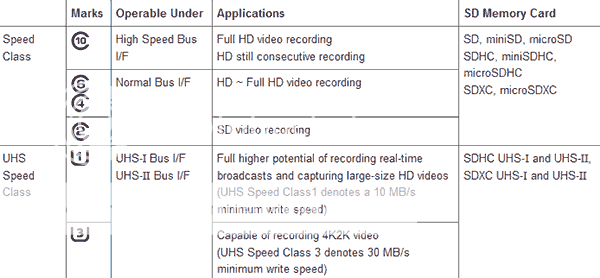
If you are confused about the card types read that great article at Suggestionofmotion! In short this is the diagram that explains it all:
11 Responses
Even a Sandisk 45MB/s is “4k ready”. I will buy a 128gb for much less, thanks 🙂
You’ll need a UHS-I Speed Class 3 card for 4K recording to be supported. Maybe it will work with cheaper cards, but a write speed “up to” 45MB/s or 100MB/s for that matter says nothing as you will need a minimum concurrent write speed for high bitrate video.
NO you only need a minimum 13 MB of constant writing speed for Panasonic GH4 4K files. The advertisement of “UHS-I Speed Class 3” cards is only to sell their super expensive and unneeded cards.
Yes, but most cards won’t be able do that. Let alone the 200Mbit high bitrate 1080p(25MB/sec). Soms cards wil do fine though.
My point is, these speed ratings are not all marketing.
I got the Transcend 128. It works well. If I ever need another one, I’ll buy the same one again. But 128 is hard to fill up. I took 4-5 hours of 1080p 50Mbps video, and it still didn’t fill up. I can probably wait until 256G cards hit the market before buying any more.
wtf is that “sample” picture showing? If you take one fullhd image and view it at 100% you get a lot of sharpness instead of the so called blur they want to make believe.
https://i.imgur.com/IArRF4t.jpg
A 200% 1080p crop vs a 100% 4k crop would leave you with a quality difference similar to what they show. Their sample pretty accurately illustrates their point.
Also @43rumors:disqus, I realize this typo was taken from their Amazon listing, but there is no such thing as UHS-3 (yet!). Transcend’s new cards are UHS-I class 3. 😉
It is, as you correctly say, marketing. There will be some difference, but not that much; you can try that for yourself.
Then you need dollies, lights, booms, crews… That does not come included, and is required to leverage that 4K.
Adata makes okish cards but the quality of the plastic is horrible, all my cards creaked after maximum two years of use.
A note to Speed of a SD card.
Don’t waste your money in 250MB/s sandisk U3.
Most people take in confusion with write speed and the market we march on.
R/W speed on SD cart is reported in MB/s that is different measure unit than mbps reported on camera specs. Remember 1bit = 8Byte
MB/s means MegaBytes per seconds
mbps means megabits per seconds (megabits/s)
From math and informatics 1megabit/s = 0.125MB/s
Then a simple sandisk 95MB/s can record 760mbps. That is the reason
why BMPCC can record prores 220mbps and RAW in a simple 95mbps card and
the reason why many users can record 200mbps stream from GH4 without any
issues in a SD card less than class 10.
For record 200mbps from GH4 you must insert a SD card with a speed of at least 25MB/s Write Speed.
Then a simple class 10 more than enough to the great for ALL GH4 settings
do a simple calculation. When download original mov from 200mbps video posted in vimeo (https://vimeo.com/92993425) is a 57 seconds for 1.4GB that is 24.56MB/s ~ 200megabits/s according to GH4 specs
The point of U3 cards is to set a minimum sustained speed. Many – but not all – of the higher speed cards already met that minimum speed, which is why your Sandisk Extreme Pro 95MBps cards work fine. It’s false to say that a simple class 10 is more than enough though, because many “class 10” cards cannot sustain the 25MBps write speed required to record a 200mbps stream. Remember, writing at a certain speed is a totally different ballgame than writing at a certain speed sustained over a long period of time.
In addition, the Sandisk UHS-II cards mentioned do not have any advantage over UHS-I U3 cards for writing video (although they do have potential for burst stills), but they definitely have significantly faster read times. This means much faster file transfer if connected to your computer through a quick reader.
Don’t be fooled and think you NEED one, but also don’t be fooled and think there’s no difference.