









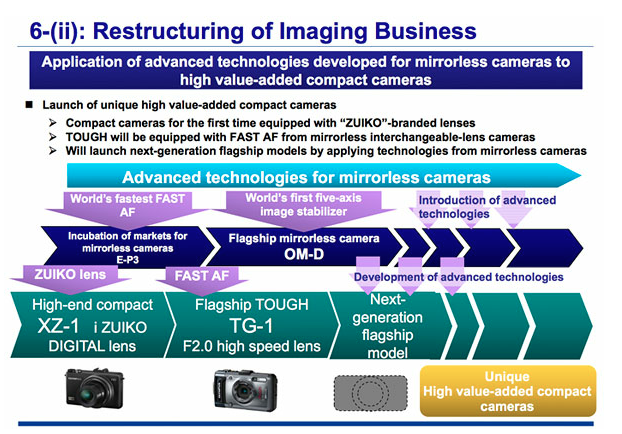
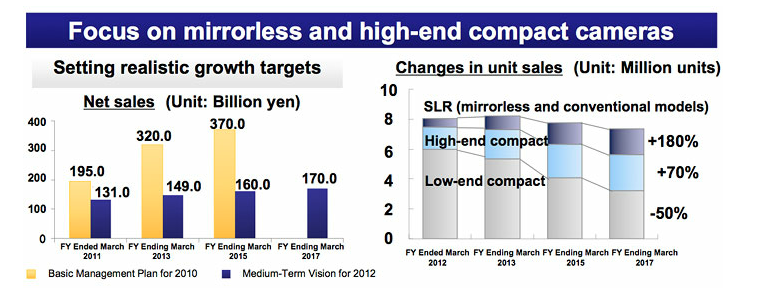
UPDATE: I added the image from the Olympus presentation
UPDATE_2: You can download the full pdf (Click here).
This rumor and antirumor game is never ending! Reuters now reports that “Japanese electronics maker Panasonic Corp has no plan to invest in Olympus Corp , President Fumio Ohtsubo told Reuters on Thursday“. Also Olympus denied the deal rumor. We can no more trust Reuters 🙂
Anyway, Olympus released an official press release describing their plans (Source: Bloomberg). Bloomberg reprts: “2,700 jobs are to be eliminated by March 2014. Most of the jobs being cut are in overseas manufacturing, Sasa told reporters in Tokyo today. The company will close a plant in the Philippines this year and will reorganize others”
The good news is that “The company plans to restructure its imaging business and increase the focus on mirrorless cameras and high-end compact models, it said in the statement.” That is what I needed to hear! Compact camera and Four Thirds camera business is not where Olympus can earn the money in future. It’s an obvious step to focus on the strengths of the m43 business!
181 Responses
Good news.
Compact camera and Four Thirds camera business is not where Olympus can earn the money in future. Unintended ‘not’? (You’re welcome to delete this comment)
Four thirds are cameras with mirrors; I think the “not” was intended. Micro four thirds, on the other hand… If they could include a way for micro four third cameras to take advantage of the number of pro quality four third lenses with good AF speed, I think (almost) everyone would be very happy with micro 43.
Those Olympus presentation images look really interesting especially on the right hand side of 6-(ii), I wonder what they mean by the introduction of advanced technologies that are still to come????
Growth targets and changes in unit sales look realisrtic and positive for Micro Four Thirds and Olympus.
So is Four Thirds finally dead!
I don’t think so.
“Will launch next-generation flagship models by applying technologies FROM mirrorless cameras.”
That is not the same as saying the next-generation cameras ARE mirrorless.
So, no. It doesn’t appear that they are killing four thirds with this.
That comment is in regards to flagship COMPACT cameras, not four-thirds DSLRs. The graphic says “FOCUS ON MIRRORLESS AND HIGH END COMPACTS.” Nothing about DSLRS. I don’t think you’ll see any new four-thirds cameras in the future. Ever.
Looks like you’re right about the heading. I’ve never seen a compact referred to as a “flagship” before.
As for “never” seeing another four-thirds camera? Far more likely they don’t abandon it yet. Not with the profit margins on the E-x. Not when the system is established. Not when the m4/3 r&d innovations translates up (& down) so easily. And especially not when they finally have everyone’s attention…
I think we’ll see at least 1 in the next year. I think Olympus will continue to make them. I am sure that since the innovations are finding their way to m4/3 first, the E-line is going to continue to be behind the cutting edge. But that’s not going to be enough to kill the line.
And before the pointless speculation based on ignorance commences again: the rumor said that Panasonic would be investing in Oly’s medical division, ie. it would not have very little or more likely no impact on (Micro) Four Thirds.
edit: two trol… I mean commentators were too fast…
If Olympus doesn’t continue 4/3 until they have a way of using the old lenses (which includes much bigger camera bodies, on top of PDAF), they’re as good as dead.
When Canikon enters the mirrorless market, m4/3 is going to stop being interesting, because right now it’s a semi-system for casual shooters and those who want something smaller for casual shooting when they can’t be bothered to carry their heavier Canikon gear around.
Agreed! One year after Canon enters mirrorless Olympus will drop from M4/3 because it is not profitable.
“If Olympus doesn’t continue 4/3 until they have a way of using the old lenses (which includes much bigger camera bodies, on top of PDAF), they’re as good as dead.
When Canikon enters the mirrorless market, m4/3 is going to stop being interesting, because right now it’s a semi-system for casual shooters and those who want something smaller for casual shooting when they can’t be bothered to carry their heavier Canikon gear around.”
—-
Well, I agree that they should keep on making at least one FT camera until their promise to provide FT cameras until the the FT lenses can be fully used on µFT cameras is fulfilled. This just a question of credibility.
On the other hand, I have to clearly contradict that it would kill Oly imaging if they didn’t. Yes, they might annoy the small but faithful FT community to the max and this wouldn’t be a clever move. But should Canon enter the MILC market with an more or less FT-sized sensor such as the one used in the GX1, this would represent a major boost for µFT, from my point of view. After all, a lot of Canon users would ‘learn’ by this decision of their camera maker that this sensor size is the way to go. And if this is the case, why not opt for a system where you already are provided with a solid range of good to outstanding lenses and good to fantastic cameras.
> But should Canon enter the MILC market with an more or less FT-sized sensor such as the one used in the GX1, this would represent a major boost for µFT, from my point of view. After all, a lot of Canon users would ‘learn’ by this decision of their camera maker that this sensor size is the way to go.
Except that situation would mean more reasons for Canon users to buy another Canon product.
You forget that it’s all professionals and enthusiasts using serious Canon bodies what makes average consumers keep Canon cameras good and if that same brand offers now also smaller interchangeable lens bodies those have automatic advertising bonus.
The Nikon 1 series system is an formidable “almost pocketable” competitor to the mu-4/3s format. Whether Olympus attracts an investor or not, the camera division must stop the bleeding or the next set of rumors will be about the pending closure of the division if the company is unable to sell it.
The “accounting irregularaties” affect the entire company, but the camera division must become profitable, and soon, or it will become expendible. We will have to see whether the restructuring actu changes the course of events.
With Panasonic now denying investing in Olympus, one can only interpret this as yet another vote against Olympus’ management.
At some point in this melodrama the shareholders are going to have to step up to the plate to protect their own interests.
The Nikon 1 series system is an formidable “almost pocketable” competitor to the mu-4/3s format. Whether Olympus attracts an investor or not, the camera division must stop the bleeding or the next set of rumors will be about the pending closure of the division if the company is unable to sell it.
—-
First of all I am of the opinion that the Nikon 1 system is neither formidable nor a competitor for µFT. And in consideration of the fact that it has been on the market for about a year, now, and there hasn’t been added a single lens since the launch, it seems that Nikon themselves also aren’t too convinced of the system they allegedly worked on for five years. (say no more).
And one shouldn’t forget that Oly imaging is far more than just a camera division. The design lenses for numerous compact cameras, for Oly’s medical division and do a lot of R&D for the medical diovision. Without Oly Imaging, the Medical division wouldn’t be half a successful as they are. Oly Imaging is a core part of Oly and will never be sold.
yalla yalla yalla…
since when exactly is Canon entering the mirrorless market? 2008? I guess since the introduction of the G1 mft was dead as Canikon are soon going to enter the market. how many canon mirrorless cameras have we seen so far? how long will it take canon to match the cdaf of olympus now? let alone how long will it take to match the mft lens selection? 5 years? probably at a minimum. The same has been said about Nikon entering the mirrorless market, but their dent in mft sales has to be seen yet.
I would like to see just one argument, why a current mft user should switch to canon… and the user number is growing rapidly
That Canon will enter the market this year is a rather good guess based on the solidity of the rumours. Before it was “where is canon?” and “they will come sooner or later”. Now it is “they are coming this year”.
And they will probably do good, not because they are significantly better than m43 but because they have a solid base of supporters that are waiting for them. (Especially in the US)
They might introduce some interesting technologies (like that PD-AF from the 650D) but m43 are going to be the big boys on mirrorless for some time to come.
The problem for Canon is this:
– use the current DSLR mount (to keep lens owners locked in), but the cameras will not be really small and will not take real advantage of the mirrorless design (see Pentax K-01).
– use new mirrorless mount with APS-c or G1x size, but this will requires existing Canon users to buy new lenses. This creates a moment where many of those users will consider other options (m4/3, NEX, NX).
– using a new mirrorless mount with significantly smaller sensor (aka Nikon 1) will allow for smaller designs, but there is compromised IQ and DOF ability. Also, the logical upgrade path towards higher end Canon DSLRs is broken.
The huge market share of Canon may lead the company to enter the mirrorless market only half-heartedly in order to protect the DSLR sales. This would be a big mistake. Don’t forget we are already seeing a lot of Canon/Nikon DSLR users getting an E-M5/GH2/PEN or NEX as a backup camera, only to find out they never use the DSLR anymore. In Japan, mirrorless is already bigger in terms of sales than DSLRs!
Canon has got some important assets of course, including a very well known name and excellent distribution channels. But these are not enough to ensure a successful entry into the mirrorless market.
Or release a mirroless the size of G1x with hybrid sensor and some lenses, like a pancake and an all around cheap slow zoom (the all mighty 28-80 f3.5-5.6 that rule the camera market since years 😉 and a adapter for the legacy lenses, so existing owner have a camera that work with their gears like if it was a dslr, but only a little smaller due to the lense and adapter size of buying the mirrorless lenses for great compactness.
@Gabriel: That’s also my bet actually.
We shall see soon anyway.
So…, how is this different from current m4/3 strategy?
What a load of tosh. M43 is a growing system in its own right and one which will continue to grow as improved sensor technology allows better image quality. I expect that within 5 to 10 years, full frame will become the equivalent of todays 10×8 and used by the very few. APSC will be full frame and m43, or something similar, will be the system used by most photographers.
Only a masochist would wish to carry around a ton of gear when they can, or will be able to, carry only half a ton to achieve very similar quality.
Whether the system is made by Canikon, Sony, Olympus or Panasonic, I really do not care.
> M43 is a growing system in its own right
Just like with any plant arriving first to new fresh ground it’s easy to grow when competition has been even more stumbling.
And like if any plant leaves some ground open it risks getting shadowed by bigger plants: Grass can win over trees only by being first on the place and covering every spot so densely that trees can’t settle down to it.
35mm will never get same position of standard it had in analog film era but who gets to own fully digital mirrorless future is still fully open and game is really only beginning because m4/3 has left big area open for others.
I disagree. In 5 to 10 years there will be two main camera formats and APSC will not be one of them. Professionals will continue to use 135 and there will be a migration to 4/3 size sensors, but there will be the m43 and the canon 4/3 mounts. Both will use a similar size sensor and the third party lens manufacturers will make a common lens that will come in either mount.
This will happen if canon makes a 4/3 size interchangeable lens camera.
Most people will not want a 50MP apsc sensor and the cost (sd cards and PC hard disks) and weight (dead weight) involved. They will be able to get a perfectly satisfactory image from 4/3 sensors without the weight and cost of image storage.
“When Canikon enters the mirrorless market, m4/3 is going to stop being interesting, because right now it’s a semi-system for casual shooters and those who want something smaller for casual shooting when they can’t be bothered to carry their heavier Canikon gear around.”
Nikon already entered the mirrorless market. Did m43 stop being interesting?
Let me rephrase:
When Canikon enter the mirrorless market they will be an anachronism (Nikon 1- redundant in light of the new 1″ compacts from Sony, Canon & probably PanOly) or too late and confused (Canon have only announced their first mirrorless compatible STM lenses today and they are for larger formats, PanOly are miles ahead). The only remaining niche is a mirrorless FF – Canon’s 40mm f2.8 STM announced today gives a strong clue they may launch a FF.
“The only remaining niche is a mirrorless FF”
That is a rather small niche. Someone is bound to fill it sooner or later but Canon would surprise me very much if they didn’t go for the big crowds first. You can call Canon many things but a niche brand they are not.
Not sure why. Yes, there’s the credibility question and reputation but if you look right now it’s clear they don’t need 4/3rds.
We’re waiting for “Can”, “ikon” allready has their mirrorless 😛
Nikon entered the mirrorless market, good product, no uptake.
Canon will enter the mirrorless market, will not produce lenses as they still have not produced all good FF lenses for APS-C. They will not produce enough mirrorless lenses to be interesting.
Nikon had a water-testing product. Nothing serious.
The future for *all* companies is mirrorless.
The only difference is that Canikon, when they decide to go fully mirrorless, will have complete compatibility with their current lenses, because they’ll have a PDAF method.
Olympus does not have that, and therefore is unable to provide any high-grade lenses for m4/3, especially in the light of:
1) 7-14: made by Panasonic
2) Fast normal: made by Panasonic
3) 12-35: made by Panasonic
4) 35-100: made by Panasonic
Anything above 100mm cannot be fast (bright) due to m4/3 size constraints.
The Panny 7-14mm is made by Olympus (I was told from an employee of Oly)
Mirrorless with their current setup will result in a K-01 which does not make any sense.
“The only difference is that Canikon, when they decide to go fully mirrorless, ”
They have so much legacy that they contrary to Olympus and Panasonic can NOT go fully mirrorless. Only companies without a large DSLR legacy (Panasonic, Olympus, Fuji, Ricoh (?) – without Pentax) can easily and will go fully mirrorless.
1) 12mm f/2: made by Olympus
2) 45mm f/1.8: made by Olympus
3) 75mm f/1.8: made by Olympus
4) 60mm f/2.8: (to be) made by Olympus
Olympus started out with consumer grade lenses because they expected the biggest sales to be with consumers: compact users wishing to upgrade, but unwilling to take the bulk of a DSLR. They then found out that enthousiasts are a big market for mirrorless and that there is sufficient room for high grade lenses. So they started to make them. Don’t forget that the whole mirrorless market is less than 4 years old, and that companies have been testing out which products work and which don’t. Expect mirrorless to go mainstream as the products and line-ups continue to mature (e.g. E-M5, NEX-7, higher grade lenses)
Absolute BS! If anyone knows how to manufacture high end zooms, its Olympus. Take a look at 4/3 lens lineup and you will understand. Oly has the know-how, its just a matter of time until they focus on the zooms. It was clearly stated when m43 mirrorless was announced that the system lacks primes and that is why you have seen mostly primes from Oly until now.
Canikon should hurry because they are 3 years late….
You’re just clueless, you know that? Four-thirds has been dead for a couple of years now, and never sold well enough to have any significant positive impact on Oly’s bottom line. m43, on the other hand, is a big hit, and the OM-D is convincing a lot of people they don’t need a DSLR any more.
I’d bet four-thirds cameras don’t amout to 1% of the sales of m43 cameras. Nikon already entered the mirrorless market (clueless again, eh?). Ever heard of the J1 and V1? Ever seen just how poorly they actually perform?
Canon’s mirrorless will have to work a lot better than the hybrid AF on the new Rebel appears to if it’s going to compete with the latest m43 bodies.
Go back to your Canon forum and hang out with your friends.
The Nikon 1 series have been selling very well, even above Nikon’s expectations. According to Nikon, the V1 is the best selling mirror less camera of 2012 so far (this was before the e-m5 release). If you go to a department store or a big electronics store like best buy, you are guaranteed to find the 1 series on display and for sale. It’s a hit or miss on seeing even a single micro four thirds camera or lens for sale. That means for the general population, they won’t even have the chance to consider a m43 camera, since m43 cameras are sold in camera stores and online, which are where most photographers but not the average joe buy their cameras.
Well, this may be the case in the US – I assume you live there – but it’s just the other way round in Germany. The Nikon 1 system is a big flop, over here, while µFT is accelerating more and more. And in Japan, the µFT mount is the most successful mount of all mounts available. So how could Nikon claim that the V1 is the best selling MILC? That’s an absolutely ridiculous claim.
Don’t you realise that records only exist between the North Atlantic and the North Pacific, excluding Canada. Nothing else is recognised on some levels and blissfully unknown on others.
Thanks’s for opening my eyes! 😉
@Babbit
as Nikon themselves have said the Nikon1 has only been a moderate success in only the USA.
As I predicted here 9 months ago, I also predicted that it will “sell in” well but largely leave users disappointed, would not generate add on sales or gain traction…
Mmmmm they will cut 2700 jobs in the cameras divisions : is that why we are not able to get the E-M5 we have ordered ? My dealer just announced me a new delay and without any delivery date this time. I have pre-ordered on the 5th of March ! The delay was first set on week 21 (around 25 May) then pushed to week 25 (between 18-23 June) and just yesterday, I received that frustrating email of a new delay, without any other possible delivery date.
Got the same email… No delivery date! Going on a safari and I really need the second camera body for wide shots.
Since you live in Switzerland, why don’t you go for a short weekend trip to, say, Munich, and get the EM-5? Whenever I looked at decent camera retailers, there were some EM-5 in stock. So, in Germany it isn’t that hard to get.
Even with the current shortage of EM-5 batteries, I was able to order two spare batteries through my local Media Markt, which does not have the EM-5 in stock, without problems. Delivery time was as announced: exactly two weeks.
Because I have paid for it in advance and because your VAT is 19% in Germany instead of 8% here and with that it would be a hassle to go through the custom. And then I’m not living near of Germany, rather on the other end, so it won’t be such a short trip to go to Germany. There are some cameras around here at smaller dealers. My fault was to pay in advance and go with a big online dealer. I think that they are the last to get delivered. But the smaller camera dealers take a premium and I thought it would only be a question of weeks, not a question of months.
Anyway the bad dealer I will avoid in the future is Microspot.
“Anyway the bad dealer I will avoid in the future is Microspot.”
Good to know since I had previously considered, but never done, ordering photo gear through Microspot. I have had some very good experience with ordering from Heiniger (http://shop.heinigerag.ch/) but their web site is only in German; if one lives in Latin Switzerland and is not at ease with that language it is obviously difficult to order with them.
By the way, if you buy something expensive in a EU country with ridiculously high VAT you can usually ask for VAT reimbursement at the border and then pay Swiss VAT when entering Switzerland.
I have no problem with language and already ordered from Heiniger. Their prices are somewhat higher but they begun as an imaging and computer selling company. They sed to sell Apple products and there you can order calibration tools, good imaging display like Eizo etc.. They sell to enterprises too and are very fast in shipping goods, provided the distributor has them :-).
Digitec is also a good company, but from what I have read they delayed some E-M5 orders too. .
What I disliked with Microspot is that they announced the very same kit I had ordered at a higher price for a nearer date than my ordered
I know about VAT reimbursement at the custom, what I said is that it is a hassle, not that t is impossible.
I ordered mine (silver E-M5 & 12-50 lens) in Sydney near the end of April & I got it earlier this week. The jobs won’t be cut from such a successful model range as the OM-D & I’m sure you will get yours soon. There are other lines that can be consolidated amongst the compacts for instance.
I am sorry for those users of 4/3 who are decent people – not all are. It was an easy guess, there’s not commercial life in the system, a matter of size, weight, old AF combined.
Even with m4/3 it’s easy to sc*ew, if you don’t get the right model – I am not sure the three latest pens sold equally well.
So I welcome concentration on the core business. Also good news that Panny won’t put their grubby fingers in the line. Oly’s success is also a matter of style and taste, which can easily go perverted.
Finally if they keep issuing good grade lenses, they need not fear Canon or other camera makers, unless the latter undercut its prices.
Compared to other systems, IMHO, good m4/3 lenses are still a bit on the expensive side. Although I use some legacy ones, so I was able to survive.
Well, I am one of the 4/3 people. Don’t know if I’m decent or not for you. I would wellcome more 4/3 bodies, but will be satisfied with smooth transition to “one beautiful system”, as long as 4/3 lenses compatibility if provided.
From what Olympus is telling, I can’t know if more 4/3 is comming, but so can’t you (or anybody else).
If more 4/3 comes some day, I hope you will popup at that time and say:
“Boy was I trolling on 8.June.2012” (if you are decent)
It wood certainly better if Panasonic would put their fingers in. Because then Olympus would learn, how to do camera ergonomics and firmware design. They did not learn this when designing the awkward to use PENs and did not improve significantly when designing the EM-5 (I own and use one).
Although the EM-5 is a great camera to use generally, it isn’t very hand-friendly. Without the HDL-6 grip uncomfortably to hold, many buttons not easy to reach and the position of the left wheel could be much better. Many important features, like bracketing and Mysets are to complicated to access (at least six steps).
The ergonomics of the competitor product from Panasonic (GH2) is miles ahead.
Or is it?
Do olympus think i will spend more money on their products if i wasted thousands on usd on lenses where there is almost no hope of upgrade in 4/3 bodies?
I love my lenses and olympus cameras – but fool me once…
there is a good chance there will be some new 4/3 bodies release this year
There was a change of AF system, right? It is usually the feeblest link in the system, because it can and did obsolesce, in other systems too.
So you can’t blackmail a maker about not improving on AF, and changing type of lenses.
Backward compatibilty can’t usually be guaranteed, but at a very weak level – which is exactly what is happening.
That is also why I think that 4/3 users arrogance is quite misplaced. Go buy other systems, you have already been replaced by new buyers, and are verging on the pathetic.
Phase detection AF is far from obsolete.
Contrast detection AF is handicapped by limited speed at which focus can be moved and sampled and that will keep its faster moving target tracking ability crapshoot compared to PDAF which knows with first sampling where correct focus distance is and also finds out instatly with next sampling to which direction and how much target has moved.
And instead of becoming obsolete PDAF is soon going to start spreading to areas controlled only by CDAF. Also Canon is starting to experiment with PDAF integrated onto sensor.
Bye, bye, Olympus. Success of mirroless systems are largely influenced by users of larger systems. If Oly has no “pro” system and Canikon enter the mirorless market, Oly imaging dept. definately goes bust.
“We can no more trust Reuters” – Admin, keep in mind what was the original source Reuters was reporting from 😉
>keep in mind what was the original source Reuters was reporting from
“Reuters reported that Olympus Corp is considering raising about JPY50 billion ($640 million) through a third party share allotment, the Sankei Shimbun reported on Tuesday. The maker of medical equipment and cameras is struggling to recover from a $1.7 billion accounting fraud which left it with a paper-thin equity ratio of 4.6% of total assets, as of end-March, after it corrected years of misleading accounts. Olympus said in a statement that the report is not based on an announcement from the firm.”
“Reuters reports that “Panasonic Corp is making final arrangements to provide up to 50 billion yen ($635 million) in capital to scandal-hit Olympus Corp, Kyodo news agency reported on Wednesday, a move that will make Panasonic the company’s top shareholder.””
That’s what admin had posted before. BTW, it’s also what dpreview reported:
http://www.dpreview.com/news/2012/06/06/Panasonic-planning-stake-in-Olympus
Panasonic is finalizing a substantial investment in troubled medical and camera company Olympus, according to reports from Japan. The Kyodo news agency is saying that Panasonic will invest around ¥500bn ($630m) in the business – ….
So it was Kyodo, not reuters. Sankei Shimbun may be quoting Reuters, yet Reuters mentioned specifically Kyodo (and dpreview did too).
@Raist
because Kyodo originally reported it doesn’t mean Reuters shouldn’t check whether it’s a fact or a rumour if they want to be taken seriously in their reporting…
(the BBC and FT didn’t report the story)
Dpreview and this very site did. Many other news places go with the news of other places that are local in terms of time of news. These kind of things happen, not exclusive to Reuters. For all you know BBC didn’t report it because it’s not even on their radar, not because they double checked.
Point being, Reuters reported what someone else said, not what they themselves said. On that end I think it’s reasonable, and quickly undid when they got the new news on Panasonic. Like dpreview did.
It’s not like Kyodo is a “fly by night” operation, so I think it was reasonable:
http://en.wikipedia.org/wiki/Kyodo_News
@Raist
dpreview is desperate and 43rumors is a rumour site.
Media agencys such as the BBC receive 100’s of stories and choose to publish and not publish stories for various reasons… credibility is often part of their criteria but obviously not on Reuters.
You need to read who Kyodo News is.
Finally, what you bring up it’s besides the point Riley made anyway and what I wrote to him.
the point is it never happened, and that both panasonic and Olympus refute the claim, as was pointed out to you in my first post. Olympus seem to have other plans
Olympus
http://www.olympus-global.com/en/corc/ir/tes/pdf/nr120606.pdf
Panasonic
http://www.reuters.com/article/2012/06/07/panasonic-olympus-idUSL3E8H71BY20120607
http://www.reuters.com/article/2012/06/07/us-panasonic-olympus-idUSBRE85604G20120607?type=companyNews
Olympus claimed to be more stable
http://www.reuters.com/article/2012/06/08/us-olympus-capital-idUSBRE8570AA20120608?type=companyNews
If that was your point in the reply you gave me here, then your reply makes absolutely no sense to what I wrote here and is completely irrelevant. I was not contending that the news was, that Panasonic was indeed banking Olympus. I was just mentioning, in a light hearted way to admin, that it wasn’t Reuters who really reported it or where the information originally came from.
So I don’t understand, your reply to what I wrote here is completely irrelevant.
well thats the case, its called journalistic integrity
That they would focus on m43 was pretty obvious from the beginning. Nevertheless, I hope that they will continue to support 43, no matter with a DSLR or a body that sufficiently enables AF on 43 lenses. If they do not, I would – after having wasted the E-5 – be compelled to look for another company…
Bye bye E7 and 4/3 🙁
What if the come with an E-M7 with solution to the PDAF-problem?
This is one possibility, and it will make a lot of 4/3 users like me very happy 🙂
The announcement said, ““Will launch next-generation flagship models by applying technologies FROM mirrorless cameras.”
It didn’t say that the next-generation cameras ARE mirrorless.
Read better. That line is under a heading regarding compact cameras, and relates to flagship compacts, not four-thirds.
I keep forgetting that this site is 4/3 Rumors, not Micro 4/3 Rumors!
However, as there is no other site that is as informative on the Micro 4/3 front I keep coming back for news and m43 rumors.
Yes, it is unfortunate for 4/3 owners that there is no system future for them, and there hasn’t been for several years (despite the E-5). The future has been Micro 4/3 since mid-2008 (G1 announcement), and despite all the Canikon fanboys, despite Sony, Samsung and Fuji ploughing the APS-C MILC furrow, Micro 4/3 remains the future for the bulk of the population that wants to make good photos and videos without needing a mule to pack your gear.
So, without wanting to inflame the passions of the 4/3 community too much, we can look forward to continued m43 MILC successes by Olympus, Panasonic, Cosina and others.
Film is dead, dead, dead, so are DSLRs – move on.
It is long past time to shut down this site and let MirrorlessRumors.com lead the discussion.
I was with you until the last two sentences, which are simply stunning in their ignorance.
Yeah, well that ignorance is founded on more than 50 years of enthusiast photography.
Tell it like it is – pdc is a moron.
DSLR isn’t dead until mirrorless offers bodies with same controls and ergonomy.
That’s why mirrorless systems haven’t done much anything to lower sales of DSLRs in western world and have cannibalized mostly only sales of compacts.
Also by its nature CDAF will always stay as crapshoot for tracking any faster targets so SLR or SLT mirror stays in cameras of sport/animal/bird photographers until on sensor PDAF has been improved to same level.
And bulk of population doesn’t even want to carry other device than cellphone in their pockets!
Look at Oly’s balance sheet, 95% debt 5% equity and their board of directors are representatives of banks(people whose interests are in the money ed to the company NOT in the business of the company) who hold a majority of their debt and equity. Boy are they royally fcuked to put it nicely!
It will be interesting when they need to roll over their debt. Who wants to be Oly’s white knight if they’re not getting a controlling stake/hand in the company. Dream on Oly.
Please learn some financial basics…. Debt is good, equity is bad. Debt’s interest rate is MUCH lower than required rate of return for stocks, issuing cost is much lower, and has less risk of hostile takeover and does not lose control of the company as easily. Common stock shareholder has the power to control a corporation’s direction. Debt holder has ZERO right to say about the company decision unless the company went bankrupt (in that case, debt holder have priority over common stockholders).
There is some sort of magical thought in these discussions. 4/3 lenses cannot be well adapted to m4/3 NOT because the bodies are wrong, but because the lenses themselves cannot cope with CDAF needs.
Even the CDAF compatible ones did NEVER improve their performance on mirrorless cameraas, no matter the speed of the CDAF performance, because they didn’t have the proper linear motors and light interrnal focussing groups.
Making a hybrid camera would be much more expensive than making an E-x, but Olympus warned that even the E-x would be only a stopgap.
I also think, but that’s me, that it is quite foolish to spend thousands over the lenses, if you are not a pro that can offset them in 3 years by paid work.
In times of rapid technological change who would have invested 10,000 in a computer?
Electronic lenses get caught into the transition. Could you not see it, instead of claiming haughtily that they were inferior?
Some behaviours are not very rational or else they come from film habits, when a mount could last 30 yrs.
BTW I concur with RaiST that Reuters doesn’t seem to have trusted sources in Japan. Perhaps there isn’t very much transparency there, but one should watch out – too much parasitic information, perhaps even vested.
@amalric and @Raist
strange with every Reuters report incorrect, correct and rumours about Olympus there is major share price movement…
Reuters needs to be more responsible in their reporting like Bloomberg, the Financial Times and the BBC… Reuters editors leave a lot to be desired…
Reuters when it comes to Olympus and some other companies is sort of like an old analog clock. It is right twice a day, but wrong all the other times. It seems it has been that way for awhile.
I don’t make any particular case for Reuters per se. I only pointed out that they came clean by saying that Kyodo News said something and Kyodo News, once again, is hardly a “fly by night operation.” Many news network in the world use exactly that- networks of news like Associated Press, etc. You make this sound like this doesn’t happen at all anywhere else.
Major share prices can happen with reports from everywhere, and you bet Kyodo News that is in Japan with millions of subscribers has more influence than what Reuters would say.
you need to realise that all this ‘bring out your dead’ stuff isnt helpful, and in this case not even accurate
You need to realize that your reply to what I wrote here is completely irrelevant and besides the point I originally made, and what I am saying now, is that in the news world there are networks of news, and Kyodo News is hardly a fly by night operation. Many other places reported from their network what they reported.
This happens, besides, I am talking about Reuter’s influence on Olympus stock point. It’s not like you pointed out to me something here with some rather concrete evidence anyway – I mean, you seem to be talking about another point I may even agree with.
>you seem to be talking about another point I may even agree with.
you dont seem to sure of that
Of course I can’t be. You have the ability to even change context and subject from what is being talked about within the same thread. How could I be 100% sure of where your mind is?
>I don’t make any particular case for Reuters per se. I only pointed out that they came clean by saying that Kyodo News said something and Kyodo News
that isnt right, they have a duty to check sources,
ie. call Olympus and Panasonic for comment.
They dont exist to simply mouthpiece news from other news sources, and using them doesnt absolve Reuters
Which apparently they did or something, since they published like ASAP that Panasonic said they were not doing that.
But my point is not that, but the fact that Reuters like many other news agencies depend on a network of local news for speed of news (not saying it doesn’t have its consequences, that’s another point). And Kyodo News is not like a tabloid magazine you know? So if Kyodo said it, it would be like say a BBC or Bloomberg of Japan saying it.
> I also think, but that’s me, that it is quite foolish to spend thousands over the lenses, if you are not a pro that can offset them in 3 years by paid work.
You forget about enthusiasts, who are generally doing it as a hobby. And Oly’s relatively cheap and feature-packed bodies, together with versatile zooms, have attracted in past quite a lot of them.
All in all, it is a f*ck up. There is no point hiding it. Every owner has to find their own personal way to deal with it. Alter all, DSLR choices are better now than what they were 3-5 years ago. And cheaper. (And no, there is no replacement for 12-60. Get over it.)
>Some behaviours are not very rationalI also think, but that’s me, that it is quite foolish to spend thousands over the lenses, if you are not a pro that can offset them in 3 years by paid work.<
In reality, I really agree with you! But this kind of common sense is not widely spread, sadly.
@amalrik: What if they make a 6 degree of freedom sensor? Then they can jog the sensor back and forth instead of the lens, and thus achieve very rapid CDAF — even for lenses with “slow” motors. Of course — I don’t know how much movement of the sensor this would require. But conceptually I think it is doable.
I had this idea some months ago and called it ‘wobble’
http://forums.dpreview.com/forums/read.asp?forum=1022&message=40362450
this doesnt seem to me to be what Canon are doing, theyre simply pulling the focus close with pdAF, then completing with cdAF, which is why the lens is shunting, thats not the sensor moving.
> Even the CDAF compatible ones did NEVER improve their performance on mirrorless cameraas
Leica D 14-150mm might well have faster focus speed in E-M5 than in lowest end 4/3 bodies.
When trying it in pre-production E-M5 two months ago focus speed was very impressive (compared to in E-30) at all focal lengths except for possible AF algorithm bug (no same problem in GH2) causing focus problem at 14mm.
What’s wrong with the performance of the 14-54/2.8-3.5 mkII? It’s fully compatible and reportedly fast focussing with m43.
“The company plans to … increase the focus on mirrorless cameras and high-end compact models”
That’s the third large manufacturer in less than a month to say basically the same – that they’re giving up on cheap P&S, which is a great thing. I’ve had enough of trying to shoot anything meaningful with 1/2.33″ sensor cameras when the light is low. I don’t know how such a small sensor was meant to replace 35 mm film in the first place. The future of digital cameras are large sensor compacts and mirrorless interchangeable lens models.
> I don’t know how such a small sensor was meant to replace 35 mm film in the first place.
It replaced perfectly the ISO 100 and ISO 200 films. Also removing the limit of 36/72 shots per roll.
You probably have already forgotten all the “pleasantries” of using the $80-120 “soap box” film cameras. Even the price hasn’t changed…
> The future of digital cameras are large sensor compacts and mirrorless interchangeable lens models.
I sincerely hope it is. But companies still have to sell something to this magical price point $100 which is what most casual people are ready to pay for a camera.
Well, the real future of digital cameras are phones. That’s why Olympus is more or less giving up on low-end compacts.High end compacts will appeal to a more specialized audience.
When I said digital cameras, I was talking about devices that are only used for taking photographs, those that survive the phone invasion :).
a lot of compacts are cheap but meaningless, phone cameras are sweeping this area off the grid. It will matter in terms of volume but not really in profit as theyre made by 3rd party manufacturers (by and large), with several brands coming out of the same Chinese factory.
>Some behaviours are not very rational<
Isn't it our consumption society's essence? Advertisement will never push someone to act rationally. And NO company wants customers to act rationally! If customers would do it, they would never upgrade!
Repeat after me : I want more and new, and will ever do 🙂
In the short to medium term we will see: DSLR is deal, just waiting for it to stop twitching. Compact sales have been completely replaced by phones. Those camera companies still foolish enough to make (small sensor) compacts are loosing money on every unit. Mirrorless (ILC and fixed lens with around 1 inch sensors) is the normal camera for anyone who wants better than phone IQ. Technology developments in the view finder have the image quality up but with the added benefits of overlaid information and previews of DOF, art filters, focus peeking etc. The idea of an optical viewfinder without digital enhancement seems ridiculously old fashioned.
Oly have made a brave and correct decision, the threatened entry of Canikon is a concern, but one I am prepared to live with and keep buying Oly kit today. I think we may still see an E-7 but it will be the last one of the 4/3 line, enough to see out the faithful and prevent them having to cram CDAF into the E-M* range.
43 is dead. Or not? Oly still has quite a lot of 43 lenses on sale (at least here in Germany – http://geizhals.at/de/?cat=acamobjo_oly&xf=2305_Four-Thirds#xf_top ).
I think for Oly it is question now: cost of introducing new 43 camera vs. profit to be made of the 43 lenses stock.
Effectively abandoned the 43 market for 3 years, I doubt they have a chance of attracting new customers without above average camera body. New customers are needed to sell the lenses. Since producing above average body might cost them extra, the chance of it happening IMO is pretty slim.
I think they will launch the E-7 largely to sell to existing users, with an never quite stated message that the E-7 is the last one, buy now, use until it or you wear out. I think that is a better solution for them than giving access to through OM-D range to all those legacy 4/3 lenses. Nothing in it for them, they want to design and launch a whole raft of new M43 PDAF lenses to sell to E-M5 users and users of future ‘Pro’ versions of the OM-D family.
>I think they will launch the E-7 largely to sell to existing users, with an never quite stated message that the E-7 is the last one, buy now, use until it or you wear out.<
Hey, wait, that's the E-5! It must be a mistake 😉
Yes! It’s a realistic way of putting it – a matter of marginal demand. If demand for 4/3 (camera + lenses) has been decreasing for 3 yrs, comes a point when introducing a new body, even an expensive one, makes no sense. You are not going to earn enough money with it.
They even predicted it, encouraging to make the transition to m4/3, but were somehow unheard.
Now people assumed they would provide an adapter, or PDAF on sensor.
The latter might have unexpected problems due to size. The first is expensive. How many Sony people use their own. Third option would be a line with translucent mirrors, but perhaps Oly does not have the financial clout.
All there is is what is sustainable for them, not for the user, unfortunately. Some amazing assumption were made in the past. That even if 4/3 lost money a profitable endoscope division would finance the camera division.
Can’t you see how warped financially is such an option? Users at 4/3 didn’t.They didn’t know however the king of hidden losses – millions! that Oly had to face.
Finally in the Digital world no material camera is even needed for most. Film times were different. People take pictures all the time with iPhones. dSLR might even be a remnant for enthusiasts, gone in a few years.
Therefore the shrinking camera, mirrorless with better performance than iPhone is probably the *only* option for a camera that cannot afford to have two different systems. Watch Sony, even they are losing money.
Yes, that Sony adaptor (which works really well) is $400! Although, that’s cheap compared to the cost of replacing some of Oly’s SHG 4/3 lenses. When talking about 4/3 or M4/3 the question is: Replace with what? None of the current M4/3 lenses are of that calibre.
@Am “Watch Sony, even they are losing money.”
What evidence do you have that Sony is losing money on their cameras, which are obviously a small part of their business?
Note that the second chart, in describing projected growth of SLR share, categorises SLR sales as “mirrorless and conventional”. Don’t give up just yet, my friends..
The most important for m43 to continue its success is to a)minimize the IQ gap to APS-C, b)build on the size/weight advantage over APS-C.
Looking at Oly plans they expect a mor significant volume increase in the high end compact segment than in mirrorless. For sure low end compacts will not survive – phones will take over.
Oly also expects total volume go down. Means they must increase the profit/unit. = more rational production = less employees needed.
The problem for Oly is that their competitors see things the same way. As always when we have a crowded field of market competitors – features and performance tend to be similar. Who wins? Best marketing, best value for money, every product generates profit.
BTW: Did you know that in car industry about 20% of the price is marketing costs.
Olympus will not create any high quality lens costing > $1000 for the m43 because it knows their novice customers will not buy them because lens will be too heavy and too expensive and their pro customers will not buy them because they know the lens will not have any value once Olympus moves on to the Super mFT system in 8 years.
Panasonic just about to learn its lesson with the 12-35 and soon to be released 35-100. I hope they have spare warehouses to store them.
In the meantime Nikon ‘1’ users are happily shooting through their high quality PDAF lenses. I expect Canon users would have a similar experience.
‘I expect Canon users would have a similar experience.’
And sooner than I thought. Just visited dpreview and found out about the Canon T4i which sensor has this:
– Phase detection AF from imaging sensor for Live View and Video.
– Continuous autofocus in movie mode with subject tracking.
And 2 lenses designed for good performance in Video capture:
EF-S 18-135mm F3.5-5.6 IS STM and EF 40mm F2.8 STM lenses with stepper motors for fast, quiet operation when shooting video.
Canon mirrorless would have used the same sensor tech and quite possibly the same lenses.
You’ve never actually used a Nikon 1, have you? Indoors, or in any conditions other than bright light, AF performance is dismal. Truly awful.
I’m too young to have experience from them but were first autofocus SLRs any better?
There’s lots of PDAF experience and knowledge from decades of autofocus SLRs so expecting first versions of on sensor PDAF to match them in performance is futile.
But once makers get more experience how to apply that knowledge I would expect performance to start improving at good speed in coming years. (like single focus CDAF has improved fast in m4/3)
Four Thirds is beastly dead.
Blame it on the accounting fraud scandal or sth. else, it does not matter.
Yes but what with the classy 4/3 glass?
This is no problem. The existing optical designs will be converted into new produts. If you do not like to use an adapter for your 4/3 lens, you can buy its m4/3 equivalent. Olympus can hedge some of their heritage.
Hedging your earlier investments cannot be of any concern to them.
Hardly anybody minds using an Adapter – the problem is that with the adapter lenses are awfully slow.
Admin: can’t you fix it so that the right hand side of the pictures you post on this blog do not get cut off?
I second this motion.
Wondering:
1. If Canon makes a mirror less model, will they eventually stop making their DSLR line?
2. Can full frame makers make a mirror less version of their FF model?
3. what will the olympus Next Generation Flagship model offer? Can it be mirror less but yet use 4/3 glass without an adapter?
Biggest problem I see in using 4/3 glass is physical size of body, it has to have that distance of back focus whether there’s a mirror there or not.
As regards any one making mirror less bodies has some effect on FF bodies, but the big question I see in that market is this, is it a dwindling market space, with the continued entry of new FF bodies how long before the consumer says whoa, how many bodies do I need???
As regards 4/3 glass I feel Oly has to support this until they conquer PDAF in the u4/3 range.
I second the motion too. V. Important for movies.
Canon’s entrance in mirrorless might be worrying if they succeed in having a hybrid AF with a 4/3 sized sensor . Could they use legacy AF lenses (EF series?), where Oly (and Panny) cannot.
Does anybody know?
apparently the new 650D has PDAF on chip for use in live view mode… shows they have the capability.
The point is if Canon mirrorless would focus ‘legacy’ lenses almost as fast as native mirrorless.
I bet they cannot do it FAST because those would need new motors and focussing groups.
What could happen is another thing, that they could focus natively NEW dSLR lenses and mirrorless lenses.
Wouldn’t it be interesting?
Now of course Oly and Panny abandoned the dSLR market, so it wouldn’t change much for them. Or would it?
“I bet they cannot do it FAST because those would need new motors and focussing groups.”
The Nikon J1/V1 focuses fast with PDAF lenses, there is no need for a new CDAF motor because the body will send PDAF instructions to the lens and the lens would focus with PDAF motor.
“Assuming that the light level is high enough, then the J1 and V1 switch to a 73-point focal-plane phase-detection AF system that offers fast and responsive ‘single-shot’ AF and impressive continuous AF tracking performance. ”
http://www.dpreview.com/reviews/nikonv1j1/8
“As a Wildlife Camera – with 1 Nikkor Lenses: Out of the box, the V1 has attributes that at least make one consider its appropriateness as a wildlife camera. It DOES have a very fast and accurate AF system and is very responsive.”
http://www.naturalart.ca/artist/fieldtests/fieldtest_NikonV1.html
That is Nikon. Canon will use a similar approach. I am expecting they are not as fast as they could be because the technology is still new for Nikon and Canon. But they should catch up within a year or two.
“Now of course Oly and Panny abandoned the dSLR market, so it wouldn’t change much for them. Or would it?”
If it would not change them, their customers would change.
Indeed, IF they can focus legacy lenses at close to full speed it would stop an awful lot of Canon users buying into m43 as they’ll just buy the Canon version and keep their lenses… if their legacy lenses are not supported then it’s not so clear cut.
I’m pretty sure that Canon have been monitoring message boards and know how 43 users have been disappointed with the support of their lenses…
If you actually read the DPR preview, it clearly says that the on-chip AF is still slower than their regular PDAF system. So far, they don’t seem to be able to focus either their legacy lenses or the new CDAF optimized lenses as fast as Oly and Panasonic CDAF.
> I bet they cannot do it FAST because those would need new motors and focussing groups.
Canon doesn’t need to start remaking lenses just because of this.
Once they get more experience to better apply gathered PDAF knowledge to improve on sensor PDAF it isn’t far strethed to see its performance improve like focus speed of Olympus mirrorless bodies has done in few years.
People fail to understand that PDAF initial focusing + CDAF precise focusing would be vastly superior for all static shot purposes, as well as faster than pure CDAF (which will also never be able to track action as good as PDAF).
I feel sorry for the people who are losing their jobs. Specially those who works at the Olympus plant in the Philippines. I’m pretty sure I know someone there. Hopefully Oly can finally turn things around and able to generate profit on their camera business side of things.
BTW
THANK YOU VERY MUCH ADMIN, for linking to the full presentation of Olypus restructuring plan.
It looks impressive and believable.
Of the 14 advanced technologies, we saw two (fast AF and 5 axis IBIS).
I am thrilled waiting what the others are going to be.
Just a few words about Micro Four Thirds versus Four Thirds.
I own a lot of Four Thirds stuff: E-5, E-520, Panasonic Leica 25mm, Zuiko 50mm, Zuiko 12-60mm, Zuiko 50-200mm and my wife owns an E-30 and uses mostly a Sigma 30mm, Sigma 50mm and a Zuiko 35mm.
I had an E-PL1 for some time which I sold, I got a GF1. I acquired some good Micro Four Thirds glass, almost all of it prime lenses. And finally, I got the OMD, the Olympus Micro Four Thirds camera I had been waiting for.
I do not use zoom lenses on the small bodies at all. I really believe with so many good primes available and the cameras being so small and discrete, they mandate a different kind of shooting than using a big SLR with a good zoom. Even if there was a Micro Four Thirds body in the same small format as the E-M5 that could focus my Four Thirds glass fast, I probably wouldn’t be interested in using the big, heavy zoom lenses on the smaller bodies, just to gain a better sensor, a smaller body with less usability of what my E-5 offers.
The E-5 is an excellent camera. It’s super rugged, I had it with me in China a couple of times and Arizona. When used properly, the image quality is outstanding. Even if the E-5 were the last Four Thirds camera ever built, I wouldn’t mind. The number of lenses missing in the Micro Four Thirds lineup is shrinking rapidly. And nobody will stop you from enjoying the E-5 and its lenses. The E-5 is hardly two years old and already people are crying they want something new?
People should buy cameras for their usability, not for their sensor performance. The E-5 still outperforms any Micro Four Thirds camera in terms of usability and customization of its interface. In many situations I get better and more consistent images with the E-5 than with the E-M5.
Well, gear heads will be gear heads.
See Thom Hogan’s discussion of Olympus’ new strategy; as always, readable: http://www.sansmirror.com/newsviews/olympus-new-management-plan.html
@BLI
readable but very flawed for so many reasons….
@YDDY
If you are going to be critical, the least you can do is state exactly why you think Thom’s article is “flawed.”
@MKJ
when I get a spare hour or two will leave a reply here in the next few days….
You should carefully read Olympus own report then. It’s pretty straight forward.
@YDDY
Is that a promise? Are you a man of your word?
Interesting that Thom can find the time to write a succinct analysis of Oly’s situation while you are so busy that you don’t have time to critique his article. Of course you aren’t too busy to post on this forum.
@MKJ
Thom’s use of a non neutral word such as crudely as well as putting “strive” in speech marks in the first 2 paragraphs insinuates that the article will not be a fair analysis.
Thom conveniently forgets when talking about figures that Olympus has 3 core divisions so the figures he uses are not really in context.
ALL CUSTOMERS ARE NOT CREATED EQUAL
He goes on about the USA bricks and mortar camera retailers without mentioning what a sorry they are in (it’s the same in the UK : Jacobs cameras went into administration last week and Jessops is in big trouble) and how little protection Olympus would have if any of the retailers went in bankruptcy (remember Olympus needs/wants to focus on profit)…
Bricks and mortar camera customers in the Anglo world now buy less lenses, flashes and other accessories…
USA customers are extremely price driven so provide less profit to Oly and Panny.
Also Oly and Panny have been gaining credible market share so USA customers must be buying online and not from bricks and mortar stores…
” The problem is that they’re trying to establish a niche in a declining market ” I’m pretty sure the camera market will grow as photography becomes more accessible for so many reasons…
“Canon, Nikon, and Sony won’t cede the markets Olympus plans to concentrate on” Nokia probably thought the same thing, Nikon (and probably Canon) has already ceded the mirrorless market to Oly, Panny and Sony. The Olympus Tough range doesn’t have any really competitors (maybe Pentax and Go Pro HD)…
“That first clause perfectly describes the Nikon camera engineering agenda for the last 25 years, so it’s not unique.” Nikon (and Canon) have been too slow to do this and have introduced very little in new real innovations in the last 5 years that customers want.
micro Four Thirds standard and cameras will win because they are cameras that people want and can use everyday, they live up to customers expectations and also because mft fits in well with people’s aspirations to share and cross use.
Canikon treat their customers as stupid: compacts for the girls/wives and big DSLRs for the boys….
“Canikon treat their customers as stupid: compacts for the girls/wives and big DSLRs for the boys….”
That’s really weird to say considering it was Olympus who recently came forward saying their micro four third cameras all the way to Pen 3 where into a “camera joshi” market or such.
Seems to me you talk as if you knew “what customers want” and the like. Micro four thirds is not making much of a big dent in the USA (not yet anyway). Been mostly Japan.
I think it’s only fair to say Olympus is trying to balance their finance sheet considering the financial issue they are in. I think they can meet the challenge- you also don’t seem to mention Thom does give thumbs up to Olympus for the plan and puts them above many other camera companies which he sees don’t have a focused strategy.
And this “micro Four Thirds standard and cameras will win because they are cameras that people want and can use everyday, they live up to customers expectations and also because mft fits in well with people’s aspirations to share and cross use.” seems no more than a marketing statement.
You can say that about many cameras.
@Raist
nope, Olympus were targeting an untapped market (what Olympus actually said was that they created the market for camera joshi)… PENs are bought and used by far more diverse people than Nikon compacts or DSLRs are or ever will…
“Micro four thirds is not making much of a big dent in the USA (not yet anyway). Been mostly Japan.” haha little do you realise/ignorance is bliss!
Thom was covering all bases so in a years time he can say this half sentence was right!
“seems no more than a marketing statement.” nope Olympus and Panny are walking the walk… look at flickr and the growth and vibrance in mft communities and forums etc
@You didn’t – Olympus actually said that their cameras went too much into camera joshi territory. They mentioned these for all their micro four thirds cameras up to the latest Pens and that the OMD was a change in direction with that.
Sorry but that’s what I remember they said.
““Micro four thirds is not making much of a big dent in the USA (not yet anyway). Been mostly Japan.” haha little do you realise/ignorance is bliss!”
How stupid of you! First of all why would “ignorance” here be bliss? You see, you like some of the other fanboys think I want to see Olympus go down or something. I have little loyalty for brands. I like to see Olympus do well, even if I am mainly shooting with something else at the moment.
2nd- you say that but then you don’t bring any evidence. You made the claim.
3rd- you quote completely annecdotal evidence. I am not saying m4/3rds is not moving forward, but what I do say is that you sure mentioned a lot of stuff out of thin air with no backing other than how you feel about it or your subjective opinion on what you think people want and like.
A good example of your koolaid can be seen in your later reply, when you think the E_7 will have a lot of guys buying DSLR’s from micro four thirds or something. Or that Nikon announcements have been lacklusters. We are certainly living on different planets apparently.
@Raist
it was me that put the market share slide show on dpreview and was linked here in a post…
mft is doing very well in the Far East and Europe and growing more slowly in North America and other markets.
your style of shooting is nikon/sony anyway, four thirds or mft never suited you…
mft will pull the rug from under canikon 🙂
most of what I have said about mft has been right, you should note that I started off shooting with Panasonic L10’s nearly 5 years ago which are very similar in spirit and in use to mft……
more info here for you here http://forums.dpreview.com/forums/read.asp?forum=1041&message=41750076
The link you gave me mentions two things you don’t seem too keen mentioning:
That it was Sony (according to that link) that legitimized mirror less in Twaiwan.
That mirrorless in general has grown there (I am not disagreeing with that so not sure why you bring it up).
This has zero figures about USA and Europe. *shrugs*.
@MichaekKJ
lost your tongue have you?
No, they are not dropping either classic FT or P&S altogether.
They merely *reduce* P&S production and *focus* on mirrorless.
Just look at their long term (year 2017) strategy graph with breakdown by segments. P&S will be still there in the long term, and the top position describes SLR as mirrorles *AND* conventional models (as though “SLR mirrorless” werent’ oxymoron already).
And that is not bad after all. Keeping FT means Olympus is serious about keeping their customers even though it may not be very profitable to them. Keeping P&S R&D means gaining further experience in miniaturization and high density sensors.
“your style of shooting is nikon/sony anyway, four thirds or mft never suited you…”
How exactly do you qualify that? I would say to the contrary. The only thing that Olympus was missing all along in 4/3rds were primes and now they have them in m4/3rds. Oh and a much better sensor, which they finally have.
Note that I have been shooting four thirds since the e-300 came out. I mean if you are going to bring your experience with 4/3rds. That’s many years before the L10.
And no, I don’t think most of what you have said has been right. What I see is a bunch of opinions and qualifications with little backing other than “because I know m4/3rds is better and customers like it more.” Sorry but that’s on its own, alone like that, nonsense.
This was for “Youdidn’t..”, not for you avds, my apologies for hitting the wrong reply.
Clearly its a realistic take. They essentially cede p&s to smartphones an concentrate on niche tough n quality lines.
Makes total sense and explains with the drastic volume fall why they expect profit to be ok…the world moved on from the 2010 start of pile em high cos everyone else is. Mirrorless says to me they expect to loose share vs overall market but its a growing thing so don’t join the race to the bottom.
Interesting as aside from not grabbing share that rules out discounting…and means epm series will be a small gateway idea with more focus on ep range. How do you keep a pen high end not impact the omd? Wonder where pana see themselves
Neither Canon or Nikon set an example for adapting legacy lenses to mirrorless. The Nikon FT-1 adapter has plenty of AF limitations, besides the 2.8x magnification.
As for Canon I had this exchange with TJ at DPR, on the basis of their preview of the 650:
TrapperJohn wrote:
Canon just debuted PDAF on sensor with the newest entry level dslr. Which means they will have it on their mirrorless effort.
Which means Olympus has no choice but to add this to the EM5 follow on, if they are to remain competitive – pure CDAF alone won’t cut it.
Me: That’s just your assumption, CDAF works better than expected, even in C-AF.
TJ: With PDAF, you also get fast ZD AF. And all of your beloved HG and SHG lenses will have a high performance and fast focusing body to be used on.
Me: That’s a misconstruction.
In the 650 preview, DPR says:
“The phase-detection system is used for identifying where the subject currently is, with contrast detection kicking-in to fine-tune focus. This means there will still be a slight ‘focus wobble’ as it confirms focus, but it should be considerably reduced thanks to the combination of the two AF technologies. However, while hybrid AF is available with all lenses, smooth and quiet AF for video is dependent on the use of the latest STM lenses.
Overall, while Canon says that the Hybrid AF system means live view focus is considerably improved, it still says there is a noticeable performance difference between live view AF and using the conventional autofocus sensor. This is underlined by the camera continuing to offer the ‘Quick AF’ mode in live view, which quickly flips the mirror down so the stand-along phase-detection sensor can be used.”
http://www.dpreview.com/previews/canon-eos-650d-rebel-t4i/3
TJ: Yes, you will probably see another EM5 sized body, not necessarily a bad thing. Yes, it will have an EVF, and a very good one, that has none of the compromises of earlier efforts, and a few bonuses thrown in. Best of all, it will make full use of the best ZD glass. In the end that’s why most of us went with 4/3. We put up with the average performing bodies to use that glass. So does it really matter that the body looks a bit different, and doesn’t have a flapping mirror?
Me: Yes it does, in the sense that it won’t still FAST focus legacy 4/3 lenses. To do it, with the a new hybrid AF, you would still need NEW lenses – as the Canon does.
You seem to forget that Oly dSLR already were/are Hybrid cameras, with LiveView.
And that this LiveView has always being slow despite it had PDAF and CDAF.
Sluggisshness indeed was due to the weight of the lens, the motors and and the focussing elements, even in the CDAF compatible ones, like the 14-54 Mk 2.
All you would save with a mirrorless hybrid is the flapping of the Mirror, but you would probably still not go below a 1 sec AF, just like now.
What the Canon mirrorless will need are NEW light lenses. Canon indeed:
“it still says there is a noticeable performance difference between live view AF and using the conventional autofocus sensor.”
My prediction is – if you want any SHG glass, grab it soon while the price is down. When an OMD comes out that can focus that glass quickly, the price will go back up.
I think you are going to waist for a long, long time.
The OM-D, even a Mk2 with PDAF, will still need NEW lenses to have acceptable AF speed. Light internal focussing groups and linear motors.
PDAF, if implemented will help for the C-AF part, but it won’t solve the material problems of 4/3 lenses.
Or so I understand from DPR’s preview of the Canon 650.
“You seem to forget that Oly dSLR already were/are Hybrid cameras, with LiveView.
And that this LiveView has always being slow despite it had PDAF and CDAF.”
This is not relevant to the discussion as a dslr don’t use PDAF during LiveView. That slow focusing speed is just first generation CDAF with PDAF optimised lenses.
@ Tim
” That slow focusing speed is just first generation CDAF with PDAF optimised lenses.”
But this is precisely my point, 4/3 legacy is not optimised, not even for new hybrid systems.
I know because I have some, and can compare them with new lenses. Moreover, for Canon we have their own statements: Legacy is not going to focus fast.
All this because people believe in Magic: that an AF system can work independently from lenses, while it is one and a same thing.
NEW lenses must be in the AF loop
As a further proof, even Nikon V1 which is supposed to be the fastest in C-AF has some seripus limitations with legacy lenses – although the small sized sensor should make hybrid AF a breeze.
In fact it needs NEW lenses. QED
Therefore people make up things if the imagine that m4/3 and 4/3 will merge in ‘one beautiful system’. That was said *before* the engineers saw it couldn’t be done without sacrificing some useful feature, like full aperture.
First generation on sensor PDAF failing to match performance of Nth generation separate PDAF isn’t any wonder and automatic failure of lenses.
Focusing mechanism of lenses needs to be differently built only to compensate for disabilities of focus detection system.
World’s best focus mechanism wouldn’t help any if focus sampling and processing are slow because focus mechanism can never do better job than focus detection system instructing it.
And focus sensor samples focus fully independently from lens. That’s what allows focus peaking of NEXes to work.
Even CDAF does first sampling before lens has moved focus to any direction.
But where well working PDAF can instantly get very good idea how much and to which direction focus is amiss CDAF can only see that image might be blurry without slightest idea how much and to which direction distance of highest contrast is. Even if focus is spot on at start CDAF needs to move focus little to determine that.
As result PDAF can give direct instruction for lens where to move focus and during focus moving it can use new samples to see how well accuracy of focus develops and if necessary give new instructions, like in case of target moving.
CDAF again needs first focus movement just to see does image get more blurrier or sharper and then continuously keep instructing lens to move focus in steps until focus goes at least slightly over highest contrast and then take back.
@Esa
Canon Hybrid AF works so well that they still need a mirror for Quick AF – LOL!
What I find crazy is that you 4/3 owners must think that Oly designers and engineers must be absolute idiots not to have found a solution yet to use legacy 4/3 lenses.
And yet no brand has yet a reliable solution, not Canon, not Nikon, not anyone else.
If it was so simple to think about a solution and expose it, I am sure we wouldn’t even discuss it.
And yet three years down the line of mirrorless no one has been able to find it.
So feel superior at your leisure, but alllow us to laugh. Perhaps the problem is in the lenses after all.
Honestly, I do not get the point of you being so scornful towards 43 users? 1. There can not be anything wrong with the lenses, as they work just fine on old-fashioned cameras like E-520 and E-3 ;-).
2. Besides, nobody claims that Olys R&D-department is foolish. I seem to remember that in one interview, they claimed that they had thought the implementation of 43-lenses on m43-cameras to be easier and that they due to the unexpected difficulties were compelled to built another 43-camera (which became the E-5).
3. For me I hope that there will be another 43-camera, as I have some excellent 43-lenses that could hardly be replaced by another system, not to mention m43.
He is mentally ill and needs medical attention. In all the forums he’s (still) a member of, he insults everyone and has even issued several death threats.
Either you say the truth, or you delude people by presenting wishful thinking as if it were it.
As the latins said: Amicus Plato, sed maius amica veritas.
You won’t have fast PDAF on mirrorless, because old lenses were not designed for it. In one system, lenses have to be stopped down to 5.6 to even work!
So hybrid is designed for improving C-AF, and video work – not for using dSLR lenses, as DPR remarked.
But if you want to propagate a lie, your pleasure. You’ll still be waiting a looong time.
both panasonic and Olympus refute the claim
Olympus
http://www.olympus-global.com/en/corc/ir/tes/pdf/nr120606.pdf
Panasonic
http://www.reuters.com/article/2012/06/07/panasonic-olympus-idUSL3E8H71BY20120607
http://www.reuters.com/article/2012/06/07/us-panasonic-olympus-idUSBRE85604G20120607?type=companyNews
Olympus claimed to be more stable
http://www.reuters.com/article/2012/06/08/us-olympus-capital-idUSBRE8570AA20120608?type=companyNews
“Olympus claimed to be more stable”
That’s not what that link says. The link mainly talks about Olympus targets for the future. And don’t get me wrong- I am not saying they are unstable per se, but they sure have work ahead to balance their financial sheet. And I think what they are doing right now seems good.
@Raist
Olympus is relatively easy to fix that’s why Woodford and the hedge funds wanted it so bad…
One of the major things that will help Olympus is the recently developed and announced technology in the endoscope division…
“Olympus is relatively easy to fix that’s why Woodford and the hedge funds wanted it so bad…”
And you know this, how?
“One of the major things that will help Olympus is the recently developed and announced technology in the endoscope division…”
Certainly Olympus medical has been carrying the company forward for a while, while Olympus imaging has consistently been in the red for years. What I do like about the report though is that they sure seem to be wiling to shoulder more losses from this division looking at it as an end-consumer brand marketing message conduit.
That means Olympus imaging even at a loss (within reason) makes sense for their strategy. That’s good news for that division. OH btw, that’s what they say in the PDF report pretty much. Not making this optimistic tidbit up out of thin air.
@Raist
“And you know this, how?” pretty obvious to everyone else isn’t it………..
Olympus imaging will be running at a profit in future with increased market share, I can’t see them tolerating losses for any reason.
so work it out
271,280,000 shares outstanding, present price 1,297.00
ding !
Ding nothing. Looks like you don’t understand. The article didn’t say what you were talking about nor it was its main focus at all subject wise.
Truth is Olympus is scrambling for healthy profitability. Since you seem to like Thom report *this time* check what he says about that. BTW, I think they are doing the right moves, but you seem to make it seem something else, then try to portray it in a way to apparently pick a fight or something out of nowhere. Well you go ahead and do that, and fight your own shadow. You are free to waste your own time 🙂
the article discusses shareholder equity
…hot dawg ! was that the door 😉
Your right , every 2 years Olympus will need to make an E-mount camera. They will still be using Micro technology on the mirror camera , while keeping their promise that the micro line will be the main concern. A good bet that this will happen is the fact they have not dicontinued selling 4/3rds lens. As for everything else other people have to say Olympus will be around for a long time
No one word about the 4/3 E-x !
I feel like I were betrayed!
May be gentlemen from Olympus can help me to sell my 4/3 lenses, that now is not necessary for no one?
What in the above graphics says no E-7?
I actually believe the “Next generation flagship model” means exactly that.
In the graphics the middle dark blue column represents m4/3, where most of the R&D and investments will happen as of now, and from those products (i.e. OM-D), technology will trickle across to other product lines, here presented in the dark green column, like high end compacts (XZ-1, TG-1) and native 4/3 (E-7). Hence, I think the “Next generation flagship model” is the E-7, packed w/ the best and latest m4/3 tech, along w/ PDAF compatibility for the native 4/3 Zuikos. OK, call me an optimist if you like – you’re probably right! 😀
Erik, “I actually believe the “Next generation flagship model” means exactly that.” – yes, of the high end compacts. That’s what the report graph line shows there. It refers to the high end compacts.
The whole bullet point set is talking about the high end compacts and how they plan to get the tech from micro four thirds and apply it to get the next generation flagship model of that line of products. It doesn’t mean E-7 (not saying it means no E-7).
In that page there is no mention of 4/3rds btw, period.
@Raist
Olympus have a massive opportunity with the forthcoming E-7 because canikon recent announcements have been very lacklustre (in these time of recession etc that have given their consumer base very little reason to upgrade from their D3’s and Mark II’s etc)
They have massive goodwill from the E-M5 and PENs.
Oly and Panny bring in new technology frequently 🙂
Olympus are making cameras that are aspirational…
What you are stating seems like a marketing statement with no basis of why the E-7 will be such a big opportunity. The good will you are talking about doesn’t translate automatically to DSLR’s.
A lot of the people that are in the DSLR market that got micro four thirds did so to complement their already existing DSLR or move out of DSLR altogether. I am not sure how you see likely they would trickle up from m4/3rds to 4/3rds DSLR.
And what you said first doesn’t even make sense anyway- they have no incentive to upgrade these cameras in time of recession yet somehow they have incentive to upgrade to an E-7? Sorry but that doesn’t make much sense.
And as for lacklustre announcements, that’s just your opinion. People I have seen in general seem quite happy with what Nikon is bringing up.
@Raist
Olympus will be introducing new technology with the E-7 and reports are that it is better than the E-M5.
Some of the goodwill will translate it’s just part of the equation.
Mft for home and leisure and E-7 for work?
Canikon haven’t give people ENOUGH reason to upgrade, Olympus will 🙂 There won’t be any major breakthroughs/launches from canikon within the next 3 years…
I’m not really excitement from photographers/consumers about the Nikon 1’s, D4 or D800
“Some of the goodwill will translate it’s just part of the equation.”
Again, irrelevant. How exactly does that good will translates in wanting to spend from a mft investment upwards to a DSLR? Didn’t you read what I wrote?
People are going to mft to use as a companion for theiri camera or just escape DSLR completely. Why go and buy another DSLR when they have one or when they wanted to *not* have one? That doesn’t make sense.
“Mft for home and leisure and E-7 for work?”
Are you implying mft is not good enough for more serious work?
“Canikon haven’t give people ENOUGH reason to upgrade, Olympus will There won’t be any major breakthroughs/launches from canikon within the next 3 years…”
You certainly don’t know that.
“I’m not really excitement from photographers/consumers about the Nikon 1′s, D4 or D800”
Like I said, apparently we live on different planets.
I am not going to address this anymore. Looks like we will have to agree to disagree. I don’t have time for this.
>Are you implying mft is not good enough for more serious work?
Turn it around, are you saying there is nothing an E5 can do that an mFT can do. I would have thought that in some areas this would be patently obvious,
you OTOH see it differently or you play dodge ball with the comeback that ‘you didnt say that’
you try to play both sides of the street all the time, like my post below you imply there will be an E7, then you say the document doesnt mention 4/3rds
>It doesn’t mean E-7 (not saying it means no E-7).
>In that page there is no mention of 4/3rds btw, period.
heh
heh what? It’s the truth! I keep hearing how good/important doing 4/3rds must be for Olympus because somehow apparently there’s money to be made. Well, if that was the case they would be mentioning it… in the very document they want to present how they are saving the company? No?
I think it will be made and it’s the right move for marketing/branding reasons.
Oh man all these comments about 4/3rds is dead – look we know there will be no more 4/3rd lens made but every 2 years it’s not that hard to put the best mico4/3rds in a body with a mirror – of course they will progress more with mico cameras -so will Sony,Nikon and Canon nobody will be buying large cameras as smaller one can do the same thing