








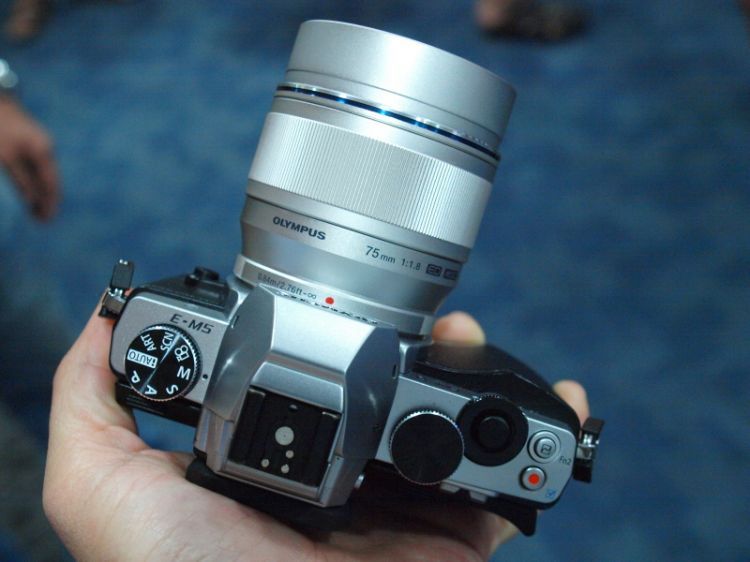
Our trusted sources already told us that Olympus is sending out the 75mm f/1.8 lens for testing. Now a new source said that the lens will cost around $799 and be released on June 18th! As you know Olympus states that this is the “highest imaging performance M.Zuiko” lens. So it’s actually better than the [shoplink 23576]Olympus 12mm f/2.0[/shoplink] and has the same price. Not bad!
As I told you a price like that is very good if you compare it with similar lenses like the [shoplink 30743]Canon 135mm f/2.0 (Click here)[/shoplink] and [shoplink 30744]Nikon 135mm f/2.0 (Click here)[/shoplink] and the [shoplink 30745]Sigma 150mm (Click here)[/shoplink]!
Rumors classification explained (FT= FourThirds):
FT1=1-20% chance the rumor is correct
FT2=21-40% chance the rumor is correct
FT3=41-60% chance the rumor is correct
FT4=61-80% chance the rumor is correct
FT5=81-99% chance the rumor is correct
193 Responses
If Olympus’s claim turns out to be true than this is great, especially at this price point. I might wait for it while saving any coin for it right now.
You will enjoy it with your new E-M5!
hey Alberto! 🙂
nice
And how does the price compare to
Canon EF 85/1,8 USM? Either it is a 75/1.8 lens and you compare it such, or you compare it to lenses that give the same look. i.e. a 150/3.5’ish lens.
Oh not again! It’s 150mm f/1.8 in terms of fullframe! Aperture remains the same! It’s only the DOF that corrisponds to f/3.5.
Don’t mind the canikon trolls who are jelaous since canikon doesn’t make anything worth mentioning beyond overpriced and oversized FF gear.
–wrong reply button… dam that happens a lot —
I’m an m43 owner and fan but like it or not, Mattias’s logic is sound. Admin’s… not so much. Both lenses give more or less the same FOV and speed (assuming one shoots the Canon on an APS-C body) so comparing an m43 75 and a FF 85 does make sense. And the former costs twice as much. So no: at $799 the 75mm is not a great bargain.
A 150mm equivalent lens with F1.8 of light gathering ability at $799 is NOT a bargain? The Canon EF 85 f1.8 is indeed a nice lens, but the focal length is totally different at 35mm equivalent and it is also one of the easiest lens to design and make. It’s not really comparable to a 150mm lens.
HAVING TO READ ARGUMENTS ABOUT EQUIVALENCE FOR THE BILLIONTH TIME IS SO FREAKING AWESOME U GUYZ
You don’t have to read it.
Comparing it to Canon 85mm F1.8 seems fair. IQ better be good to justify the higher price, but street prices are bound to reduce the difference.
What is good for the goose is good for the gander. If you start using equivalent focal lengths, also use equivalent f-stops. It is like converting the nominal value of your assets from the U.S. Dollar to the Hong Kong Dollar but keeping your debts in the U.S. Dollar.
Awwww… but my bottom line is so much more attractive that way! Where is Bing Crosby when you need him “accentuate the positive, eliminate the negative”
The focal length is NOT totally different. Put the Canon 85 on a 7D and it’s a 136mm lens. 14mm difference in focal length, $410 difference in price.
No, not only DOF. It’s not relative aperture (F-stop) that counts, if comparability is to be achieved, but the absolute aperture. And a 150mm f/3.5 lens has the same absolute aperture as a 75mm f/1.8 lens. Comparability includes light gathering ability, too, so everything else is cheating.
Not cheating, it’s the advantage of a smaller sensor. So when doing the price comparison, Admin might always say, look here guys, the advantage of the smaller sensor.
The only advantage of the smaller sensor is that there can be smaller and lighter lenses, but only if they gather less light. If you want comparable image properties to that of larger sensors, you need even larger and heavier lenses for the small sensor. Which is why the Voigtländer 17.5/0.95 is larger than the Voigtländer 35/1.2, even though the 35/1.2 still has a light gathering advantage on a full frame sensor.
No, it doesn’t.
Stick a CV 35/f1.2 on an M9 and set the aperture to f1.2, the shutter to 1/500″ and the iso to 200.
Stick a CV 17.5/f0.95 on an EM5 and set the aperture to f1.2, the shutter to 1/500″ and the iso to 200.
The images will show EXACTLY the same exposure (assuming that both bodies have shutter speed and iso calibrated properly). Open the 17.5mm up to f0.95 and the EM5 will display a brighter exposure.
Simple as that…
+1
But the noise is not equal…
But edge sharpness is not equal either.
And?
Only if the pixels are bigger, not if you have a 32mp ff sensor.
Try this at iso 100. O no i forgot iso starts at 200 with the OMD…..lol.
Oh no! The M9 doesn’t have ISO 100 either. (M9: ISO 160-2500, but can be set to ISO 80 “as a pull”).
But ISO 200 on the M9 would be much better IQ (if it had a competitive sensor) than ISO 200 on the EM-5.
The advantage of the smaller sensor is that you can shoot at the same ISO value with a more compact and cheaper lens than with a FF camera & lens?
Sure, but you get a noisier image. Get a real compact and get even more noise and and even more compact lens.
The advantage of a smaller sensor…. my iPhone 4S has a lens equivalent to 30mm f/2.8. Now would you say pictures taken with an iPhone rather look like 30mm f/2.8 on full frame or rather 30mm f/16 ?
I think that makes it clear, that equivalence in f-stops is not as trivial, as some might think. Even though it might not be as obvious with a 4/3rds lens like the one above!
How is getting the same exposure time on a 75mm f1.8 lens on 4/3 as with a 150mm f1.8 lens on 35mm “cheating”?
Oh, wait. It isn’t.
Please stop muddying the waters, because in reality for photographic purposes it’s really quite simple. For exposure purposes, f1.8 is f1.8 no matter what damned sensor it’s in front of – DoF is another matter entirely.
For photographic purposes, you need to use two stops higher ISO with a four times as large sensor to get a comparable result, so you will get the same amount of light, the same DOF, the same shutter speed and roughly the same combined yield of resolution and image quality regarding noise.
Tell us how much more comparable, if the photographic result is what counts, it is to compare different levels of light gathering, different depths of field, different levels of image quality/noise.
Exactly – as you say, the larger format will need to use two stops higher ISO to maintain ‘equivalence’ in your comparison. But if you use the same ISO for both (as any sane person would when comparing them), then F1.8=F1.8, regardless of format. For F1.8 on 4/3rds to equal F3.5 on FF, then ISO 200 on 4/3rds has to equal ISO 800 on FF. I don’t know about you, but I’d much rather use an E-M5 at ISO 200 than any FF camera at ISO 800 – you’ll have better IQ, and a much lighter and cheaper package too. Full frame trolls constantly cite equivalence as if it favours larger formats, but if anything, the opposite is true.
Funny thing: Hubertus B didn’t say that the ISO performance for the E-M5 should be compared with the ISO performance of an FF at 4 times higher ISO number — if his point of view should be meaningful.
Why would “any sane person” compare the same ISO setting? Because it would mean “equivalence” to him to be forced to compare depths of field different by two stops, amounts of gathered light different by two stops, and sensor performance different by roughtly two stops?
>I don’t know about you, but I’d much rather use an E-M5 at ISO 200 than any FF camera at ISO 800 – you’ll have better IQ, and a much lighter and cheaper package too.
Lucky you. I only have a G1/GF1 to shoot with, so in my case I would rather shoot my FF camera at ISO800 when maintaining “equivalence.” The aperture/FL comparison assumes similar tech at the sensor level, so anyone using an OMD is going to have an advantage over previous generation FF sensors – but probably not a D800 (by the looks of it).
Since when does the same exposure on m43 and FF gives you even remotely the same IQ?
So: Basically, you are saying that for a fair comparison, the m43 needs to have 2 steps wider aperture in order to gather the same amount of light on the sensor/pixels? For practical purposes, doesn’t this imply reducing the ISO number by two steps?
Example: an FF lens with aperture 1.8 should be compared to an m43 with aperture 1.25? (1.8/1.2^2). But if the ISO of an FF camera is set to 6400 for correct exposure, won’t you then have to set the ISO of the m43 at 1600 for correct exposure?
If so, do you actually say that the ISO performance curve of the E-M5 should be shifted two steps to the right when comparing it with an FF camera?
I kind of see Hubertus’ point. If you’re comparing lenses in terms of price/value, then it makes sense to look at how difficult they are to make. Regardless of format, a lens with a focal length of 75mm and a maximum aperture of f/1.8 will require elements of at least a certain size, which will be fairly similar to the size of elements required to make an 85mm f/1.8 lens.
If all other things were equal (which they never are — quality of glass, quality of barrel mechanics, complexity of the optical design, volume produced, etc.) then lenses of similar specs should have similar manufacturing cost.
I think that’s what he means: if you want to decide if the Olympus is a good value, you should compare it to lenses that theoretically would have similar manufacturing costs. So if you compare to the Canon 85mm f/1.8 — which has been around for a while and which is made in larger volumes — then the Olympus lens seems more expensive.
Of course the rest of us are more interested in taking pictures, so we’re comparing to what other lenses might let us make the same kind of picture on cameras of different formats. On a “nostalgia format” 36x24mm camera, we’d need a 150mm lens to get the same framing, and we’d need an f/1.8 aperture to get the same shutter speed at the same ISO. So for us, it makes more sense to compare to what other lenses would give us the same field of view and the same shutter speed at a given ISO. There aren’t a lot of such lenses for larger formats, and they’re quite expensive, so when you look at it that way Admin is right in saying US$799 would be a favorable price.
But if you put it that way, then all you care is the FOV, shutter speed and ISO. What about the look (i.e. distortion, DOF, etc.)? Those aspects are as important as well (dare I say more important). I understand the merits of m43: mostly small/compact and decent IQ. But to compare m43 lens to a full frame is always an orange-apple thing; it is ridiculous to do so just to justify for the price. There is no 12/2 on a full frame camera, but in 24 equ. you can find a cheaper FF 24mm that is sharper and has less distortion than the 12/2 at equ. DOF. And one can’t compare this lens to a 85/1.8 either; mounting this lens on a FF camera would not give a 75 FOV. Mounting the 85/1.8 on a m43 body would, however, yield a “similar” focal length. But m43 user would whine because of the size. With m43, you lose quite a few things but you do have the small size (and recently decent AF and ISO performance). I would take it for what it is.
zzzzzzzzzzzzzz. Wake me up when this boring rubbish is over. I suspect people DO NOT CARE!
If people didn’t care… I suspect the discussion would have ended a long time ago, not get rehashed every time an expensive “equivalent” lens gets released.
Manufacturing cost? Talk about a moving target! The claim takes things way overboard — or is that your intent?
@RAnger 9: Absolute correct.
The other discussion about DOF etc. is bean counting. Just to simple and stupid. For example: there are big physical differences in the ability to collect photones depending from the sensor type. Live-MOS is better/less noisier then CMOS/CCD and BSI is much better/less noisier then Live-MOS. So the bean counters should regard that as well in their simple thougts.
If you center crop a 36M FF picture to 16M 43 size, then your lens changes and the cropped image gets darker?
No, it gets noisier.
I agree equivalency discussions are tedious, but if you’re comparing lenses across formats, they’re hard to get around. The basic idea of equivalency is sound, though: That a 135-format camera needs a two stop larger focal ratio to get the same depth of field as the four-thirds, and for that they need to bump up the ISO or the shutter time accordingly. The general idea is that this disadvantage to the 135 is balanced out by better noise performance and a higher diffraction limit than the four-thirds. This gives the 135 the advantage of a larger “gamut” of EV, but with the disadvantage of the bulk and weight of the larger system.
And while equivalency can make sense in a photography perspective, it makes little sense when discussing the price tag: That is only determined by demand. If there are no other lenses that gives you a 75 mm/1.8 autofocus lens for the micro four-thirds, Olympus can pretty much price it the way they see fit.
In this particular case, I’ve been saving up for this lens for a bit already, and I’m pleasantly surprised at the price, regardless of what equivalent lenses cost for other systems and formats.
–
Why in the world noisier?. Crop is crop nothing else.
If you use a smaller part of the sensor you get less light, and with less light the signal to noise ratio suffers.
And remember in this equivalence- malarkey a crop isn’t just a crop, since the point of the exercise is to figure out how to capture two identical images (same field of view, same depth of field, same shutter time) on two different sensors. If you crop, you change field of view (obviously) and you change depth of field (not so obviously, but since you change the level of magnification that translates into a change of depth of field as well).
So, in this context mr. E-1 crops his 135-format full frame camera and his 50 mm/2 lens takes an image that he would need a 100 mm/4 to take on an uncropped sensor. But to do that he would need to bump up the ISO two stops and that would balance out the extra noise he got from cropping the sensor in the first place.
Macz: I see crop as something you do in post-process, you seem to discuss from a more theoretical point of view. Normally you use the sensor you have.
With a D800 you can shoot different formats, including DX. That is nothing but doing a crop already at the sensor. Has nothing to do with exposure, nothing to do with lens you use. It will simulate a DX sensor, but DOF and exposure will be tha same as if shot FX.
When I used a EP-1 and a D300 in paralell I never experienced what you are describing. Exposure was the same + more noice in images from the EP-1 than from teh D300. -And more (longer) DOF on the EP-1
By the way, love your photos, Kylberg.
Yes, it is tediously theoretical, and your are right that the exposure is the same with two lenses with the same focal ratio, but the point of the equivalence game is to try to take identical pictures, i.e. with the same depth of field, with different sensors, and for that you have to have different f-ratios.
If you play along with the game and try to take identical pictures, with the same field of view and the same depth of field, you need two stops smaller aperture and two stops more ISO on your FX than on your m43.
In regard to your D800 example, I’m feeling I’m going out on a tangent, but the depth of field does actually change with your crop. We probably won’t see it when we’re pixel peeping at 100%, but depth of field isn’t a fixed physical property that’s only connected to focal length and focal ratio, but it’s highly dependent on the magnification. By cropping “the digital negative” you end up needing more magnification, and thus the depth of field gets smaller. Which is really another property of the smaller sensor that most people seem unaware of. For example, all the following gives you the same depth of field:
50 mm/4 on a PEN
50 mm/2 on Nikon D3
25 mm/1 on a PEN
This is only really useful knowledge when using legacy lenses with dof-markers where you need to remember that if you’re using it at f/8 you should use the f/4 markers to estimate your depth of field, but it serves as another example at how even when the physical dimensions of a lens stays the same, the end result is different when we use it on differently sized sensors.
I think most people are a bit bored by equivalence-talk, myself included, but I find it isn’t really fair to just disregard it and go “50 mm = 50 mm, f/2 = f/2” While this is undeniably true, it’s not really a practical assertion from a photography point of view.
+1 🙂
dont say aperture…say t-stop..its more accurate..
So starting dof at 3.5. Nice for a price tag of 799…….lol.
Just something you have to live with handling a 43 camera.
Yes, that’s life, just as the back pain from 5kg FF systems.
@ Adriaantie
Yup you right ,. DoF 3.5 ,.. But in tele lens equiv of 150mm ,.. Do you understand ,.. How shallow the depth of field it would be ,. Plus With the F stop of 1.8 which is imposible in FF camera.
Get this idea; We have 150mm of equivalent FOV in a small and lighter package and DOF 3.5 and the shutter speed value of 1.8 which is imposible to happen even with my Nikon 70-200mm F 2.8 VRII. And this is Prime lens and probably it has Excellent Sharpness @wide open
Hubertus is right, a 75/1.8 has a front diameter of 41mm. It gathers as much light as a 150/3.6 (also 41mm diameter).
A 150/1.8 has a front element of 83mm, it lets more light in. Where would the light be lost or invented if they were equivalent ?
If you put the first on a E-M5 and the second on a 5D :
– in one case, you concentrate the light of the smaller lens on a smaller surface, giving a certain illuminance on the sensor. Lets say this gives you a middle grey at 800iso.
– in the second case, you spread the light on a 4x bigger surface, but as you have 4x more light you still get the same illuminance. So you also have an 800iso middle grey. But the quality is equivalent to 200iso of m43 (logical : you got more light from your lens !). For 200iso on m43 you would have needed a 75/0.9 (83mm front element).
Or look at it the other way :
– take an EF 85/1.8 (or 100/2), put it on a E-M5. It is longer than the 75/1.8 for the same aperture. So has it magically become comparable to a 200/2 ?
Why insist on doing these wrong comparisons ? Small formats have enough virtues without that, don’t they ?
I know I’m not the only one sick of the endless regurgitation of the equivalence argument. Don’t know about you guys, but I chose m43 because I also wanted something smaller and lighter than FF, I don’t want “equivalence”. Strange that none of my exposure meters have ever had a film format or sensor size setting – it seems the same exposure is correct for all sizes!
“Either it is a 75/1.8 lens and you compare it such”
Lecture us about ‘comparing as such’, yet you compare two completely different systems as if they were the same.
Comparison with 135mm is reasonable in terms of the role that the lens plays within the system.
Comparison with 85mm is reasonable in terms of cost to build.
With the canon 135 f2 going for a little over $1000 and the canon 85 f1.8 for $400, The price seems perhaps a touch high. As a new lens that still has fixed costs to recover, $600 is probably the absolute floor.
Your comparison is too simple. According to tests/claims, e.g the Zuiko 14-35/2 is pin sharp wide open,while e.g the Canon and Nikon 24-70/2.8 need to be stepped down to around 5 to achieve the same sharpness.
Let us see what the reviewers say for this lens.
> Comparison with 85mm is reasonable in terms of cost to build.
This is the one factor in the “equivalence” discussions that I think most people don’t think about. I would tend to agree with you. ie. A 75mm F1.8 lens should cost a similar (if not lower) amount when compared to a FF equivalent. I always hear people on forums mention that the glass is the expensive part of a lens, so it should follow that a significantly smaller lens should be considerably cheaper to produce. Even though the lens would have most of the performance and attributes of a 150mm F1.8 FF lens, it doesn’t feel right that we should be paying a hefty premium. $700 for the 12mm/2 or this 75mm/1.8 in m43 seems quite expensive. I know I personally can’t justify buying at those prices, and I’ll just be hoping for prices to drop, or for a second hand deal to come up. I’m sure I’m not the only person who bought into the m43 system as a cheaper alternative to a FF system, and I’m slightly disappointed to see that is not necessarily the case so far.
Price has nothing to do with cost. Price is determined only by what buyers will pay.
In order for the manufacturers and retailers to make a profit, price has to be higher than cost, so they are not completely independent.
That said, they surely charge what they can, I agree with you on that!
I know and I agree. Clearly a lot of us m43 users are tricked by the equivalence factor into thinking that our lenses are fairly priced. ie “This 75mm f1.8 is excellent and is equivalent to a 150mm f1.8 lens, therefor they are worth the same.” I guess to some that’s true, but I prefer to think that the price I’m paying is at least somewhat related to the cost of manufacture.
Just to further illustrate what I mean, I’ll extrapolate to FF vs medium format. A quick Google (I admit I know next to nothing about medium format) seems to indicate that a 50mm lens on FF would be equivalent to an 80mm lens on a medium format. So I had a quick look on B&H for an 80mm medium format lens. There’s a Hasselblad 80mm f2.8 that costs $2,595.00 I’m pretty sure that nobody in their right mind would think that a 50mm f2.8 FF lens fairly priced at anything close to that, no matter the quality. That’s because we all know that, for various reasons, the bigger format costs more, and that’s accepted. It’s also a major reason why far more people shoot FF than medium. Why then, do we not also demand that m43 lenses should cost much less than their FF equivalents? Just sayin… 🙂
The high cost of Medium format has more to do with the considerably smaller market place for it, design and manufacture therefore has to be covered by a smaller number sold, simple question of economics there.
Oh but it is much cheaper, it’s not cheap, but it’s much cheaper.
Unfortunately photography can be an expensive hobby, you did buy into a cheaper system, you could go for a high grade P&S if you want minimal expense.
You can’t just compare each lens with another lens because it is roughly the same focal length and aperture. Have you noticed that m43 glass is of very high quality? Would you compare the NEX pancake to any of the m43 pancakes? No, because the NEX pancake is rubbish and m43 pancakes are great quality.
Please, you’re getting a 150mm f1.8 for (possibly) $700, if you can’t sniff the bargain in that then you’re either new to photography or naive. Forget what you hear “people always talking about”, you’re talking about random people on the web saying whatever their opinions are, yes Olympus is making a profit from these lenses but they’re not stupid, they will have done market research, they will know how many they are likely to sell and at what price they recoup the costs and also make some money. It’s business.
> Have you noticed that m43 glass is of very high quality?
Granted, we do have some great primes now 🙂
> Please, you’re getting a 150mm f1.8 for (possibly) $700
But only if you’re thinking from a FF perspective… See my other reply above for what I believe to be a fair analogy (FF vs medium)
But anyway… I’m not trying to get anyone riled up over this. I do realize that m43 is great value for money, but I just can’t help thinking that we’re still being taken advantage of a little. If we all just accept that, then the manufacturers will just continue charging their premiums.
ps. I believe the Oly 45mm f1.8 to be a great lens and great value. I think Oly are charging a fair price for this one. But if you were to think from a FF perspective, that would be a 90mm f1.8 on FF, so should we expect to pay the same price? A quick search on B&H doesn’t show any 90mm f1.8, but some slower f2.8 lenses that cost even more ($50-100 more) than the Oly. This, to me, seems fair and how it should be.
EDIT: Just realized that all those 90mm on B&H are macro, which would be one reason they cost more.
Well what is a ‘150 mm f/1.8’? A lens that gives the FOV of 150 mm on FF and the exposure f/1.8 allows. Fine, but the same exposure on m43 and FF will result in clearly different IQ. I mean if I increase the ISO by one stop on FF, does this also makes my 150 mm f/2.8 lens into a f/2 lens? Because I am getting the same shutter speed as an f/2 lens would give me.
El Aura,
This is a flawed argument because ISO values are not concrete, aperture has a constant relationship camera to camera, ISO 1600 on the 5dmkii is not the same as ISO 800 on the EM5… in fact they are very similar. Sooo?
ISO will continue to increase to the point that it won’t matter any more, aperture will stay the same though.
I feel like you are trying too hard to knock a peg out of m43’s. The fact is a 75mm f1.8 acts like a 150mm f1.8 in my terms (and in most professionals terms) because we are talking about light gathering ability.
>The fact is a 75mm f1.8 acts like a 150mm f1.8 in my terms (and in most professionals terms) because we are talking about light gathering ability.
But in terms of light gathering, quantitatively, a m43 75/1.8 gathers only 1/4 the light of a 150/1.8 on FF.
Put simply, why would anyone bother with a $2000+ 150/1.8 (were one to exist) when they could simply crop their $400 85/1.8 to the “same image”? Is this just an issue of too few megapixels? Pentax Q + 50mm f1.8 vs a D700 + the legendary Nikkor 300mm f2.0? Saving yourself >$20k give or take.
Dzv
Just one point, A “ff” (35mm) 50mm lens is equal to about a 30mm lens on Medium Format, not a 80mm. An 80mm Medium Format lens is equal to about a 50mm ff lens.
I don’t think you’re being taken advantage of for the simply fact that m43 is not dominating the camera world, they are competing as hard as possible to dominate the camera world, therefore they will set reasonable price points. I come from FF and Medium Format, m43 is indeed much cheeper, please understand this, I know it is still expensive, but it’s at least 1/2 price for similar quality items.
Such a comparison would be difficult. Lenses are not only priced on their build costs, but also on demand.
Yes, but what about the optical design? Just because the focal length is the same, and the aperture is roughly the same, doesn’t mean they use the same optical layout. For example:
Canon FD 50mm f/1.8 – Double gauss design: http://www.mir.com.my/rb/photography/companies/canon/fdresources/fdlenses/50mm.htm#f1.8
Olympus 50mm f/2.0 Macro – Not a double gauss design:
http://www.four-thirds.org/en/fourthirds/macro.html#i_050mm_f020_olympus
-or-
Pentax 67 105mm f/2.4 – Double gauss design: http://www3.xitek.com/bingqiku/pentax/120lens/67lens/67-sdmtele-fig.htm
Nikkor 105mm f/2.8 – Anything but a double gauss design: http://www.kenrockwell.com/nikon/105mm-f28.htm#spex
This also doesn’t include aspherical elements and different materials (eg. ED glass) that might be used to achieve a different purpose. The 70mm is a mid-range telephoto lens on m43, the 85mm is a short telephoto/portrait lens on a full-frame Canon, so they warrant different optical designs.
Nope, DOF is not another matter entirely. For me, one of the main uses for such a lens would be portrait. For this matter DOF is at least as important as exposure!
If you want to use f1.8 on this lens, you will have a comparatively shallow depth of field. Meaning that when you actually compose a picture, DOF is probably even more important than Exposure time. Therefore it makes sense, to say this lens is equivalent to 150mm /f3.5 rather than 150mm /f1.8. As it behaves as such a lens in terms of what your picture will look like – as long as shutter times are fast enough to prevent blur.
It the aperture broken record…..LOL!
Yaayyyy! 😀
+100
Equivalence Nazis are on the March!
Today, micro four thirds forums, tomorrow… The World!
Sieg DOF, Sieg DOF…
Give it a rest. The War is over…
+divide by zero, times infinity…+1
Equivalence: Nooooooooooooooooooooooooo!
http://nooooooooooooooo.com/
@equivalence trolls: a 24-70/2.8 FF lens is equivalent to a 48-140/5.6 on some imaginary large sensor format. All FF users must be stupid to pay $/€ 1.400 for an f5.6 lens! LOL
+1000!!! 😉
+1000
Except that no FF ups the focal length in the way you illustrated. No FF user says his 70-200 mm lens is equivalent to a 140-400 mm lens (as it would be on 6×7).
+1.8
m43 butthurt oblige you will get a lecture on F-Stop and how 1.8 is 1.8, problem is DoF is the reason why people want faster lenses usually, of course light gathering is very important to keep ISO down and therefore noise but as far as distance to subject and DoF goes this is a 150mm 3.6 lens.
I also consider OP post misleading and wrong for making an equivalence on focal lenght but not on aperture, if you scale do it all the way or don’t. There are also reason to say that 75mm is 75mm and crop factor does not affect focal lenght and that 75mm + crop factor is not the same as 150mm. So if you say 75mm is comparable to 135mm than you have to say 1.8 is comparable to 3.6.
It seems to me some m43 users just want to convince themselves size does not matter.
150mm 3.6 is actually pretty good, the price is decent AND you get 1.8 light gathering ability… pretty sweet actually.
“It seems to me some m43 users just want to convince themselves size does not matter.”
It seems to me that you are creating a problem where there isn’t one and then you are concluding some weird generalization out of it to belittle m43 users.
I think that most MFT users know that size matters (both ways), it’s just that MFT fulfills their needs (for certain tasks, some MFT users also use other systems / sensor sizes).
@thisguythere: you forgot to say that in order for your idea to make any sense at all, Olympus should also multiply their ISO numbers by 4 before comparing with FF cameras. In other words, the m43 S/N, DR, etc, etc at ISO 1600 (current scale) should really be compared to ISO 6400 at FF. If this is done, the ISO performance of m43 becomes more than comparable to that of FF. Why don’t you say this? Could it be that you really are not that interested in truth?
If you check e.g the Canon G1x (http://www.usa.canon.com/cusa/consumer/products/cameras/digital_cameras/powershot_g1_x#Specifications), what do you say to their reference of a 35mm equivalence zoom range? Liers, too? What about other brands?
I was talking about focal lenght and aperture equivalence.
Don’t your panties all up in a bunch I was not comparing FF and m43 as a whole.
Actually, I prefer fast primes because I shoot in available light, often at night, mostly hand held, and don’t like using a flash. If there’s mo’ bettah DoF, that’s a bonus.
+100 and…. a lot sharper!!!!
Yes, it should be compared to the likes of canon 85mm f1.8. It will require a bit more distance and have a narrower FOV but the result should be very similar. However I would think this $700 Olympus would be a tad sharper and nicer than the $4-500 Canon
You talk like this price is already set, but FT2 says otherwise. Anyway i hope it’s true because that would certainly be quite a fair value. As if MFT didn’t have enough going for them already, more reasons and good news just keep on coming !
It’s not hard to be better than the 12mm. That’s a very average lens with only one extraordinary feature: a price that is more than double what it should be, considering the performance.
Time for your medicine ?
The 12mm is not sooo great. It is not better optically than a zoom like the 12-60 at 12mm, and yes, it is expensive.
Why would I need medicine?
The lens is expensive, it scratches easily, has an unprecedented amount of distortion and vignetting and isn’t that sharp to begin with (especially in the corners, where it’s on the level of a kit zoom). Overall not a bad lens, but at least twice the price it should be, given its poor performance and build quality. Also, no bag and lens hood, which is laughable. But as long as Olympus has fanboys willing to be milked dry, more power to them.
I have the ZD 7-14mm, the Panasonic 7-14mm, the ZD 11-22mm and the 12mm f2. Sorry to disagree with you guys, but the 12mm f2.0 is better than the three zooms at 12mm at all apertures, in the center and in the corners to.
It is an expensive lens (and the lack of incl. hood and pouch is insulting), but unless you have a bad copy, it is amazingly sharp (for a 24mm equiv) corner to corner when stopped down to f4-5.6. Much better than any competing lenses that I have tried.
Try a 12-60. It’s sharper, and it’s also a weather-sealed zoom built like a tank, for only slightly more than the 12mm costs.
I agree with you that the lens is overpriced. I don’t have a 12-60 to compare, but my copy of the 12 is very good. Maybe you got a not so good copy. If you check the blur index of both lenses provided by Slrgear.com, at f2.8 and f4.0 they are quite similar, but over f4.0 the 12mm looks sharper, not to much, but sharper. I use an E-P3, so for me the size is quite important, I’m not willing to carry a large lens like the 12-60, even if it were marginally sharper. I have the big monster 14-35mm f2, which is superb, but useless in the pen camera. You also have to consider that making a good 12mm f2 with the size restrictions they imposed themselves is not easy. But Ok, agree with you that the lens is overpriced.
According to the tests, the 12/2.0 is indeed not the top performer. I hope the 75/1.8 will be as good as the 45/1.8.
The 12/2.0 is good but the 45/1.8 is better. That’s true. Also, its more fair to compare it to the 45, since both are tele lenses.
Don’t forget, it has that manual focus doohickey, too! Nice feature, but yes it’s overpriced. For a little more you can get a 7-14mm.
yeah…I think that the 12mm is overpriced ESPECIALLY with he $100 extra lens hood. Love the lens…but it should be $600-$700 including the lens hood AND a $2 lens bag (there is none). Still REALLY love that lens. Small, sharp and plenty fast enough for my needs.
I forgot about that special lens hood… hand crafted by naked virgins, gently washed in unicorn tears and sprinkled with fairie dust. It’s Kosher, too. 😉
The 12mm + the $100 lens hood costs about the same as the 7-14mm.
Yes Mr. Reeee, This is the exact reason why I bought the 12mm 😛
My 12mm lenshood broke from normal use!!!! There is a threaded insert that the “tightening knob” threads into on the hood to tighten the hood to the lens. The whole insert, knob and everything just popped off in my hand one day when I was putting the hood on the lens. I was told that there are no warranties on Olympus Accessories but I sent it in to Oly USA and said “look…this thing cost $99 and it has received moderate use for 4 months so I think you owe me”. Thankfully they saw it my way…but I have not received the fixed or a replacement unit yet. So I would warn other users …tighten gingerly. Your insert may pop out too. LOL!
Maybe they didn’t use enough unicorn tears on my lens hood?
I try not to over tighten it. They could have made it tougher IMO.
Unicorn tears LOL
My dealer gave me a Panasonic lens pouch with the 12/2…
I use a wool sock to carry mine, it works very well.
if 75mm 1.8 is four times expensive that 45mm 1.8 and not sealed, waiting also four times better image quality.
Perhaps. But as Amazon charges $399 for the 45/1.8, I am wondering why you think the 75/1.8 would cost $1599?? Admin’s rumor suggests 2 times more expensive.
The 45mm f/1.8 is $400..Therefore popo if the 75mm is 4x as expensive it would be $1600? I think you may have a calculator on your digital phone……..check the math.
Me personally…I am thinking WOW!, a sharp, fast-focusing, fast-f/stop, prime lens, small (for the aperture it offers) and all metal. $800 ..looks like a winner to me. Olympus’ sharpest MFT lens so far, did you say?????…
Now…is the lens hood included or are we charging an additional $100 like for the 12mm lens hood? (the thumbscrew inset on mine broke, by the way and Oly is honoring a fix).
Also…I will not make a purchase until I see some reliable tests on the lens. Non of this pre-order stuff for me. 🙂
Interesting formula. Is that an “equivalent” price? 😉
well played, sir.
Yes, to correctly calculate price you must consider that there is a 1 stop money equivalence as well. So if it’s $800 the the actual equivalence in full frame money is $1600.
But this does not affect doctors, lawyers, etc. who have full frame money gathering abilities. (But they prefer Leica Monochromes anyway.)
LOL! VERY FUNNY!!!! …… this forum has become nutz, lately!
To all those Canikon drive by squads:
Canikon comparisons do not make sense to me. What does make sense to me:
1.) Is the lens very good (between 45/1.8 and 50/2 quality)?
2.) Based on the quality, is the price worth the quality for me?
3.) Do I use a 75 (150) lens?
What would be relevant for me, if Canikon produces a comparable system with comparable lenses, because I’m not in for m43, I’m in for the small size for very good quality reason.
The 75/1.8 sounds to be a fine lens. For myself, however, I am much more looking forward to the 60mm Macro. Is there any rumor out there concerning release date and price?
Ive seen this talk of DoF and comparisons before and it always leaves me confused. Can somoene give me an unbiased account of what 75mm f1.8 means on a m43 compared to a full sized sensor. thanks 🙂
Damn where have you been lately,..lol
Great news ! I’m going to get it .
I expect the IQ on par with four third standard .
Hopefully it will be even better .
Hubertus,
Are you the same tool in this thread? The guy who goes by Sunlyte Studios?
http://www.flickr.com/groups/micro_four_thirds/discuss/72157629493226732/
Good grief.
Let’s see how it performs before we decide whether or not it is overpriced.
And let’s see what the street price ends up being too.
+10 on both counts.
It’s nice to see more good primes appearing instead of more middling zooms!
..er…power zooms.
“highest imaging performance M.Zuiko”
Sharper than the oly 150mm f2.0 ? It would be nice!
The 150 is not M.Zuiko, it’s just Zuiko 🙂 That “M” bit is still making quite a bit of difference.
Sold all my Canon bodies and L lenses to put my money in m4/3.
Looking what I did with my 24-105L shooting concerts and theatre, the announced Olympus is around 4x times more powerful for a reasonable price.
I can’t wait for the test and review, to check if it performs well wide open !
Anybody seen the lens schematic for this gem? Is it like a Leica APO-Summicron 75mm/F2.0?
I’ll stick to my Carl Zeiss 85 1.4!
They will lose customers by not selling these prime lenses in black color. Silly Olympus…
My only question is when can I get it pre-ordered?
I don’t care about these silly price comparisons with FF lenses. For those of us who use m4/3, it’s a must have lens!
To be absolutely fair, why should one 75mm/1.8 lens cost more than another of equal quality just because of what kind of camera it plugs onto? Minus the upfront costs of course, but the costs of making the glass should be totally independent of what kind of sensor it sits in front of, right? Is there really such a premium on manufacturing one type of mount vs. another?
I’m enjoying my E-PL2 so far, but it seems like people are willing to put up with a higher costs for these types of lenses vs. other formats just because they’re micro 4/3.
What am I missing here?
2 Neil> the thing you are missing is called image circle. the larger area the lens is supposed to cover, the more glass you need. Try to compare the size of some old 50 mm lens for 35mm film with 50 mm lens for medium format. And while the dimensions of the lens increase with the second power of image circle diameter, its mass increases with the third power. Also it is progressively more difficult to work with bigger and thicker glass pieces.
Another thing to take into consideration is the economy of scale. As somebody pointed out above – the m4/3 lenses are all new designs and their manufacturers want to recoup much of their development costs while they can. If somebody else enters the market a year from now, they can cut the price considerably and still make nice profits while their competitor can’t do the same thing.
Just guessing, but I would say coverage and resolution. Bigger sensors require everything to be bigger, which can increase material costs: more glass, bigger motors,… Smaller sensors require higher absolute resolution, and tighter quality specs in production. Seems to be a wash in practice, although newly released MFT lenses are more expensive than similar focal length FF lenses released in 1992….
+1000, absolute agree.
I think it mostly comes down to r&d and low production numbers (compared to Cannon or Nikon). Whatever the reason, I don’t think we’re getting ripped off (as neither Panasonic nor Olympus have been flaunting the incredible profits of their m4/3 divisions to shareholders).
You are only looking at production costs, that is the problem.
You, and a lot of other folks in previous threads are missing, that it’s not just about DOF, but also about absolute resolution: The sensor is much smaller, so to get a sharp picture, the lens has to be much sharper than an equivalent full frame lens that addresses bigger pixels.
A lot of my old full frame glass that works quite fine in full frame lacks resolution when used in MFT.
For me – who considers the Oly 45/1.8 the first fixed focus lens any MFT user should by, even before thinking of the Pana 20/1.7, which has fine optical qualities but slow autofocus – the 70 mm sounds interesting, yet rather expensive.
However, let’s just see how it performs.
“people are willing to put up with a higher costs for these types of lenses vs. other formats just because they’re micro 4/3”
Not necessarily true. I think m4/3 can provide decent value for the money. My Oly 14-150mm is cheaper than any Nikon/Canon/Sony branded 18-200mm. The Pany 7-14mm is cheaper than the Canon 10-22mm (by list prices) and the Oly 9-18mm is cheaper still. It’s a decent UWA to WA lens (if you don’t mind the soft corners) and I got mine only for $500 from BestBuy. My fav lens, the Pany 20/1.7, lists for $400 but I paid much less than that. Not expensive if you look at the Canon 28/1.8 and Sony E 24/1.8 to have a similar FL on APS-C. The Pany 25/1.4 is about the same price as the Fuji 35/1.4 but not even half of a Canon/Nikon 35/1.4. My 4th lens, the Oly 45/1.8 is similar in price as a FF 85/1.8 but cheaper and brighter than the Nikon/Canon 60/2.8 for APS-C.
Yes, some m4/3 lenses can be expensive, but I think m4/3 is reasonably priced in general while having better than average optical quality (like the 45/1.8).
That said, Nikon and Canon had an advantage of having APS-C for much longer, resulting in much lower selling price than the listing price. However, Nikon/Canon haven’t really been as prolific as Panasonic/Olympus when it comes to bright cropped lenses – Nikon makes 4 DX specific lenses with f/2.8 or brighter and Canon only makes 2 EF-S f/2.8!
Man, so much good gear coming out. Can’t keep up.
…
The lens looks terrific! When is the 60mm F2.8 Macro coming?
Jesus, how come so many people don’t understand basic photographic principles.
A 75mm f/1.8 lens set to f/1.8 will produce the same exposure NO MATTER what sensor it is throwing the light on. A 75mm f/1.8 full frame covering lens with an indicated exposure of 1/1000s, ISO200 and f/1.8 would also mean that if you have a 75mm f/1.8 4/3rds lens on a 4/3rds body would also have a correct exposure at 1/1000s, ISO200 and f/1.8. The pixels of both sensors will have exactly the same photon count.
The only difference, other than size of the lens and imaging circle, is that the depth of field is different by a factor of 4, for the SAME field of view. So a 75mm f/1.8 lens on 4/3rds has the same depth of field as a 150mm f/3.6 lens on a full frame camera, HOWEVER, the depth of field is the same as a 75mm f/1.8 lens on full frame. The difference is that the field of view is half that on 4/3rds compard to full frame.
I’d also like to add that the smaller sensors needs much sharper lenses than FF because the absolute pixels are just smaller.
>The pixels of both sensors will have exactly the same photon count.
If you are comparing a 48MP FF camera with a 12MP m43 camera… but there is a 4x greater photon count per pixel with a 12MP FF camera vs a 12MP m43 camera at any given f-stop.
And the sensors are not equal: Live-MOS reaches more photon count at the photodiode then CMOS and BSI hast the most. Developing M43 was also a decision taking into account the possible photon count by format(directed light) and the new live-MOS sensor.
So the discussion on DoF is theoretical bean counting.
Overpriced micro 4/3 lenses are why I’m looking at moving onto the rumored d600 entry level full frame. The decent Panasonic and Olympus lenses are a rip off.
I might also get the rumored D600 in addition to my MFT kit, but I do not think that MFT is a rip off (my kit):
E-PL2 €250 used
20/1.7 €300 new
45/1.8 €250 new
Canon FD 135/2.0 €200 used
I will get the 12/2.0 next, they go for around €500 used
So you have everything between 24-270mm covered in f<=2.0 (<=4.0 for equivalence trolls, but then don’t tell me that in addition to my lenses being f4, the FF sensor has another 2 stops of advantage) in a compact package for €1.500,-.
Where is the rip off?
LOOOOL
Uh good luck with that.
You cant compare DOF with just a sensor size. You have to look at the whole system. If you compare an E-5 with 35-100 2.0 you can get less dof than a 7d 70-200 2.8 and the 7d sensor is larger so it isnt all about the sensor its has to do with the system in general. People for get if you have a larger sensor but it is still cropped you have to back up to achive the same focal length. When you back up you gain dof. Olympus was smart in making their focal lengths match FF crops. Yes e-5 has more dof than FF but if your comparing price you have to compare the 7d which has a cropped sensor but uses the FF lens focal lengths.
M43 primes are prime time for people/portrait shooting. 25/1.4, 45/1.8, 75/1.8. Good stuff!
On a Panasonic body with no stabilization the 35-100/2.8 Panasonic seems like a much better deal to me. Of course we all know that Panasonic products won’t be available in the US for a year after the announced arrival time.
RE: sensor sizes, FF equivalents, and aperture
Comparing a lens between systems is best done as the Canikon trolls insist, but with the light bonus included either as shutter speed or ISO. It’s not always about thin DoF. For me I’d prefer a 50/2.8 with a 2 stop light bonus over a 50/1.4 on a Full Frame.
Sounds great! Admin, has there been any word if the 60mm macro will be released at the same time?
Or are they going to stagger it so they can make the “best image quality to date” claim about both lenses?
Not sure yet 🙁
The real question for me is will it be worth giving up my Canon FD 85mm 1.2 L for this. I’m not sure it will just for auto focus and a bit of size/ weight savings.
I have the FD too.. for video I wouldn’t upgrade, but for stills the advantage of autofocus is too good to compromise. This 85mm 1.2L lens is amazing.
Thank you for giving me a headache!! Just use your damned cameras and stop bitching about DOF. 4/3 is 4/3 so deal with it.
I wouldn’t give up my 7D for a fullframe because I would lose the reach. DOF on the 1.6 crop is great because I can shoot wide-open. If you shoot portraits just get a fullframe and if you have a crop just get a telephoto to get the bokeh you need.
On pricing, I think it’s very good for an all metal construction. Go check how much the Zeiss sells for.
Exactly.
There’s also a Voigtländer 75mm f1.8, designed for portraits, for $715 at Camera Quest. Add a $25 Leica M mount adaptor and it’ll still cost less. There’s even an older Voigtländer 75mm f2.5 Color Heliar (L39 Leica screwmount) you can still get new for $489. Both are all metal, too.
@ BobB…. You KNEW I had to toss in a Voigtländer reference somewhere, right? 😉
No naked virgins and no AF on the Voigtländers. No way!!!!!!!! LOL!
And what a shame. 😉
I got a Voigtländer 75mm f2.5 the other day, BTW.
It’s small and light, with excellent color and smooooth… it came with a really nice lens hood, too! AND it’s black, so not only will it match my GH2, but my camera bag, shoes and belt! Fabulous! 😉
Thank God my camera bag, shoes and belt are all silver!
Can you fly, too? 😉
I think Olympus should concentrate on making FAST (focus and aperture) top-quality 25mm and 17mm standard lenses (in black).
Yes I know PanaLeica 25mm, but for my new OM-D I don’t want to spend a lot for a rattling lense and pay for unnecessary OIS. This lense is made for Pana not Oly.
And I also miss a fast top quality 35 eqv. lense. A big miss in M4/3 system IMO.
What’s more important, matching your camera or fast? 😛
I guess you missed this lens…
http://cameraquest.com/voigt_m43_17.htm
Forgot: with AF. Matching my camera AND fast.
PanaLeica has no OIS. Rattling is hardly a problem on the EM5.
This focal length seems odd to me, never used 150 on ff and I don’t shoot around 80 on my mft. Really sexy looking lens, if I was loaded I would buy it just to have on my shelf.
This lens on the OMD will be a great combo!!! I can’t wait to own this lens!
Crop factor is not this difficult to understand, people!
It’s this easy:
This is a 75mm F1.8 lens, with the equivalent field of view on a FF of 150mm. The equivalent DOF on a full frame of 150mm F3.6. Yet, with the light gathering ability of F1.8. OR…it’s exactly like having a 75mm F1.8 on a FF, but then cropping down to a 4/3 image size in post.
The advantage can work both ways. If you want ultra thin DOF, it’s easier to obtain on a FF camera. However, one could argue that 150mm F1.8 would be too shallow of DOF on a FF. In some instances, you might want more in focus, and would then stop down to, let’s say, F3.6. Once you stop down, you would compensate with either the shutter speed or bumping up the ISO.
It has been my experience that the 50mm & 150mm Zuiko lenses are just the right amount of DOF at F2. The out of focus highlights are perfectly round, not octagonal like a closed aperture. Sure, ultra tight DOF is fun, but if you’re taking a picture of a drink for a magazine, you want more in focus than an edge of a lemon. A 50mm F1.4 on an Olympus even, is too shallow in this case. I stop that thing down to F2 and then wish I had the Zuiko on instead.
Plus, with the HG Olympus lenses, there’s no need to stop down for more sharpness. They are incredibly sharp wide open.
Yup these are two things that are often overlooked. On m4/3, the widest aperture is nice and sharp and there is no need to stop down. Also, when it comes to a fast telephoto like this, or the upcoming macro – the wider equivalent DOF is an advantage of the format, not a shortcoming. It will allow you to have enough of your subject in focus to actually tell what it is, while also being able to take advantage of a fast shutter speed/low ISO in lower light.
Finaly I got it, thanks!
Man….I guess i need to stop reading the comments….its just full of people replying and arguing about the equiv and dof. Pretty stupid….
+1.8 too many get caught in a useless discussion trap.
What with the stupid equivalence nonsense.
A 75mm f1.8 is a 75mm f1.8. If you want to talk about price, try to find another 75mm f1.8 (or close). Some 85mm can be compared, for example. Are they totally sharp at full aperture ? The 45mm f1.8 is, not many 50mm around that price can claim the same. I think we can be confident that the 75mm will be of the same caliber. $700 or $800 for a totally sharp 75mm @f1.8 ? hell yes.
boycott – price too high unless this is the greatest lens ever created. olympus marketing = shenanigans
If 800$ is right price on 75mm F1.8 lens is this a good price. 😉
75mm doesn’t hold much interest for me at the moment. Why isn’t this lens weather sealed to go better with the EM-5?
Make a new faster and optically superior 17mm and I’m all over that.
Probably because it will get much more indoor use than outdoors in wet weather.
Equivalence schmequivalence. If this lens turns out to be tack sharp from corner to corner at f1.8, has fabulous bokeh and colors, never flares and has a transmission that is beaten only by vacuum, then I’ll gladly pay whatever olympus charges for it. If, on the other hand sharpness is average, colors wierd, bokeh uneven etc. Then I’ll consider $800 a ripoff.
Ahh, a Nikon user who moved from canon! Go on take the step.
I wouldn’t mind if Olympus would release a 17mm F1.4 (an AF lens of course) instead of a 75mm F1.8… 🙂
$799.. Oh a little expensive though
Can we expect a price will be down a year after released?
Say 20% off 🙂
Bullshit.
Olympus is suicidal if they stick to $799 for a 75mm f1.8 lens.
EM5 is good compact body with amazing technology bundled together. $999 is still expensive.
But a fairly easy to make 75mm that charges 799 US f* dollar? I do not buy it.
Pricing lens at a protruding price just for identify oneself from others? Sorry, Olympus just do not have the L* charm.
excuse me but what do you mean with the L charm? While i have some good experience with the 85 L, my 300 L 2.8 from job fell apart into 2 separate pieces because the construction unscrewed itself. Even Canon makes BS charm.
Well, I’d suggest to leave that up to Olympus. It always boggles my mind how many people think a company would be suicidal, just because they don’t understand a product or price point.
I would rather not assume that the „Leica charm“ is something Olympus puts into the equation.
If they manage to sell it at the price, the price is right, and if they don’t get the numbers they expect, they will looking into a price reduction.
$799 is a perfectly great price for a high quality lens. I realize MFT fans aren’t used to quality optics or the prices associated with them, but frankly, $800 for a large aperture moderate telephoto, assuming it is a top performer, is a great deal.
The very best lens in this class, the Sony 135mm ƒ/1.8 Carl Zeiss, costs around $1800.
And if you think a 75/1.8 lens for MFT is just a smaller version of a 75/1.8 for any other larger system, you’re wrong. In order to perform well on these tiny sensors with tiny pixels, it has to be even sharper than usual, with better aberration correction than normal.
Sounds like a great lens!
let´s see what people can do with it instead of pure speculation 😉
i cant wait for the 75mm, with my style fashion and portrait photography and videography this lens will be my better half! i love reading these comments and upcoming info on the 75mm! i already have money in my paypal ready to go!!
////dslr move out of the way micro 4/3 is taking over////
ps. can the 4/3 haters please stop blogging comments on here. the negative energy is really getting to me. if you dont like (scared to try something new) the 4/3 stick to your dslr blogs and stop being so nosy and comparing these zuiko lenses to lenses you need a gym membership to shoot with. stop being a hater and fighting against the inevitable! this evolution will eventuate in the same comparison as film and dslr.
the old dog will always be defeated by the newer and fitter young dog! thats life accept it ‘hombres’