









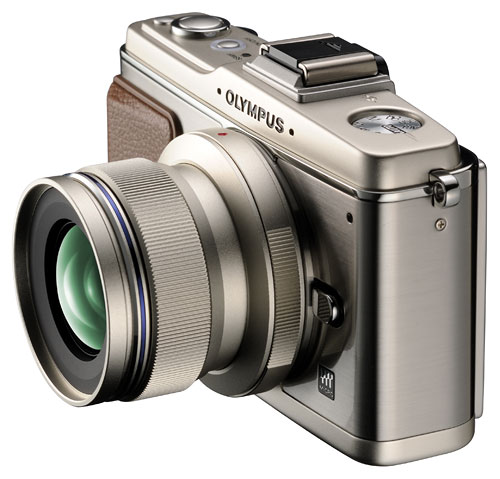
The rumor:
Some of my sources read your comments and sent me some of the answers you were looking for. The Olympus 12mm f/2.0 High Quality lens should cost around $800-$850. It’s not exactly cheap but this lens is supposed to be the first ultra-high-quality lens from Olympus. It should be just a bit less long than the mockup lens Olympus showed in February (see the image on top). Filter size is 46mm. As you know the production of the lens began in April and the lens will should be in Stock a short time after the announcement on une 30th. The lens will be made in Tatsuno. it’s the plant that realizes the high quality lenses from Olympus like the crazy expensive and crazy high quality Olympus 300mm f/2.8 ([shoplink 22138 ebay]Check the scary price on eBay[/shoplink]).
The second news is that the 45mm f/1.8 lens is not a MACRO. I guess that it’s ok for a lens that costs 299 Dollars/Euro only!
I guess we have now plenty of awesome new lenses for our Micro Four Thirds camera. If I could I would buy all three new lenses, the 12mm f/2.0, the 45mm f/1.8 and the Leica 25mm f/1.4! By the way, preorders of the Leica lens are still available on Adorama (Click here) and BHphoto (Click here) notifies you when the lens will be in Stock.
So let’s start a poll:
[poll id=”70″]
Reminder -> Rumors classification explained (FT= FourThirds):
FT1=1-20% chance the rumor is correct
FT2=21-40% chance the rumor is correct
FT3=41-60% chance the rumor is correct
FT4=61-80% chance the rumor is correct
FT5=81-99% chance the rumor is correct
145 Responses
Everytime I see this mockup and the silver E-P2 (japanese only I think) I fell in love with it. It looks so damn great.
Sören said: “. . . the silver E-P2 (japanese only I think) . . .”
Could be, yes? I’ve got the “silver” E-P1, – bought in Thailand. Don’t know if it’s rare or not. Looks damn great, no matter what. 🙂
E-P1 in silver is normal, the E-P2 in silver I only saw during my stay in Japan last year. Never saw a silver E-P2 in Europe.
The E-P2 in silver is no big deal in sweden at least. But a E-P2 in silver with brown leather grip is japan only.
Admin,
Still don’t know whether the 45/F1.8 is a high speed lens or not, do we?
If it‘s not a high speed lens, it means that – unlike Panasonlic – Olympus wants to preserve high speed focus only for those who can afford pro quality (thus expensive) components.
I really don’t know that yet. Have some doubts it will but that’s just my personal feeling. I have many doubts:
1) Will AF on older lenses will be faster?
2) Sensor: Is it a completely new designed or just Panasonic tweaked sensor?
3) Price of the PEN cameras
Hmmmmmm
What did the sources say about the new sensor, does it show an improvment in DR?
No idea yet, just marketing blabla.
I’m glad to know that our irreplaceable Admin has literally the same question as I do. And the same view on the “marketing blabla.” 😀
It really has to be the high speed AF. I mean, none of the bodies launched now is particularly high-end, so that must surely mean that the HS-AF will be available on less expensive equipment too. Maybe not on the entry-level models but the 45/1.8 is hardly entry level (kit zooms are).
The price IS entry level.
Just think about the ordinary 14–45 panasonic kit lens which is hardly a professional one and costs a bit more than 300$.
300$ for the 14-45 is a joke. Who will buy a kit lens separately at all? There just isn’t a market for it, which means the price is arbitary.
The 45/1.8 might not cost much more but it contains a lot less parts than the kit zoom. So it’s cheaper to make. Furthermore, beginners will hardly buy a 45 mm prime when they’ve already got the kit lens. So in that sense it’s not an entry level lens either.
Actually, the 14-45mm is the best and sharpest M4/3 kit lens.
It also has OIS built-in, with an on/off switch, so toggling it on/off is a snap.
I still want to hear about the 12-50/60mm lens Panasonic is supposed to release at some point.
The 12mm f2 sounds great, but I guess I’ll just have to settle for my 7-14mm on the wide end. 😉
I still want to hear about the 12-50 as well! Should be a killer lens. BUT! One of the main attractives of m43 at this point for me is size, and the availability of high quality primes in 24mm, 50mm and 90mm FF equivalent…something i can’t have for my 7d, as canon has not bothered to create those.
A small 3 lenses kit and m43 is a killer combo for travel / street.
Yes. If you’re willing to go manual, there are some fantastic small, fast, sharp lenses.
Lenses that use the Leica M mount, like Voigtländer primes, are especially appealing because the adaptors are so much smaller than Nikon and Pentax adaptors, about 9mm vs. 25mm or more. The M42 to M4/3 adaptor makes a small lens like my Pentax 50mm f1.4 Takumar look much longer than it is (40mm up to 70mm±).
It depends on if that beginner has a photographer friend or not. I have a friend about to buy his first interchangeable lens camera (the G3), he asked me how to take portraits with blurry backgrounds. I told him if he doesn’t like to manual focus then buy the Olympus 45mm after it’s released. He now plans to do just that.
Or…he could buy a 5D Mark II and a Canon 85mm f/1.2! 🙂
The 14-45 is the most highly sought after std. zoom for m4/3 with excellent sharpness and contrast, probably better than any other kit zoom offered by any other company for any system. They get $300 because they’re no longer being produced and the demand is greater than the supply. It’s the fastest focusing lens that I have for my PEN and I’d want more than $300 if I ever sold it.
Lumix G 14-45mm is surely the best m4/3 standard zoom, making it crazy why Pana discontinued it without at least offering other high quality standard zoom outside kit but there were quite a few optically superior standard zooms in “predecessor” system without need for many different software corrections to start with. (Oly 4/3 standard zooms from 14-42 to 12-60 were all parts in various kits)
The 12/2 should be a masterpiece. It looks like one of those lenses that keep for 30 years. I’m getting one.
Hopefully the pictured lens is the lens Oly will release. It is a gorgeous lens and hopefully it will come in black too. Olympus seems to have the fashion statement going on but that doesn’t help them…we need the inner guts of the cameras to be great & not just the outer shell.
It’s focus by wire. That’s a lot of faith that the focusing algorithms are still in use 30 years from now (or even 10 years from now).
It’s a wide angle, so it doesn’t really need AF at all.
You can’t FOCUS IT AT ALL without the focus algorithms. There’s no manual connection to the focus ring. You can’t manually focus a focus-by-wire lens. The ring sends an electronic signal to the camera that moves the lens. If that algorithm isn’t recognized by the camera, then there’s no focus.
I suppose it’s possible the 12 isn’t focus by wire, but I would be very surprised.
(side note — what is this myth that wide angle lenses don’t need AF? At 2.0, taking a picture of a close subject, I sure as shoot want AF)
“You can’t FOCUS IT AT ALL without the focus algorithms. There’s no manual connection to the focus ring. You can’t manually focus a focus-by-wire lens.”
That is a common mistake. Focus-by-wire lenses support manual focusing.
“side note — what is this myth that wide angle lenses don’t need AF? At 2.0, taking a picture of a close subject, I sure as shoot want AF.”
Well, I can easily focus the Nokton 25 wide open. A 12/2 should be a piece of cake.
Well, to each their own. Who am I to say if you like to MF 🙂
Playing with the 20/1.7 and the 14-140 right now, and the focus elements do not turn when I turn the focus ring (this is detached from the body). Unlike, of course, my EOS or takumar lenses.
Are you saying that as long as the lens has power, it will focus? How do you know for sure? I am open to being wrong here. Just wondering if you can document the claim, which would put me a bit more at ease about investing in these lenses.
Also, as someone else noted, it could be an SWD or other lens — which would be welcomed.
Focus by wire is electronic, it needs power to work, you need to mount the 20/1.7 and 14-140 to an m43 body and set the body to MF or MF-AF to see it works. There is no mechanical link between the focus ring and the focusing mechanism inside the lens.
“The lens incorporates Olympus’s ‘focus-by-wire’ system, whereby the manual focus ring is used to drive the lens’s AF motor electronically (as opposed to being mechanically coupled to the focus unit).”
http://www.dpreview.com/lensreviews/olympus_50_2_o20/
i thought this was common wisdom; focus by wire only works when the lens gets power
I thought so too. That focus by wire has no direct mechanical coupling.
I was just looking at the lens reviews on dpreview. I noticed that the Oly 4/3 50mm macro was focus by wire. I also looked at the 4/3 12-60mm SWD lens:
http://www.dpreview.com/lensreviews/olympus_12-60_2p8-4_o20/
See the paragraph starting with
“This lens also sees Olympus finally adopting the now near-ubiquitous ultrasonic motor for focusing, here dubbed the ‘Supersonic Wave Drive'”
It says that this can allow for mechanically coupled focus ring unlike previous lenses which were focus by wire.
Direct quote there from dpreview hope thats allowed.
Now I know the 12-60 is a phase detection designed lens. But I wonder whether any Oly designed high end lenses for micro 4/3 will have a SWD system which allows for mechanical coupling or whether they will be focus by wire? Any ideas? I would prefer that.
I worded my question poorly —
OK, when the lens has power it focuses, but what if it ONLY has power, and no other communication with the body? Will it still focus then? That is, does the turning of the ring cause the focus to change with maybe an on-board micromotor, OR does the turning of the ring communicate something to the body, and the body tells the lens how much to focus in/out.
If the former, than 10 years from now, the lens MIGHT still work, as long as there is a backwards-compatible power point. But if the latter, then the camera ALSO has to speak the language of the lens.
At any rate, this is a far cry from, say, using an all-manual Takumar from 1972. Plus, on those older lenses, you could disassemble them and rebuild them. Not so easy on lenses with green boards.
My whole question is this — will these lenses still work on bodies 20, 15 or even 10 years from now if they need a specific power setting at a specific point and especially if they get focus commands from the body. To me, that would impact whether I’d spend >$1,000 on an m43 lens. $300-500, sure. No problem. $600-900. Hmmmm… let me think about that. >$1,000 — not so sure on that.
Add to that their reduced image circle (so you can’t use a $900 12/2.0 on a Canon or Nikon DSLR, but you can go the other way).
Look at all the expensive 43 lenses that sure look like the may be obsolete in as little as 5 years from now.
good point.
i don’t have any idea about that.
I can understand your worries, but if it were true you can still use any “obsolete” ft cameras, be it used ones or remaining stock.
This should all be covered by the micro 4/3rds standard. Of course whether there still will be cameras being made that adhere to the micro 4/3rds standard in 10-20 years is a different question. Just like will there new cameras made that support Canon EF-S and EF format, or Nikon or Pentax? 10-20 years is a long time in this business.
How do you know? Could also be coupled as in the SWD FT zooms. A new AF system might also be better in addressing ultrasonic ring motors…
Focus by wire requires a response from the body – just gives the lens voltage does no good. Once clus is, if you notice in the hidden menu there is a function to reverse the direction of the focus ring.
Well…you forgott it is just plastic…
Maybe it’s just rhe type of image I do, but isn’t a 45mm MFT (90 35mm) prime non macro prime an odd lens? Portrates maybe? Just asking.
I think an inexpensive portrait lens is important for m43. Think of all those family shots for those family types (like me!)
Nope, an 85mm portrait lens equiv. is pretty much a necessity for any system. It’s hard to believe Panny/Oly have waited this long to make one. Any person that has ever taken a head and shoulders portrait (doesn’t everyone do that?) should be interested in this lens.
As far as the non-macro, perhaps I’m in the minority on this one, but I’m glad it’s not a macro lens since macro lenses tend to focus slower. I don’t do much macro work, but when I do all it takes is a $30 extension tube and a $50 manual focus lens to do the job. That’s the exact set up Thomas Shahan uses and he’s the best macro photographer I’ve ever seen:
http://www.flickr.com/photos/opoterser/
awesome gallery!
+1 completely agreed with you on this!
There is already a 45/2.8 lens from Panasonic. So what is the beef other than price? Or as usual most people are too cheapskate to buy a good lens?
admin, any rumors received about the 12mm being weatherproof?
+1
What body would you pair with a weatherproofed lens? Has there been any rumor that any of the new bodies would have weatherproofing?
Could be that the Pen PRO will… but that seems to be an eternity away.
i find the question funny, because why needs there to be a weatherproof body first instead of the equiv. lens? the one or the other both implies that both will be part of the system.
+2
Actually if water got into the body, the electronics will be fried, so it’s a valid question. There are many holes/slits around body, not just the lens/body connection (e.g., if battery compartment is not water/drip proof, you’re done when it rains). Weather proof lens also implies there is no holes all around the lens construction, so sand won’t get in between lens elements when you zoom in/out, or focus.
Lenses are the true guts of photographic equipment. It’s true even today, despite all the hype about electronics. I suppose that to realize that one must be acquainted with quality glass.
well for weatherproof lens you need a waterproof body so if you going to atach it to any of m4/3 cameras it doesnt matter is it. But for this price maybe its a light saber who knows.
Sorry for being so sarcastic and overall negative about all of this for a while now but we need one leading OLY body wich will convert many DSLR users to system, and lenses will come more better and cheeper. For now they are just milking the cow. If they continue to release products like they are doing it right now without pro level i think they will dich the whole system and maybe even go to FF to pro.
A few things:
1. Weatherproof lenses will also work with future weatherproof bodies.
2. Alas, Olympus is not in the position to convert existing DSLR users (with the possible exception of 4/3 users).
3. IMHO Olympus is finally getting on track with those lenses. The more “serious” body is not quite ready yet, but it will come (perhaps in a few months – only guessing).
Agree, but its kinda inside out.
Actually i meet a lot of ppl wanting OLY just to use old FD, OM or M lenses and many of them who get it dich DSLRs. If they come up with better pricing and better sensors even advancsed DSLR users going dich that overweight stuff like d7000 or 60D.
True, but still overpriced. I found my Kit lens back element suffering multiple scratches fot keeping it in bag with both lens caps on, and as it champagne lens it got peels on surface from other lenses in my bag. now over f8 or f11 its unusable. Oly wants 100e to rapair lens (actually any lens repair is the same price) and i can get used lens for 50 to 60e. That’s just not the way to treat customers.
Btw they really need aperture ring and true manual focusing for video if they are interested in that section of cameras. And more and more videomakers are converting to DSLR video and also many Photogrphers want to explore videography. I think im not the only one who thinks it is like that.
Hopefully the lens is waterproof, as this would be a strong indicator that the future mFT-pro line will be waterproof as well.
thats why i asked…thinking the same here
Any more info about the size of the Olympus 45/1.8?
Not yet. The contact form isn’t working yet so maybe that’s why I dind’t get an aswer about that question. 🙁
Dont care much for lenses since the Lumix 20mm/1.7 came along. Just want an Olympus Mini to put it on…
Personal expansion to poll response :
— I’ll buy the Olympus 45/1.8 as soon as I can get my hands on one. A fast medium tele is a must-have lens for me, and the low price means I can afford one right away rather than having to save up for it.
— I’ll buy the Panasonic 25/1.4 as soon as I can save up the money. Until then, I can get by with my 20/1.7, but the slightly longer focal length and wider aperture of the 25 make it worth having.
— The 12/2.0 is a nice expansion to M 4/3, but I don’t need to buy one since I seldom use wide-angle lenses in dim light. Outdoors, the 14mm end of my kit lens is wide enough.
STILL MISSING IN ACTION: Two lenses that are an important part of any “serious” system but still not available in M 4/3:
— Wide-aperture (f/2.8 or faster) “standard zoom” — something equivalent to the big DSLRs’ 17-50 or 24-70 lenses. (Actually, 17-50 itself is a pretty useful focal length range on M 4/3.)
— Wide-aperture (f/2.8 or faster) “grenade launcher” — something equivalent to the ubiquitous 70-200 lenses for big DSLRs.
Yes, both of these would be bigger, heavier and more expensive than most M 4/3 lenses so far. But I won’t be able to ditch my DSLR boat anchor and go solely M 4/3 until these two holes are plugged.
+1 for the fast standard zoom.
All the recent activity is great for the platform, but this is the fundamental enthusiast lens for every decent system. You’re not a player until you have one…
u speek my language
Wide zoom 16-50 eqivalent
Normal zoom 28-70 eq but fast and not colapsible but small
as to a telephoto zoom im not interested. I hate big lenses, and somewhat dont see the point if youre not a pap. 🙂
each to there own but i wouldn’t be buying a fast zoom for m4/3 anytime soon, looking forward to the 45 and 12 and will order them asap as to me they represent the m4/3 ideal, of which the grenade launcher is the antithesis of. Also i never really see myself ditching the DSLR, sure i’m using it less now but on occasion the sensor size is just to much of a compromise on 4/3 🙂
Does this mean that oly won’t release a macro I.e. They will rely on their macro adapter. It was on their roadmap… Otherwise pana 45 here I come!
You can always use a 4/3 macro lens with adapter. You don’t need fast AF for macro anyway. I use the ZD 35/3.5 which balances well on the E-P1. For more range (and more cash) the ZD 50/2.0 is an excellent choice.
If I were Olympus I also wouldn’t care that much for a 50mm Macro lens, because these are avaiable everywhere as legacy glasses. The Minolta 50mm 3.5 for example is a sharp and cheap alternative. If Olympus offers a macro, than please a 100mm+ lens.
olympus thinks that this collection of glass is essentially the same price as a gh2 body? just because you slap SGH and “pro” on it doesnt change the fact that in theory this lens shouldn’t be that much more technically difficult to make. ergo the conclusions: (1) olympus knows people love this focal length, and (2) thinks that it can screw customers desperate for it by charging a $200-300 premium on it. haha, clever.
sorry, no question about it… wont be considering this lens at this price. since this is basically my favorite focal length i’ll have to take a closer look at sony or upcoming pentax/nikon offerings. thanks admin.
Actually what makes a Pro or SHG is more complicated than price. Pro (HG) in 4/3 means it must have distance scale and weather proofing, on top of that, better optical correction than standard grade, that’s why 70-300mm is standard grade (no distance scale, no weather proofing).
SHG, on top of all that, has constant aperture, and have obscenely high amount of ED and Super ED glasses inside. You won’t observe any visible distortion (which requires complicated designs and extra correction elements = more glasses inside), and optical resolution usually out-resolves any Olympus DSLRs…. They’re usually big and heavy because of those reasons.
i would just be happy to own a regular grenate launcher 😉
An 800-dollar-ultra-high-quality-lens for MFT? If this is true, there´s no other way than also to await a high-quality PEN body. In my eyes you can´t sell such a lens without offering an adequate camera. So I´m very very curious about 30th June!!!
I think the same. However it might be designed to be sold with the E-P3, like the dummy shows. For how much? 1200 as a kit?
It’s damn expensive and I should sell the 9-18 to finance it. Not sure I want to go through all the hassle.
In the back of my mind there is always the problem -what if in the future another mirrorless system becomes more universal?
OTH the SLRmagic ultrawide, might do as well, if you don’t need the lens for paid jobs.
hopefully Admin’s sources were toying around when they told him what’s coming out and left out to other specs too…I hope that the E-P3 is a Very High END Model 🙂
I’ll do something crazy. Not decide on any purchase now. Wait for tests and image samples and then see if and what and when. Just a minority vote.
I am joining the minority as well.
I had the impression that while miniaturization has its cost and complexity, the final effect of the reduction in size and weight under the m4/3 system would mean significantly lower lens prices in lenses compared to dSLR lenses.
While I can understand that m4/3 lens selection would initially be limited, I had expected that the m4/3 lens prices would be lower than dSLR lenses. This is not proving to be the case. And I need not even look at the selling price expected of the Olympus 12mm f/2.0 to complain.
Despite the smaller size and lighter weight of the m4/3 system vis-a-vis the dSLR, the soon to be available prime lenses such as 12mm f/2.0 and 25mm f/1.4 are providing to be as expensive or even more expensive than their equivalent dSLR lenses.
I recently bought a Nikkor 50mm f/1.8G 3-weeks ago. This is a full-frame lens yet I paid only $219 for this lens, a price significantly lower than the $325 I paid for the 20mm f/1.7 as well as the $345 I paid for the 14mm f/2.5.
Despite the bigger-sized glasses used in the Nikkor lens, the price of the Nikkor 50mm f/1.8G is lower at just $219. And this low price did not come at the expense of poor performance. This is a lens with an aspherical element, has good bokeh, sharp in the center at the corners even wide-open, has improved color and contrast, has fast and precise focusing, etc.). It even outperforms their earlier f/1.8 and f/1.4 counterparts when shooting at the same aperture setting. This lens represents great value and buying it was a no-brainer decision.
Despite the Nikkor 50mm f/.18G representing great value, I can still understand the value proposition of my Nikkor 200mm f/2.0G. Big, heavy and chunky, I understood and was willing to pay more for the 200mm f/2 despite the big price differential. The material cost of the glass and the enclosure alone and the limited manufactured qty ensured that the 200mm f/2.0 would be more expensive.
What I cannot understand is why an m4/3 lens which is far smaller than a Nikkor 50mm f/1.8G would cost so much more when its material cost and manufacturing process could not be much more and is likely even lower. Again, I understand that miniaturization will add to the cost and offset the material cost but this alone should not and cannot justify the current price of good m4/3 lenses when one compares it to the price of the lenses made for dSLRs.
Except for the 14-140mm that I purchased with my GH2, I am thus unlikely to pick up any new m4/3 lenses for a while to add to my 20mm f/1.7 and 14mm f/2.5 until I see a more promising outlook for the m4/3 System.
In lieu of buying the upcoming Panny 7-14mm f/4 OIS, I will just continue to use my Tokina 11-16mm f/2.8 with my Nikon D7000 or my 14-24mm f/2.8 with my Nikon D700.
I hope that this situation will change with the entry of 3rd party lens manufacturer making m4/3-specific lenses (rather than adapting dSLR lenses for m4/3). These firms will hopefully have a significant impact in lowering the cost of m4/3 lenses as well as expanding its selection of lenses.
except that the materials cost of a lens is a very small %, it you honestly believed that m4/3 lenses would be cheaper because they using a few grams less of plastic then you sir are an idiot. Do you tie your own shoelaces or are they velcro?
there is no need for such a strong language. Afterall we are here and comment just for the sake if someone is listening.
And all said in comments everyday it seems that we are all a bit frustrated with the tings that are presented to us. Being a product designer myself, i have a pretty much clear idea how much things cost in production includinf labor, and how much goes to profit at each camera unit and lens. It is a known fact that the lens are and always been expensive, not becouse a production and labor, but just becouse optics are really tough science, and not many people really know what it is all about. Yoey do you honestly believe that production automatization of the lens elements did not change an become easier during 100 years of mass production of cameras. If you do than you are living in ignorance. They are milking us freestyle. More plastic less qlt thats their moto. And when something is a bit better its by much narrow margin than before. look if you want good kit with 3 lenses other than included you nee body (350-800e) 20 1.7 350e VF2 250e 12 2 800e and like 45 1.4 500e wich comes at about 2000e (couse everything in Europe is much more expencive) That is just bolocks. And look at this Canon 600d kit, 50 1.4 or 1.8 28 2.8 and 430EX flash is cheaper than this, and you get 1.5 crop. So i ask Where is the LOGIC in that. Not to mention functions that only GH2 has but for more money. If they dont come up with some foveon m4/3 sensor they are done.
yeah… major internet tough-guy alert. $800? comparable NEX 16mm is approx $250 and I’m almost certain it is not 4 times as bad. granted it is does not say SHG, pro, olympus, and is not f2.0, but it is surely useful as a photographers tool. im not even trying to troll here, i’ve bought into m43 for about a year and had 4 lenses to boot.
the combination of available focal ranges and pricing scheme really illustrates how olympus and panasonic try to extract money from their customers. olympus priced this lens acting like the world just found out that 24mm equiv is a great focal range, and they just now want to take advantage of it… after 2 years? ridiculous
…you are right, except:
-it’s 3 time the cost not 4!
-1 stop faster in a pro lens is a
huge difference
-the 16mm f2.8 sony is probably the worse prime lens ever made…
-“the combination of available…from their customers”…take a look at the price of 45mm f1.8 olympus.
-the really bad thing is that we never have the very useful 30mm f3.5 macro prime…:)
@ Joey
Describing yourself while looking in the mirror? You painted quite a nice image of yourself there. 🙂
Don’t feed feeble-minded vulgar-mouthed posters like Joey. He does that to get the attention that he so desperately craved but missed during his childhood days.
shave off a few grams off the olympus 12mm then price it triple so stupid blocks like Joey will buy it
If Olympus is really going to charge at least $800 USD for this lens, then it will be finding itself sitting on dealer’s shelves collecting dust with the extremely overpriced Lumix 45mm f.2.8 macro.
But when you look what Olympus is charging for their crappy micro 4/3 consumer zoom lenses ($900 for the world’s slowest plastic 70-300? Really?), I guess $800-$850 for a decent lenses isn’t all that shocking.
As have been accurately pointed out, you don’t pay this kind of money for quality primes for FX or DX cameras, unless it’s the exotic f.1.4 stuff. That’s why this price doesn’t make sense. It’s even worst when you realize that Panasonic just released a FAST LEICA BRANDED lens for a mere $600.
Every single Olympus micro 4/3 lens is far more expensive than the regular 4/3 counterpart, and of worst quality. No wonder there is such a run on Panasonic glass.
I’m glad Olympus is getting around to producing the lenses that they should have back when the E-P1 came out, but they really need to learn to price things properly.
Olympius
@LGO
Pricing is a function of demand, not a function cost (for the large part). If the expected selling price is lower than the cost (just break even is a no go also), then the company won’t produce it at all. Companies do the calculation before they design the entire project, even long before they actually put something in production.
So while Joey’s words are rather badly put, he has a point. HOWEVER (don’t gloat yet, Joey, you need to wash your mouth no matter what), lens is not just plastics, but it actually contains… (*drum rolls*) lenses inside…. And those are the most expensive parts inside the lens…. That’s why Canon kit lenses can be sold for under $100, because the lenses inside are made of plastic…, not glass (plastics are full of distortion, do not bend light consistently, easily scratched, and won’t produce sharp image because of all that).
So if you could understand price is a function of demand, then ask yourself this question, how much money you’re willing to pay extra for a smaller lens, or how much you’re willing to sacrifice for the miniaturizing, and that’s the same questions the company asked themselves before they set a price. They’ll do a mixture of feature/price to come up with something that general public will accept.
12mm f2 is NOT a general public lens (how many typical people shoot in 12mm and 12mm only?), but for professionals, and pros’ requirements are not the same as general consumer. They’re more willing to pay extra money for marginal performance because they depend it to make money. Extra bit of sharpness may mean they could print the photo in 20×24 instead of 16×20 with the same 12mp photo and still get acceptable result. When you print photo this large, any CA and distortion will be more visible. General public usually don’t print anything larger than 8×10 (if they print anything at all), so they don’t even have to pixel peep for defects, and usually down size their 12mp photos to 3mp for online sharing…, which even a bad lens can make sharp enough photos at that resolution if you down sample enough.
So yeah, everyone has their own requirement, so if that little bit of better performance is not important to you, then you don’t have to buy it. In fact, you’d be better off buying a better body than a marginally better lens, if all you want to do is sharing photos online (which 3MP is more than enough. HD monitor 1920×1080 is approximately 2.1MP).
That said, Nikkor 24mm f1.4G is $2,068 on Amazon. Zuiko 12mm f2 is $800. Yes, it’s about one stop slower, and 1.5 stop loss of depth of field than the Nikkor on an APS-C, but Zuiko 12mm is a lot smaller. Do your math. When you compare lenses, try your best compare the lenses in the same class. Otherwise, why stops you from compare a PL 25mm with a Holga plastic lens?
just order as soon as you can, use it yourself and ignore what the measurabators write, if YOU don’t get on with it, unhappy with quality just send it back for a refund, started doing this a few years ago and it makes life so much easier 🙂
will the 45mm only be for m43 or will there be a 43 version too?
Fully agreed. The pricing for the m43 lenses is a big surprise – or disappointment. I can only assume that it’s due to smaller numbers produced – or simply a marketing observation on the manufacturers’ side that the current high prices bringt the most profit and shareholder value.
Supply and demand. M43 lenses prolly have lower material cost. However since the demand is much lower than the canikon lenses they have to sell them at higher price to make profits. Additionally, their initial fixed cost such as machinary and tools has not been recovered. Another reason they are still more expensive. Unless m43 market gets bigger we’ll not see the price reduction. (on the other hand if they give up on m43 the price will still go down:)
I’m sure the 12mm f.2 lens will be a very nice lens, but at $800 to $850 USD, it makes the 9-18mm zoom look like a bargain, and the 7-14mm seem reasonably priced. No 12mm for me, thank you. Now if it were a 12mm f.1.4, I might be interested…
Well, I guess I can also wait on Panasonic, and see what they come up with before the year is over.
Olympius
I agree. I think I will just go for the 9-18mm zoom – at least its wider as well. And then with the money I save I will get the 25mm 1.4 Leica! I think that would be a bit more useful for my photography but everyone is different.
Yes, your objection is quite natural. A number of us have reacted by using the system’s potential for easy use of legacy lenses, hoping that on reaching maturity native lenses’ prices would decrease.
At any rate for a top lens the introduction price is quite usual in the Olympus line.
Tough luck that because of the crop factor no ultrawide can be adapted, except fisheyes. The only exception being the Heliar 12mm, which is some 600 $ and two stops slower, perhaps about the same size.
I have the “legacy” Olympus 9-18mm for regular 4/3, that will hold me over for the time being, and perhaps well into the future. No need for legacy manual focus. And I don’t really need the micro 4/3 variant either, other than for it’s compact size.
Another option is the Panasonic 14mm f.2.5 pancake, but sadly, it’s IQ is no better than that of the kit zooms, but it is smaller, lighter and faster. Not even sure that lens is worth it’s $340 USD asking price.
Having purchased a 4/3 25mm f.2.8 pancake directly from Olympus a few months back, for a mere $200 USD, I’m not keen on spending more to get a lesser lens. That 25mm pancake does an amazing job, the IQ is very impressive, and it works great on micro 4/3 cameras, even Lumix, with an adapter. I would be very happy if Olympus came out with an improved version of this lens for micro 4/3, with a faster f.2.0 aperture.
Olympius
I have the old 9-18 too, and I don’t see relinquishing it, although I’d like a more pocketable. 9mm is simply too useful and sharp.
Consider also that as m4/3 consolidates other makers like Sigma or CV might want to introduce a cheaper 12mm, so it’s just a matter of patience.
There is a second important factor. With real multi aspect, when you shoot 16:9 every lens becomes 10% wider. If only Oly had such a sensor.
Finally IBIS allows to use the 9-18 even in a dark church, so a fast wide is really needed only for pro work.
The difference in price is due to quality. The 9-18 is nice, but not a pro level lens either in construction of image quality. I expect the 12/2 to be tack sharp and distortion free.
I have the 9-18mm, and it’s the best zoom I’ve owned – and I used to own the quite highly regarded 28-105mm Canon L zoom. Nevertheless, I’ll wait for the test results to come out for the 12mm; if it’s as good as the hype makes it out to be, I might get it, or more likely trade it for the 9-18mm.
My dream is to go all-prime, but currently it’s not a realistic goal with MFT – but soon it just might be.
I can see that the price is what you would expect for this lens. However, I would have preferred, and been much more likely to have bought, a cheaper 12mm f2.8 – that was priced substantially less than the 9-18mm. I used to have a 24mm f2.8 on my OM cameras which was one of my favourite landscape/architecture lenses. But for most of these purposes you don’t need f2. I can see a lot more reason for an 17mm f2 for indoor people and as a general-purpose fast lens – and anyway it would also have been much cheaper to make. So I think the line-up of primes from Oly as it is is a bit strange:
12mm f2 – very expensive even compared to 9-18.
17mm f2.8 – pancake (not good enough or wide enough to replace kit)
45mm f1.8 – good value lens (this is right!)
I would have thought better would have been:
a) 12mm f2.8 – lower cost and smaller alternative to 9-18.
b) 17mm f2 (or less) – medium cost pancake (similar to Panasonic 20, but usefully wider)
c) 25mm f2 – good value standard lens
d) 45mm f1.8 – good value lens
Hopefully fast focus versions of b) and c) might be in the pipeline, especially if d) is very successful. However, it seems unlikely the’ll now produce a) – so there is no way to get a good wide without paying more than the camera for it.
I very much agree with you.
A few lenses on my wish list:
– 25mm f/1.8 pancake at half the price of the Leica f/1.4 one
– 12mm f/2.4 pancake at half the price of the Olympus f/2.0 one
The lenses you list (25mm f/2.0 and 12mm f/2.8) would also be very acceptable to me if they were pancakes and reasonably priced.
25f2 is to slow for MFT, – same dof as the 20, no advantage,
but i would prefer a bit smaller PL25 – even at expense of slightly less quality
Just a minor correction, because I see you’re confusing “speed” with DoF. “Slow” and DoF are two different things. f/2 is same speed no matter what platform it is on. Under the same light condition, if you shoot f/2 @ 1/250″ on a m4/3, it’ll still be f/2 @ 1/250″ on a FF or medium format, no shutter speed increase/decrease is required.
But DoF is different due to flange distance. m4/3’s flange distance is shorter than that of FF and covers 1/4 of sensor size. It all has to do with much much light has to travel. DoF is determined by a combination of sensor-to-lens distance and lens-to-subject distance (exact detail I don’t remember).
Advantage of f/2 is it can be used under low light. So yes, there is an advantage. DoF is a double-edge sword. Depend on what you are shooting, shallow/deep DoF can be either good or bad. For landscape, usually you want deep DoF (that’s why lens’s performance at f/16 is more important than its performance at f2 at this application), for portrait, just the opposite (exception applies).
These two lenses indicate to me an advanced body is development. They also suggest such a body may be worth having. This is new territory for Olympus in the digital age. I could never adopt 4/3 due to the absence of high performance prime lenses. Is there hope yet?
admin, how soon will we have photos of the new bodies?
No idea.
Around June 27, based on the last few leaks.
Looking at the poll results, price does matter after all 😉
The new 12mm lens may be really good but 800-900$ for is just too much for a fixed (limited) focal length
Oky,
But so i look the, 12mm F2, a very good pub to pub or street by night lens,
and 45mm is protrait, tele and maybe macro to,
so combe 12mm, 17mm and 45mm is maybe not bad.
So Olympus has no macro lens in their range, and had a nominally 50 mm macro on their roadmap for this time of year and you are saying the lens is not a macro lens. Yeah… Okay… That makes no sense honestly.
Sounds like Olympus is damned if they do and damned if they don’t. We need to make up our minds because most often Olympus is criticised for releasing duplicates of panasonic lenses rather than filling the gaps in the line.
If you want a macro lens, there is already one offered in this exact focal length. I would much rather have the option of either a macro lens and a reasonably priced portrait lens, then having to choose between two, expensive macro lenses in the same focal length. Based on the panasonic’s price for a f2.8 macro (a sufficient aperture for macro), what would Olympus charge for a f1.8?
Would you still have 1700 people on 43rumors who wanted to buy it?
I said nothing about what I wanted or what the market wanted. I am just saying Olympus said they would release a macro lens in the 40-60 mm focal range in Spring 2011… It is spring 2011 and there is a lens that is going to come out and it is a rumored to be 45mm and people think it isn’t a macro? Seriously? Why.
The fact that Panasonic makes one is pretty irrelevant, they don’t have any m4/3 macros at this time. It is an obvious lens to design… Something between 35-50 mm… There was a telephoto zoom from panasonic also doesn’t mean Olympus didn’t make their own… And the Olympus could be light, smaller and better, or just less expensive because it isn’t Leica branded.
My strong suspicion is that the 45 or whatever it is will be a macro, because it has been on the roadmap a long long time.
I didn’t mean to put words in your mouth, I was just commenting on your view that it wouldn’t make any sence for this not to be a macro lens.
IF the market doesn’t want it, then it would make perfect sense not to release a macro. Olympus has already been criticized for some of their buisness decisions, but developing a lens that will not be profitable “just because” they put it on a roadmap a year ago – would be absurd.
And the fact that panasonic makes a 45mm macro already is not irrelevant. If we were talking about a different focal length then it would be less-relevant, if we were talking about different non-interchangeable formats it might be irrelevant. But we are talking about swapable lenses used on both systems, in the exact same focal length, and both serving the same purpose (macro photography). Whether or not you believe there would still be a market for a second such lens… the existance of the Panasonic product is the very definition of relevance.
If Olmypus has gone back on their roadmap plans (as the price of this lens suggests – surely a “good” macro would be more complex and more expensive than $300), because they have decided that they would have more sucess selling a dedicated portrait lens (something we don’t have), with faster focusing, and lower cost… then I say good for Olympus. If you can be as popular as this announcement has been, and sell enough of them to keep you in the black – then do it!
The reason it isn’t relevant is that olympus wants the profits that Panasonic is getting. Sigma, Canon, Tamron, and Tokina all make what is basically a 17-50… Yes having the market to yourself is better but the fact remains it was on the roadmap along with a wide prime as a macro since last year for spring 2012… It should be a macro, which would you believe a rumor from an unknown source or what Olympus stated publicly?
Ya, but Sigma, Canon, Tamron, and Tokina are producing for a market that is massive compared to the numbers that Panasonic could expect to sell. And Olympus would be going after only a piece of that market. Olympus and Panasonic both released wideangles and sure, Olympus went a different route with smaller and more affordable, but without a fixed aperture and not as wide (or sharp). Doe you think Olympus could do the same trick here? Make a cheaper macro lens? Sure why not? Make a macro lens that is cheaper while STILL being faster at f1.8, AND having good enough image quality that Olympus could put their name on it without being embarrased? And do that while being a third or even half the cost of the panasonic macro? The Leica name carries a premium,but not that much of a premium.
Don’t get me wrong, it would be nice if it was a macro, it just doent sound likely.. at least not the lens that has been described.
It only said “macro” on the roadmap. I don’t think it said “50 macro” — and they released a macro attachment.
I, too, wanted a macro/portrait, but as someone else noted, just a pure portrait will focus much more quickly. So…. if it’s a portrait only BUT can also have a reasonable close focus, I think I’ll be happy. If it’s a 1m focus, though, I won’t be pleased.
We shall see…
http://www.43rumors.com/new-olympus-lens-roadmap/
Macro between 40 and 60 mm spring 2011…
I mean come on…
I don’t want to be an apologist for Oly. I wanted the same thing but in that graph they released 3 attachments for the kit lens — super wide, macro and FE. They are all there, so my guess is that’s what they meant. Again, I don’t like it any more than you, but that seems to be what they meant.
Yeah, but look at that roadmap. They released 3 attachments: ultra wide, macro and FE. I don’t like it either, but I think that’s what they meant.
It is pretty convenient that the attachments have lined up with the roadmap. However – how does an attachment fall into a focal length?
Secondly, the wide in the roadmap lines up with the 12mm f2. This would suggest that actual lenses were at least planned,
Maybe the 45 was going to be a macro. I am hopeful that this was a lens that wasn’t on the roadmap and that there are still other lenses coming including a dedicated macro.
It is a pity that a manufacturer can’t say what they’re NOT doing. If you’re NOT making a macro, then my money isn’t going to them anyway (at least not for that) – what do they lose out?
Will the E-P3 be sold with any of those lenses as a kit ?
I hope it will be sold with the 45mm!
Maybe E-P3 not buy in kit by normal zoom lens now,
but later after 12-50mm F2.8.
I voted for 12mm F2 (or faster) in many polls, because I want fast wide, so I’m going to put my money where my mouth is :). 800-850 USD ( 700 EUR ? ) is a bit steep, but I’ll wait a bit for the price to fall to say 600 EUR and to see how fast and how wide will be that upcoming Panasonic fast wide lens.
Nevertheless, after June 30th, m4/3 will be almost a complete system – if you count in those adapted tele 4/3 lenses that would be large anyway. Only fast ( video optimized ? ) normal zoom badly needed.
Miroslav, why do you need a FAST wide? I’m not being facetious, I really want to know. The way I use wide angles is either handheld during the day or on a tripod in the evenings, and neither of them requires me to go below f/5.6 or so. You’re not the only one who wants a fast wide – it’s clear since Olympus is actually making one -, it’s just that I don’t understand where the fastness is needed.
Ahem, I will be buying the 12mm f2, also. I need a fast wide lens for concert and event photography, where a flash is not permitted. f2 vs f2.8 is the difference between 1600 and 3200 ISO. And I refuse to use 3200 ISO, on the current sensors.
I would really like for this lens to be of high quality, without sacrifice for size or price.
well speaking for myself as a long time wide angle user (Canon 24mm Fd 2.8 back in the late ’70s, still have it to!) i want the control over DoF at least to the extent that you can in a lens like that and i shoot hand held all the time and chronically in low light. Fast lenses are about more than just low light you know
Low light, of course, not DOF. Two reasons I’ve written before, so I hope no one gets offended for repeating.
On my business trips, often the only chance to see a city ( and to photograph it ) is at night. Since I’m not in a photography related business, I don’t carry a tripod, so a wide fast prime is very welcome. Besides, here in Europe streets of old city centers are often very narrow, so wide is very useful there as well. Inside churches and buildings as well.
The other reason is round-the-table friends and family shots without flash. Again, rooms here are small and I sometimes end up in room corner in order to get everyone in shot :). I am aware that for this type of shots the lens will have to be stopped down a bit, to say F2.5, but it’s nice to have a choice.
Thanks, everyone. That makes sense, but it’s the kind of shooting I don’t do. But perhaps I will try it out when I get the 12mm 🙂
Exactly. Hauling a tripod kinda ruins the whole idea with making the camera small and light, don’t you think?
I don’t know where people got the idea that it has to be cheaper just because it’s smaller. It’s actually more difficult to make a small camera with the same quality as a large. Already Oskar Barnack discovered this. The tessar lens, which was considered very good for medium format, wasn’t adequate for his new 35 mm camera. So he had to start by designing a new, better lens. Then he could finish hs Leica camera.
If the image format is half the size, the precision of the lenses has to be twice as high. This has to be reflected in the price. So you must be prepared to pay something to save your back from carrying heavy equipment.
Absolute small lens is not easy and make, but Olympus have patenter on produce small lens to very good optical quality,
so for example, lens Olympus do in ZX1.
So if we look on SHG lens to Olympus is the very long way and go for Olympus by come up lens so very smaller 43 SHG lens is.
But,i think Olympus do the before Olympus be 100 year 😀
thing is they rarely drop asuming there is no competitor in sight. Even if there is they dont drop more than 10 to 20 p. Why i cant find any 20 1.7 for 250 tops, and its been a long time since announcement actually 2.5 years i think.
Hmm, didn’t 20mm F1.7 started at 500 USD?
I hear only lenses for m4/3, lenses 1.4, 1.8 but nothing for Olympus Dslr……. Dslr E-5, E-3, E-620 will be continue to have new lenses?????? or The Dslr department closed and exist ONLY micro4/3?????????????????????????
I am so sorry to have to tell you this, but the 43 folks really need to move on here. You’re only tormenting yourself.
@wt21 why don’t you say something useful?
And tormenting us m4/3 users, too! 😉
Olympus come now by the first HG in M43 (12mm F2), but Olympus say the will come but 43 later, but not soon.
did you sleep the last 2 years? lol
That a lot of money consider it is actually a 24mm lens, which is a borderline wide angle, 7-14 Panasonic is a better choice since it is much wider, and has OIS, that gives you 3 stops advantage. Is it all metal? for $850, it’d better be metal.
Olympus really needs to re-think their new products, making their M4/3 body cheaper and crappier is not the way to go. Panasonic is making a high end M4/3 version of L1, Olympus should too, until then, I’m keeping my E-P2.
7-14 with OIS? where? 😉
7-14 is @f4, so the Oly will be 2 stops better. Essential for church-,event-,night-shoots.
Yes, im one of the fews, that appreciate the f2.
For nature shoots, yea, you surely dont need f2 except you shoot at night. but for everyday use, f2 is far superior. There are lot of places out there, whre light is rare: in churches, temples, bars, clubs, even at normal shops, light conditions are barely good. And then, you will love the 2 stops advantage of the 12/2.
So: i will def. go for it!
The price on the high end lenses reflects the rarity, and not necessarily the quality of the Olympus lenses.
It just demonstrates what professionals have known all along, ever since AP tried using their products, that they are not serious in supporting the professional.
I plan to buy this above all other lenses. 24mm and 50mm (full frame equivalent) are all I want/need for this system 🙂 Thank you olympus! can’t wait to handle this one and see how it goes.
It’s funny when people bitch about price when in optics, you pay for what you get. Just in case no one has paid attention, the Zeiss ZM 15mm/2.8 goes for a whopping ~4600USD and it is the sharpest known 15mm lens for Leica M-mount. And it’s manual focus! People seem to forget that wide angle focal length lenses are more demanding to make than longer focal length lenses.
If you don’t like the price and the optical quality that goes along with it, and you would rather suffer lousier optical qualities, then go for the lousy stuff. No one is stopping you. Just quit the bitching and just quit the system.
+50.
My Nikon FM2 use Tamron 24mm f2.5 and I like the angel of view on wide angle.
If there have more reviews after 30th, I probably will more compare between 12mm and 9-18mm. It has the same situation on pancake 20mm f1.7 an 25mm f1.4.
I smell an ultra expensive E-P3 and twin lens set with the 12mm and 45mm. And it has my name on it. Nooooooo… >.<
LOL! Well, having a wishlist like that keep hope floating. 🙂 Let’s hope they’re as good as they are promised to be.
I’ve been weighing m4/3 as a lighter alternative to an APS-C DSLR for landscape photography. (D90, 10-20, 55-200vr) Or maybe as a digital version of an FM with f/4 wide prime and cheap telezoom. With the size and cost of the 12 f/2, I don’t think I will go 4/3 due to the marginal weight savings and cost. I was hoping this would be a f/2.8 or f/4 pancake type lens for around $300.
That being said, the 12 f/2 makes sense business-wise. Lens makers apparently don’t think cheapish mass market f/2.8 and f/4 fixed ultrawides will selll well. And I can’t say I can argue against that logic- I doubt they’d do well on sale at Best Buy. Rather, the hot ulrawide of the year is the 24 f/1.4, which as someone alrady mentioned is what this lens is aiming to replace. in that context, this lens is quite attractive.