







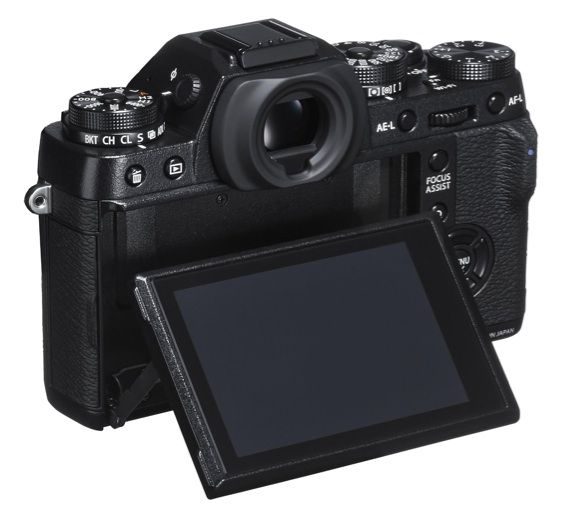
X-T1 in stock check: [shopcountry 21553]
_ _ _
FR-reader vortsg sent me the following article of Michael Reichmann over at luminous landscape here. Since I like unpopular statements, I’ll start by quoting the following one:
“It’s clear to everyone in the industry that the future lies in mirrorless technology.”
And here is what Michael Reichmann from luminous landscape says, among the others, about Fujifilm:
“Fuji seems to have been “thinking-out-loud” for the past few years, experimenting with novel designs and trying new technologies. Some are misses, and some are hits, but they certainly appear to have the cojones to try something new.
[…] Fuji, always a great lens maker, are also bringing out new X mount lenses at a fairly rapid clip, and offering the high-end market some interesting primes as well as bread-and-butter zooms. When combined with their innovative cameras this makes for a compelling sell, at least compared with some others.
One area where Fuji shows that they “get it” better than possibly any other camera maker in Asia, is with regard to firmware updates. Not only do they release regular updates for current models, to fix bugs and add features, but they even do it for older discontinued models. Some camera makers don’t even bother with bug fixes, and if they do, it is often months after these are well known before they become available. Nicely done Fujifilm!”
But Michael has comments to make on many other brands out there. The [shoplink 21555]Nikon DF[/shoplink] is called “Frankenstein“, the Hasselblad “a joke“, he talks about Sony’s “lens mount fiasco“… and what about Olympus, Panasonic, Sigma, Canon, Pentax and more? Read it here at luminous landscape.
And as always, feel free to make your own considerations in the comments. Is mirrorless really the future?
I don’t know what the future is, but the present isn’t looking good at all. Here are the figures of the CIPA (the Camera & Imaging Products Association) summarized in a nice infographic by lensvid here. Smartphones, the global crisis and the fact that Americans and Europeans still don’t like mirrorless cameras make of 2013 “the worst year for the photography industry in a long long time (maybe even decades).” (via Canonwatch)
image courtey: lensvid

36 Responses
Y’know, it wasn’t that long ago when Fuji gossip was all about how surprisingly great the Fuji X100 (and then the X-Series) was. And that was brilliant. It felt like being one of the enlightened few who knew the best-kept secret. Now it seems to be all about defending consumer decisions by slagging off the competition, and that’s just lame.
It’s actual market data….this has nothing to do with bashing the competition.
ironically enough I think that the high quality compacts like the X100’s and Sony RX100,s will have had an impact on sales of some mirrorless .
I agree with that, and I own a RX100 myself and love it. Ironically, the $ cost for the Sony at release was comparable to the entry-level DSLRs from nikon and canon. Which is really the core of what this is about to me. You have consumers who want competent cameras at reasonable prices driving the market in terms of overall volume, and once most have purchased a Nikon D3100/5100 and a kit zoom they’re set for a long time. The serious hobbyist / serial upgrader market is where these companies find a foothold for cameras like the xe-2 and XT-1. How many people on this forum alone have been chasing the next greatest thing from Fuji — buying an X100 then the Xpro1 and now the XT1 because each is “improved”? Or the XPro1 followed by a x100s and perhaps the xe-1 or xe-2, with a XT-1 on order now? How many are holding out for or can’t wait to buy the next update to the XPro1? How many will sell their XT1 to buy whatever comes next?
If consumers acted like “enthusiasts” there’d be no lag in sales volume for any format.
Those (like Al Downie and others) who want to blame the camera manufacturers for releasing new, improved, or cutting-edge products need to do a little introspective analysis as to WHY they feel duped, or resent so much that camera makers solicit pro photographers as spokesmodels for their gear.
The difference between a consumer and a “prosumer” is that specs only matter to a consumer at the Point of Sale — after that, it’s about taking photos. The prosumer isn’t taking photos as much as he’s waiting for the next best camera or lens to try out.
Considering economic conditions and the reported movement from compact cameras to camera phones it would be interesting to see these ones included in the “equation”, not only to read the figures but also to try to foresee the future.
More and more when I read articles from journalists that make statements like “It’s clear that…” I realize it’s not really clear, the writer is just trying to establish a point without bothering to first make a case. Kind of lazy.
In this case we’ve been hearing for six years that mirrorless will take over the world. We never hear this from DSLR or rangefinder cameras. Why the missionary zeal? It’s either a cult or a vendor-funded meme.
In this case if the writer was correct, shouldn’t we have seen a little bit of evidence that it is “clear” that mirrorless will take over? After six years? Instead we see mirrorless sales falling even faster than DSLR sales, and not a single mirrorless vendor ever making a profit on mirrorless. It may be clear that mirrorless is taking over, but it’s not clear to the market. It may be clear to web ‘reviewers’ who make money off links to camera retailers of mirrorless equipment, but it’s not clear to consumers who actually part with their dollars.
Disclaimer: I have a lot of mirrorless gear. I hope some of the manufacturers stays around at reasonable prices. But without reasonable prices, all the declaration of permanent success are going nowhere.
Guess mirrorless is not doing so well 😉 Aside from the obvious problem of price take a look at Fuji’s latest effort, the T1 – a great camera btw!
LL did a nice write up on one drawback of the new wunderkind:
http://www.luminous-landscape.com/reviews/cameras/fuji_x_t1_further_thoughts.shtml
But I give you another point of view – only a person who understands photography can use that camera. So what … well anyone can use a camera with a Mode Dial, just put in on the Green Square, or the People, or the Mountains. How big is the market for “DSLR” and “DSR like mirrorless”? And how big is the market for technical difficult to use cameras … well its probably several magnitudes smaller.
I would take a guess today that in a few months time all the T1’s that will be sold, will be sold, and Fuji will have the same situation that they have with the XPro1, the E1, the XF1 and so on.
In these X cameras, can you give saved setting custom names yet? That sums the situation up for me.
I think that a lot of the initial demand for mirrorless was fueled by DSLR users looking for a smaller lighter backup kit for travel etc with better image quality than their existing P&S offerings.. Though some did indeed jump into mirrorless fully , I suspect far more went no further with their DSLR kit being the “serious ” option and mirrorless for when weight is more important.
Looking at the price of some mirrorless gear especially some of the mFT options you can get better image quality for less money in APS DLSR land.
Admin, you are attributing quotes from Nick Devlin’s article to Michael Reichmann.
thx, corrected
With DSLR and Mirrorless sales well down, it’s not so much that Americans and Europeans don’t like Mirrorless cameras, it’s more probably due to economics. The Western economic situation is dire with the cost of living going through the roof. If you have already bought into a system, then it is my guess that people are going to hang on to what they have got for much longer than before. It may well be that it is the buying power of the emerging middle class of China and India that supplies the growth for manufacturers in the coming years.
One must bear in mind that Fuji is not even part of the market yet, in so far as the X system is concerned. It remains incomplete, and they are targeting professional and devoted amateurs anyway. Why do you think the X-T1 costs $1300? It certainly doesn’t need to. But that’s the price range of the competition for high end APS-C cameras and it is approaching the point of competing with low end FF cameras.
Now, I personally know *MANY* working professionals. They have a pretty scared mindset. They don’t want to put much risk into an already terrible business environment (photography). So they will just buy Canon. Sadly, even choosing Nikon seems like a step out of the safe zone for many.
But this is changing! There are thought leaders that many of these people seek out and obey. Fuji has garnered the support of some of the most important to the small photography business community. Zack Arias and David Hobby are two photographers that I can pretty much guarantee that all or nearly all of the large group of local professional photographers will not only know about but respect to a large degree. And I’m talking thousands of photographers. We have a ridiculously large pro photography community here largely revolving around wedding photography. (Heavily conservative + religious local culture = tons of weddings).
Anyway, more and more of the portrait photographers and even other types of photographers are beginning to endorse the Fuji X system in one way or another and it is gaining attention. In the discussions between this large group of working pros I refer to, there has never been any serious mention of any mirrorless system for professional use outside of videography (which has been and remains dominated by Panny) until the last year where more people are talking about viability of the Fuji system. But, there are still some hurdles:
#1) Probably the top hurdle is that Fuji has no real flash system to speak of whatsoever. This bisects the community. Many are into manual flashes and monolights and such, but, many are also very dependent on TTL flash systems with remote control. People want this. Fuji MUST deliver this and soon. If it isn’t a focus this year or next then I think they’ll merely lose most of the pro market for good.
#2) Battery life is a real concern that affects all working pros. On the plus side, Fuji has standardized on one battery for most of their cameras. This helps a lot as all serious pros must have backup bodies and it sucks to have different batteries. And the X-T1 helps here with the battery doubling grip. That’s a pretty good step. But, Fuji is probably going to have to put some of its engineering muscle into improving battery life. Pragmatic photographers will know you can just toss a few extra batteries in your bag and be good. Others are a little mores skittish.
#3) Video. Sorry… but, most working pros will have to do some video now. Fuji just doesn’t even register here. May as well not even have video. There is far too little control. It needs to be on par with high end APS-C DSLRs at least. Even if the actual video quality didn’t change, there must be more sizes and frame rates, more on-the-fly controls, and better AF performance in video.
#4) Shutters: Need QUIET shutters (maybe a fully electronic shutter mode is due), need faster shutters (1/8000 at least), and need faster flash sync. 1/250 is definitely doable in the X-T1 body class.
I think Fuji probably knows about this stuff. But, it’s worth noting what the barriers are and realizing that, unlike the rest of the CSC market, Fuji came out swinging for the big spenders. High end amateurs and low end pros probably spend more on equipment in the SLR-alike market than any other group. It took Sony years to figure out that they might benefit by targeting this market and their offering is hobbled badly in certain ways as well. All this means is that Fuji is actually off to a really good start. Nobody in this large group I refer to is wondering aloud about the A7 and A7R at all. They are still wondering aloud about Fuji. And some of them are just openly proud of the fact that they dumped Canon for Fuji (at least for most jobs) and such things. Fuji’s making headway and gaining traction if only slowly and they haven’t even finished version 1.0 of their basic system.
So yeah, the overall photography market is waning. That should be obvious. People are concerned about economies, they have cameras, they are interested in other things and high end product interest tends to come in waves anyway. You don’t need a huge market to be profitable and successful. You just need to build your business around the market appropriately. Fuji can grow their business by way of turning people who are tired of carrying a bunch of full frame gear around into Fuji converts with lenses like the 56mm f/1.2. Seriously, for portrait photographers, this is a lens that has literally never existed as a first class modern offering. There has never been a legitimate option for the classic 85mm full body, isolated portrait shot besides full frame until now. This product isn’t even out (in significant numbers) yet. It has the potential of being a game changer. I know staunch full frame advocates that are asking me every few days for more info about this system. They want to want it. They want this tiny camera to work for them.
Despite what people say about the US market for photography, it’s not irrational, it’s just pragmatic. The market they serve expects a look that is professional in nature and that’s currently only achievable, especially for on-site photography, with full frame gear. Fuji is changing that one lens and camera at a time. And as long as they continue to invest in this business with the understanding that it might be a few more years before they are really pulling in converts, I think they will end up in the top camera makers for working pros. That might mean their prices remain high or even go higher, but, it also means they will offer us gear that does what we all really want.
Full frame performance without the burden.
I’m hopeful for the future of Fujifilm X cameras, despite this recent overall market trend.
Tks for the good comment.
You touched most of the important points and I would only refer two more. I think Fuji shout look at: (i) flash high speed sync; (2) a definition about their long term support for the sensor technology as this impacts software (namely RAW converters) and workflow – when there are new patents and the so called organic sensor project that Fuji is said to be developing with Panasonic it would be important to know what that means – for instance, DxO is not supporting X-trans because it would be too expensive for them to develop new algorithms not knowing if Fujifilm has a long term commitment with the technology and they have a track record point to some risks there.
Personally, I think once you realize what is actually happening in high speed sync, it loses its interest. But that said, I would just lump that in with the general competent flash system sentiment and don’t disagree with you.
As for the X-trans, while I think this may be a concern to some, I’m surprised at how many “normal” people in this group are putting out work without ever even mentioning any of the known issues with X-trans raw processing. I take it as a testament to just how little the extremes of image quality impact the actual working professional. Considering many of these people were making a living on 6mp or less cameras in the past, it makes sense that loss of fine detail in Lightroom, or whatever, will not even remotely register on their radar.
Still for fine art work, I’d love to see some improved support for X-trans RAW processing. I’d also really like to see Fuji move to Sony’s latest 24mp APS-C sensor (as seen in the A6000). I think that moving to 24mp would be extremely helpful in mitigating the detail loss that is not fixable by any raw processor and is merely caused by the convolution imposed by a large 6×6 CFA pixel array.
People think that camera makers had avoided 24mp APS-C because of noise characteristics when in reality it is because of the significant increase of data and the imposition that has on processing power required for the camera to operate at reasonable speeds. When normalized, the higher resolution sensors actually do better at higher ISOs. Since progress has been made in this area, and embedded processors are becoming much cheaper, I predict Fuji will produce an X200 with this sensor, possibly even announcing it this year, and all subsequent X bodies will use it.
At least, I hope that is what happens 🙂
Agree to this. Nice comments from your side. Using a 6×6 pixel array has to lead to differences since the transfer function of interpolation schemes lead to errors at high wave numbers.
You mentioned the 56mm/1.2 as a lens never existing in a modern setting before. What about the Panasonic/Leica 42.5/1.2 with stabilisation and smaller minimum focus distance?
Apart from that, you are right with 24Mp. I enjoy that for cropping or downsampling to reduce noise but keep better detail. If Fuji delivers an X-T2 with a 24MP processor, I could leave m43 as my secondary system and would go for Fuji.
Regarding the Panasonic 42.5/1.2, it’s roughy equivalent (again, this varies whether you are comparing circle of confusion based on output physical size or possible resolution at the pixel level) to 85/2.4. It clearly aims to serve the same purpose as the 56/1.2, but, is an entire stop away from meeting up with a budget-level full frame portrait prime. The candidates of comparison here would be Canon or Nikon’s 85mm f/1.8 which are both probably the best values available in portrait lenses regardless of system currently. Bright enough to get full length portraits with good background separation, cheap enough to buy without any sense of regret.
And the 56/1.2, at least at pixel level when comparing to a D800, is equivalent to 85/1.8. At smaller prints, you might notice a tiny bit of shallower DoF on the real deal. It’s hair splitting at that point.
At some point, Fuji will have really no practical choice but to move to 24mp APS-C. The demand for 16mp APS-C sensors from Sony is disappearing, slowly, but, surely. It will become too costly to be the only customer for such a thing, especially at Fuji’s low output rate. I suspect their primary concern is alienating customers who have falsely latched onto pixel count as the primary driver in sensor performance. Really, this comes down to the extreme ease (and bad habit) of seeing an image at its finest possible representation blown up to the size of a car at the click of a mouse, and that Fuji suffers from this habit already when it comes to RAW processing. So they are probably pretty sensitive to this and will put off the 24mp update until they can give it the best possible chance for acceptance amongst their fanbase.
If you mean AOV and DOF, then yes, the 42.5/1.2 equivalent to 85/2.4, else for light gathering capability it’s equivalent to 85/1.8 on FF. I have a 85mm 1.8 and usually stop it down to 2.8-4 for portraits with my D610, so a DOF of an 2.4 equivalent lens is fine enough for me, but other people might object. The zoom to 100% is often called photographer disease. But, to be honest, most top cameras for each format >= m43 are so close in image quality at lower ISOs and prints smaller than A3, that differences are usually only visible at 100%.
Nevertheless, I agree, a company needs to sort out the market and if people desire 24MP they should deliver, if it helps strengthening the market position.
In terms light gathering ability, you have to get T-stop measurements. f stop is rarely accurate for this. If we pretend otherwise, then f/1.2 is f/1.2, not f/1.8 regardless of sensor size. It’s already a ratio. So both the 45/1.2 and 56/1.2 under discussion will gather more light than an 85/1.8 on any system. Of course, one can get into “whole camera” comparisons and will have to be very specific about which exact body is in this comparison before talking about sensitivities and other such things to draw grander conclusions. Today, we’re just discussing compositional capabilities as that’s what is mainly relevant to a portrait photographer.
And my argument isn’t that 45/1.2 isn’t enough for… someone, whoever. It just isn’t able to do what 85/1.8 on full frame can. The Fuji 56/1.2, can, arguably, match up.
The 1.8 was just a typo from my side, of course I meant 1.2. Yes, the Fuji can deliver the DOF equivalent to 1.8. But using a 85mm/1.8 on FF I know that wide open it’s quite difficult to get the shot sharp and everything you want in focus. I think the greatest thing would have been a 56mm/1.2 with stabilisation. What I like about the 42.5 on m43 is the smaller minimum focus distance, delivering even shallower DOF if neccessary (using it for animals, flowers, creative things). Is there a test available measuring T-stops of the Fuji or Pana/Leica?
The thing I’ve come to realise is that ALL of these super-star Professionals who receive pre-resease equipment for review, are ALL just marketing puppets. Don’t get me wrong, Zack Arias (for example) is a great photographer, but he’d be a great photographer with whatever camera was put in his hands; he has a relationship with Fuji. In five years’ time, I fully expect to see him reviewing every single new model as if it’s the very best thing in the Universe, apart from all the previous best things in the Universe which he also reviewed.
No offense, Al – but I feel bad for anyone who finds these photo workshop/lighting workshop ‘gurus’ to be great photographers. The Zack Arias’, Fro Knows Photos’ and Eric Kim International Street Photographers’ of the world are nothing more than motivational speakers with a camera trying to peddle their wares. These are not great photographers by a long shot. Just because they have a workshop, a video or more shit to sell you does not make them great or even good.
🙂 No offense taken – I mostly agree with you! In fact I have no idea if he’s a great photographer or not and I have little interest in ‘street’ photography, so I’m not really able to say. But I’m sure he’s more competent than me…
But… it was a review by ZA that convinced me to buy the X100, and although I still do love the camera and don’t regret the purchase, after observing Fuji’s marketing army at work for the last year, I look back and feel utterly ashamed of myself for being so easily led!
I think the most important piece of logic to consider is simply that in this day and age, most tools will do the trick.
All photographers come in varying levels of skill and competency. You can see beginners with $8000 bodies and pros with $500 point and shoots. All of these cameras serve a basic function and then more advanced in features as the prices go up.
If you’re a non-pro, you really could close your eyes, spin around 3 times and the first camera you touch at your local store will be good enough. Everything else is just obsessing over gear and marketing fodder.
And while pros could argue the need for higher spec’ed gear, really they have the same wants vs. needs as the rest of us.
I think it’s fine to read reviews, and take opinions into account. Plus, at the end of the day, it’s your money to spend as you wish. So as long as you’re happy with your purchase, that’s all that matters.
But I do believe it’s beyond popular for these snake oil salesman to pop up now and suddenly they are the new cool thing and they label themselves as this and that without any real pedigree to speak of.
That’s OK, I feel bad for you that you don’t think these people have skill. I’d like to see your photos for comparison. Also who you might consider to be “great” I might consider boring or mediocre as well.
Funny, I can’t even class these guys together. Kim (IMHO) is a joke, Jarred is a pro “music” photographer and marketer. He get the gigs due to his skills. And Zack is the most well rounded and competent of all. And as mentioned one with integrity. From what I can tell, he is invited to speak for more than he tries to solicit and that speaks to his skills. As always my 2 cents.
I basically agree with you although I like Zac’s work. Many of the pro photographers Fuji is associating with are good and produce work I admire no mater what gear they use. In many ways Fuji have employed a traditional marketing strategy. It is a well trod path for a camera company to engage professional photographers to promote their latest camera model.
To some extent. Same as Rick Sammon, Scott Kelby, Moose Peterson, etc. They’re all shills on one level or another. The only true man of integrity I’ve run across is Bill Fortney. And he enjoys both Fuji and Nikon and doesn’t get into the silly game of fanboyism.
And even though some people don’t like him for some reason I think I’ll put Thom Hogan in that list of integrity, too.
Yep, all shills. Big time.
It is not about them being great photographers. It is about whether the market follows their lead.
At this point in time we can think so (the future being mirror less) but there are always some possibilities that something completely new comes “out of the blue” and changes the game.
Nikonrumors site just posted something some a new patent for a “modular camera”, that would allow the user to change viewfinders (OVF or EVF), lenses and even sensors (several Mpx counts or monochrome could be some possibilities).
If such a thing comes out, is reliable, shows a good size and reasonable prices it would be an almost unexpected move.
Except that modular cameras already exist and have existed for quite some time. A patent like this is only relevant to discuss and protect specific details of implementation such as how the latching mechanisms work and how components communicate.
Given how extremely conservative Nikon has been in recent years, it’s very unlikely this will ever relate to an actual product. Very few patents in entrenched industries ever directly represent anything ever produced. Still, portions of the patent may actually apply to far more typical camera designs, even something like the method of interfacing an EVF that connects to a hotshoe.
Just referred that as an example of something that can introduce new concepts other than DSLR vs Mirrorless.
Besides you say these cameras exist this one seems to take the interchangeable items to a new level. But as you add, nothing tells us that Nikon will ever produce it.
There have been gurus that made about the same statements regarding bridge-cameras many years ago. It never happened. Even more, MLICs are just an evolution of bridge-cameras. It is a niche and will remain a niche. That’s the reason why no major manufacturer makes a real point of them. Occasionally, they might adopt some ideas from it. Oh yes, Fuji is only a very small niche player, not a trendsetter. They need to differentiate very hard to make some numbers and it is questionable whether that will lead to a bright future. It lets me think of hybrid cars, they’re everywhere but at the same time nowhere in sales.
As long as the two major players of the consumer photo (Canon and Nikon) won’t make the move to mirrorless (and why would they?), this feature alone will not be compelling enough to make the market shift.
We need another (or several other) breakthrough to bring this innovation forward. Maybe if Fuji and Panasonic manage to make a real step forward in IQ with the rumored organic sensor, and if they retain this as an exclusivity, combined with a step up from Fuji to more professional format (say full frame or larger), then it might trigger a strong shift.
There’s one thing in Fuji X system still missing. A flash. Serious professional flash, not a “mighty” GN 20 toy that you can’t tilt, rotate or gel (the latter can be done though).