









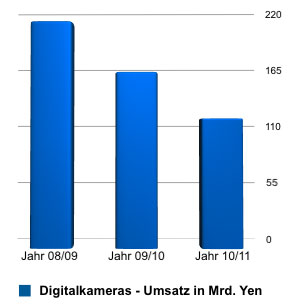
The revenue made by Olympus with the Imaging division. Graph made by Photoscala.de
One thing is sure. it’s time for Olympus to wake up and change their product and marketing strategy. The last “Consolidated Financial Results for the Fiscal Year Ended March 31, 2011″ describes a terrible situation for the Olympus Imaging division. The company as a whole is not doing bad at all with the medical division still signing a big “+” in both sales and net profit. But the Imaging division revenue of the year 2010-2011 is halved compared to two years ago (See the graph on top. Thanks Photoscala!). Photoscala made a detailed analysis of the report. Olympus did lose “only” a 5% in the Japanese market but around 30% in US, Europeans and other Asian markets!
And the biggest failure for Olympus is that they are year for year selling less cameras while the digital camera market as a whole is growing! See the next graph made by Photoscala.de:
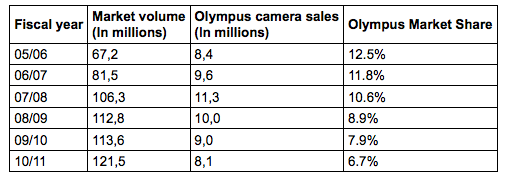 In short, Olympus is doing very bad outside Japan. And it continually loses market share and that’s a bit surprising if you do consider the recent Micro Four Thirds success. Probably Four Thirds is indeed almost a dead system (from a sales point of view) and maybe Olympus didn’t manage to be as good as Panasonic in selling Micro Four Thirds products. But that’s just my speculation. They need to rethink their product and marketing strategy. They have a history of innovation and certainly a group of top engineers. It’s the product and marketing strategy that fails. This is a huge wake up call for Olympus!
[poll id=”58″]
Read the full article from photoscala in german or via google english translation.
156 Responses
that’s easy.. just bring out m43 camera with build in viewfinder & better sensor. Up the sales go!
if the E-PL1 already had a flash inside the results would look different!
I am positive for the future!!!
E-PL1 has builtin flash already.
We will see thom to speak soon 😀
No wonder they lose sales when they don’t have a full range of camera models anymore.
They need to have m4/3 models ranging from beginner, thru intermediate to enthusiast/semipro. Currently they are only competitive in the beginner segment and have nothing at all for the enthusiast/semipro, which is the most profitable segment.
First of all, Olympus let its competitors to steal the market share from its four-thirds by only offering entry level cameras in the very beginning. In 2009, E-P1 has increased its sales of Olympus cameras but cannot sustain because there are already products from Panasonic which is more competitive. Poor marketing is one of the problem. The other problem is the insistence of marketing low price entry-level products, lack of innovation and unforeseeable future of four-thirds, while more competitors like Sony has already joined the battle.
> The other problem is the insistence of marketing low price entry-level products
E-P1 was in reality “pro” product (it had 2 wheels, digital level indicator, good build quality) but it was not presented as profi product: advertising was aimed at simplicity.
It was not entry-level product, but only because of relatively poor sensor performance it was so presented by reviewers 🙁
Square soap box design of Pens is light years away from good ergonomical design needed from real high end products (not even at level of E-xxx) and imagining otherwise will only further loss of marketshare.
In Asia anything fancy goes through easily but there’s some wisdom in exaggeratedly slow movement of Europe/NA markets where majority justifiably put these Pens into compact curiosity/low end position.
E-system wasn’t (isn’t?) that successful. The sales volumes on the higher end cameras were low compared to R&D efforts.
I think pen lineup has been a financial success. Olympus marketing just isn’t quite there and the European and US markets change slowly. Pens (and many other EVIL cameras) are still concidered fancy girls toys. Panasonic has done a great move with the video. Olympus has to find a way to specialize their products as well.
Olympus has always been innovative. Maybe they could bring up the first true digital modular camera system? It’s hard to predict what’s going up in future.
The big money is made with small cameras. Olympus P&S cameras are not going strong? XZ-1 is great, but quite expensive for average camera buyer.
While I consider obsessive clinging to film era mirror of Europe/US markets as stupid when EVF can offer some notable benefits for non-fast moving object photography there’s also good chunk of wisdom in not running after everything new like some headless chicken.
Small soap box design is anything else than ergonomical and even Panasonic’s hyped GHs aren’t above entry-level DSLRs.
The problem is, that actually there is nothing between PEN and E-5. Because of that, they have lost many potential customers in entry-level DLSR field.
Olympus should bring out a “larger PEN” with built in EVF, and a successor of E-620/E-30, until the technology is developed that Olympus can produce a Pro-PEN that can replace the E-Series.
But after I’ve read the latest interviews, I think they know about this problems and will bring new products to market that will solve this.
And sorry for my bad English 😉
My soughts exactly the same.
Don’t know much about compacts, but:
E-4xx and E5xx series cameras have lifted off sales for Olympus DSLR cameras (after initial flops with E-1 and E-3xx series). They have abandoned them (and 4/3 consequently) just to easily.
Micro4/3 is OK, E-5 is nice too, but they sorely miss bodies in between (something like E-5xx, E-6xx, E-3x), so potential customers will know, there is a system, that can cover all needs.
To start saving their self inflicted product line loss, at least one body somewhere between e-5xx and E-3x is needed. Small, and well specified.
Hi Matthias,
Agreed. I think Olympus realise this but have been very slow and lost alot of customers because they havent been clear on their communication. Plus i dont know how much cash they have for investment.
I think Olympus need ASAP
1. E-xx 43rds replacement to keep 43rds users happy
2. Micro43rds version of E-xxx (Called E-Pxxx ?) to replace 43rds models who want an EVF in DSLR styling
3. E-P3 which is a nice enthusiasts camera with rangefinder styling – either like E-P2 with nice finish & swivel LCD, or even a slightly bigger model with small built-in EVF.
By the way – I understood your English no problems at all. Its very good. And I am sure you are much much better at your particular European native language (did not want to assume any particular country) than any of us. Thanks for the comments.
The state of the camera division has little to do with 4/3 or m4/3 products. The mass market is still in compact cameras where Olympus has indeed lost some face in recent years. I hope that the XZ-1 and the new dual processor models are successful enough to keep Olympus in business.
The idea of producing Zuiko lenses for competing manufacturers is not bad at all. They could begin with large, expensive glass for FF systems where Olympus does not compete at the moment.
BTW, another option for your poll could be a brand new medium format system at half the price of the Leica S2.
Isnt there something wrong with the percentage? only the first three have more than 100% when you sum them….
If you’re referring to the market share table, no, they don’t.
I wonder if anyone from Panny or Oly is intrested in with this what we (who know what want and are willing to buy it) write on sites like this
Yes and no (aka I very much doubt it). Too much noise. Too much bias. Such sites are OK for taking note of a problem. But figuring out what the problem really is, what might be its solution, is best done by surveying actual customers. And there is a whole sector – market research – doing precisely that.
P.S. There is so called “curse of consultant:” instead of doing what customer wants, do precisely what customer asks. We are customers, Oly/etc – consultants. Rationale: customers fails at telling what they want; what they want changes every 6-18 month (and that is about how long it takes to bring a new product to the market).
They need to develop/market the m4/3 PEN system! m4/3 has lots of potential and they aren’t doing it well. They could’ve easily grab customers from the consumer to prosumer levels.
These are the results of the Olympus imaging division as a whole, so I don’t think any “pro”, “Zuiko” and similar stuff will help sales and revenue. The problem is with compacts, as Thom Hogan said couple of months ago, 22 models, many very similar. So the solution is:
1. Reduce the number od P&S models, make less than 10 different ones: entry 3x zoom, mid-level 6x zoom, travel 10x zoom, superzoom, fashion, waterproof and prosumer. No more needed.
2. Market the important stuff in your cameras, for example DSLR like image quality of m4/3, get rid of stupid slogans that every camera maker has – “taking photos has never been so easy” (?).
3. Make features of your cameras up to date and market them. Why is there no AF assist lamp on PENs? Why is panorama mode available on some compacts only? Why has SP line lost EVF and flash hot shoe? Those and some other small things don’t cost much, but sell well.
4. Build your brand name by concentrating on quality of specific features: “Oh, yes, Olympus – they’ve got the best tough compacts” or whatever. Why is mju line discontinued? Olympus used to have the slimmest P&S cameras, it’s not the case now. The product strategy shouldn’t change every three years.
5. Improve the image quality of compacts. Olympus P&S are known for worst images among small sensor digital cameras.
6. Put your products in more shops and market the discounts better. I’ve only found out by chance that E-PL1 with 14-42 lens is selling for 400 EUR here in Belgrade. All the places I go to have it for 500+ EUR. 400 is a competitive price, lower than most entry level DSLRs, but where was Olympus marketing to tell me that?
7. Since february 2010 there have been only two fairly similar m4/3 models and the competition hasn’t stood still. If Panasonic wasn’t going full steam, Olympus m4/3 would have been dead by now. Where are new m4/3 Olympus bodies? Why are they not more diverse in shape and features?
On the other hand, look at their total sales numbers. They are fairly constant. The only thing falling is the market share. Keep in mind that Olympus is not the company chasing no. 1 spot, they are satisfied with what they have and are not keen on expanding too much.
And, don’t forget that compact sales are falling because of competition from mobile phones and the overall effect of the ongoing economic crisis on camera sales.
So, it’s not all that bad. The compacts are going to disappear sooner or later, it’s better to concentrate on large sensor ILCs and the associated products, they will survive much longer than P&S and their profit margins are certainly higher.
8. Four thirds DSLRs are dead end. They are never going to catch up with Nikon, Canon and Sony unless huge investment is made. Merging them with m4/3 is the only way, but has been going very slow. Three years and all 4/3 lenses are still not able to AF on m4/3 bodies.
I agree 43 is dead. This makes it even more sure. I’m not sure the lenses will ever AF on m43 though. Or at least not AF very well. They did completely drop the ball on converging the systems, though.
Fuji has sensor integrated PDAF so that kind approach would be one possibility for getting full AF compatibility with high end 43 glass.
The question that has to be answered is “what does 4/3 offer than m4/3 doesn’t”? And the answer to that is basically down to “faster focus and more available high-end lenses.” Both of those things can be fixed in m4/3 eventually, thus 4/3 is a dead format, it’s just a matter of time. Time Olympus doesn’t have. They need to fix those things now, not iterate some more 4/3 bodies in order to sell off their inventory of 4/3 lenses.
Small mirrorless cameras and high-end P&S like the XZ-1 are probably the step up from camera phones and all the other P&S other than disposable (yes, there is/will be disposable digital) just goes away with time. So the question is this: what will Olympus have OTHER than that? They need something higher end, and 4/3 isn’t it.
In the film world, Olympus owned “small and professional.” The XA was the high-end P&S, the Pen was for a short time the small SLR, and the OM’s were the small high-end camera. All were distinguished by extremely high level of photographic competence in smaller bodies. Where did that go?
The XZ-1 needs to be executed smaller.
The E-PL2 needs to be executed smaller.
A Prosumer m4/3 needs to be no bigger than an E-P1.
Olympus is missing a larger sensor, but smaller-than-competition DSLR.
“In the film world, Olympus owned “small and professional.”
That could be Olympus’ new marketing slogan. But you are right they need the small bodies / products to back that up. Part of it is that they include IS on the sensor which alot of us like but the downside is that it makes for larger bodies. Thats an engineering/marketing decision which has trade-offs.
Although their lenses are smaller than any APSC compact system camera (ie NEX etc) – perhaps they should be chasing that slogan in relation to their Zuiko optics. But they havent been with the current lot of M.Zuiko m43 lenses. I guess the 14-42 is small but the others havent been that small and high quality. Hopefully that will change soon.
As for high end P and S. They dont seem to have kept continuity on that at all. The XA was fantastic then they went to the worse XA4! Then later on the Stylus Epic/Mju models which were fantastic but they never translated into the digital world very well to keep their all their hard earned reputations going.
> 1. Reduce the number od P&S models, make less than 10 different ones: entry 3x zoom, mid-level 6x zoom, travel 10x zoom, superzoom, fashion, waterproof and prosumer. No more needed.
This is “following the leader.” Following the leader is what got us to where we are today. At the risk of sounding like a broken record (hmm, shouldn’t we update that cliche to “sounding like a broken MP3”?), cameras need a fullscale reinvention. Just adding some pixels, focal length, buttons, art filters, whatever isn’t cutting it. EVERYONE does that. And in the P&S realm, the market is flat DESPITE those constant additions. GET A CLUE! Iteration isn’t the answer.
> 2. Market the important stuff in your cameras, for example DSLR like image quality of m4/3, get rid of stupid slogans that every camera maker has – “taking photos has never been so easy” (?).
Marketing is lazy across the board. Moreover, people forget that marketing can and should drive engineering. Salaried engineers sitting in cubicles don’t know what customers respond to. In the 21st century the primary question you have to ask is “why does a P&S camera exist at all, and what customer would want it?” The lazy response has been “customers have always wanted P&S cameras, so they’ll still want them.” I call BS. Things changed. Cameras didn’t.
> 3. Make features of your cameras up to date and market them.
For the most part, this is the wrong line to follow. It’s just iteration and follow the leaders. You have to start at the other end: why does the user want this camera and what are they going to do with it? Those are the only “features” you really need if you do it right. You can iterate later. Look closely at the iPhone. It didn’t come out with third-party apps or a camera. But it very much changed the way people use phones. It was up to date with customer needs, not another iteration of same-old features.
> 4. Build your brand name by concentrating on quality of specific features: “Oh, yes, Olympus – they’ve got the best tough compacts” or whatever. Why is mju line discontinued? Olympus used to have the slimmest P&S cameras, it’s not the case now. The product strategy shouldn’t change every three years.
Agree. All the Japanese camera companies are virtually directionless. They’re afraid to abandon the past, they don’t recognize the present, and they have no future in site other than the same old iteration game. And it will play out EXACTLY the same as it did in film. Indeed, it already is.
Olympus and Nikon think their brands are about “high quality” and “newest technology.” Neither directly serve a customer need. We all want those things, and all companies deliver them to a similar degree. You dismiss “taking photos never been so easy” a little too fast. While that’s not the right approach, it’s closer than “high quality” and “newest technology.” Try this “photos when you want them and where you want them.” That notion drives design two ways: compact and portable (when you want them) and programmability/communication (where you want them). The issue isn’t the marketing statement, it’s whether your product actually lives up to it. Virtually no camera lives up to the “never been so easy” claim. Why? Because the makers keep adding features! Many of them actually useless to the task 90% of the customers want solved.
> 5. Improve the image quality of compacts. Olympus P&S are known for worst images among small sensor digital cameras.
The least of their worries, I think. 90% of P&S customers can’t tell the difference. Which is why Nikon’s constant Instant Rebates on Coolpix has worked: people buy on brand/price. Face it, P&S cameras as they are today are commodities. Price and availability wins. Olympus isn’t great at either.
> 6. Put your products in more shops and market the discounts better.
Yep. See my previous answer.
> 7. Since february 2010 there have been only two fairly similar m4/3 models and the competition hasn’t stood still.
This one I understand. It’s difficult to make substantive model changes on the wicked schedule that consumer electronics dictates. We’ve had four m4/3 cameras in two years, but the differences are small. Of course they are, because we’ve had four cameras in two years. The other problem here is that I don’t think Olympus (or Panasonic) quite fully understood what it was they had and where it should go. They’re getting a lot of feedback from a lot of different quarters, and it’s not all consistent. Unfortunately, m4/3 is NOT being driven hard enough by a single decision maker who has a clear understanding of what it is and where it should go.
> If Panasonic wasn’t going full steam, Olympus m4/3 would have been dead by now.
But that was part of the plan, otherwise Olympus would have just done 4/3 and m4/3 by themselves. At the end of the film era it was pretty much Nikon/Canon with basically all of the market share. Nikon and Canon successfully transferred that into digital, with Sony muscling in via both the sensor and acquisition (Konica/Minolta). Those are some tough competitors to dislodge. Olympus picked the partnership route to try to do it (I wouldn’t have–it’s hedging your bet).
> Where are new m4/3 Olympus bodies? Why are they not more diverse in shape and features?
Good question. Basic answer: the E-P1 was a mistake. It shot too high yet not high enough. Olympus had to improve margins, which is why we got the E-PL1. The E-P2 wasn’t really a new model. The E-PL2 was a second attempt to fix the problem. Great, so now they’ve got an intro model almost right, but nothing else. Hard to sell a SYSTEM that way.
> On the other hand, look at their total sales numbers. They are fairly constant. The only thing falling is the market share. Keep in mind that Olympus is not the company chasing no. 1 spot, they are satisfied with what they have and are not keen on expanding too much.
Nonsense. If you’re going to tell me that a company is satisfied with being a number 3, 4, or 5 player in a market, I’m going to short their stock. Olympus just hides their ambition well ;~). With the rest of Olympus growing and doing decently, it’s even more important for Imaging to do well or become the bastard division within the company and disenfranchised. Believe me, if they are even remotely aware, they want to expand A LOT.
> And, don’t forget that compact sales are falling because of competition from mobile phones
Yes. Again, why does someone want a P&S camera? Answer that question right and you’ll sell one. Answer it wrong, and your sales will decline as fast as phone sales grows.
> and the overall effect of the ongoing economic crisis on camera sales.
Not convinced that is actually true. Interchangeable lens camera sales increased during the crisis. Prices of cameras have softened some, but the demand is still there.
> So, it’s not all that bad.
Sorry, but it’s bad. If you want to know why it’s bad, go back to the 80’s and 90’s and rewind the decline of film camera sales and see what happened to the marginal players. We’re in the re-run now.
> The compacts are going to disappear sooner or later, it’s better to concentrate on large sensor ILCs and the associated products, they will survive much longer than P&S and their profit margins are certainly higher.
See what I wrote just above. Now, let’s take your scenario to the extreme: Olympus quits P&S tomorrow and concentrates on m4/3 (and I guess 4/3 based upon what we’ve heard recently). Unit volume is less than 1m units. Market share is less than 5%. Growth is coming off the interchangeable lens camera marketplace and margins are dropping. Let me be generous, though. Let’s say Oly sells 1.5m units at an average of US$999 and a GPM of 35% (none of those numbers come close to what they’re currently doing). That’s a potential total of US$1.5b in overall sales and about US$500m in gross profit (probably less than than US$200m by the time all expenses are added in). That’s still only 10% of the total of all of Olympus today. In other words, you might be able to shore up the division’s finances, but you haven’t actually made the division a bigger part of Olympus. There are political implications that happen because of that. Unlike Nikon, where an Imaging executive was made overall CEO, you wouldn’t see that happen at Olympus. And remember, the numbers I gave are near home-run numbers.
But the real problem for Olympus imaging is this: they are a drag on profits. Medical is a big win for Olympus, and Life Science/Industrial is doing decently. Information and Communication is smaller but profitable.
There are other things I noticed in their results: increased turnover period for digital cameras. Olympus used to sell a camera in 1.8 months, now it’s 2.2 months. That’s a significant change and one that indicates decreasing demand for their products (or complete marketing/sales ineptitude). And overall camera sales in UNITS is down from 2006. That’s actually more horrible than it at first sounds, because average selling price has dropped considerably in that time. There also isn’t any sign that there’s a reversal happening. There’s been a decline for four years running, and those numbers predict further decline.
If I were on the board, I’d be demanding a clear strategy and detailed plan for reversing the Imaging division’s downward spiral. I would not accept “we’ll iterate our way out.” ROI in Imaging is negative. That’s unacceptable.
“> 1. Reduce the number od P&S models, make less than 10 different ones
This is “following the leader.” Following the leader is what got us to where we are today. Just adding some pixels, focal length, buttons, art filters, whatever isn’t cutting it. EVERYONE does that. And in the P&S realm, the market is flat DESPITE those constant additions. GET A CLUE! Iteration isn’t the answer.”
Well, they’ve got to start with something and the first thing they have to do is catch up with the competition. Features-wise their newest crop of compacts presented in March is a good step forward. I remember your theory that in order to gain marker share and overtake current leaders one needs to have some disruptive technology, but I think for such approach to work, you have to have the same as competitors + something more.
“Look closely at the iPhone. It didn’t come out with third-party apps or a camera. But it very much changed the way people use phones. It was up to date with customer needs, not another iteration of same-old features.”
What should be the next step? For example, make a partnership with some mobile phone maker that has no photo experience/background/legacy ( say LG or Motorola ) and merge mobile phone with 3x entry level and 6x zoom compact. Make it a bit larger than existing cameras ( it shouldn’t be that hard, there’s little to add ), but don’t lower image quality or take away some features as SonyEricsson or Samsung did in their phones. Also, make very easy sending photos by e-mail or to social network sites.
“You dismiss “taking photos never been so easy” a little too fast. Try this “photos when you want them and where you want them.” That notion drives design two ways: compact and portable (when you want them) and programmability/communication (where you want them).”
And then you can market that phone/camera with “good photos when you want them and where you want them”. If a such phone is a smartphone, then its features can be added by apps and there’s the gold mine. Some revenue comes from the hardware and some from the software and users can upgrade their camera longer than they can now.
“> If Panasonic wasn’t going full steam, Olympus m4/3 would have been dead by now.
But that was part of the plan, otherwise Olympus would have just done 4/3 and m4/3 by themselves.”
If this is true, there are two positives: 1) it was part of the plan, 2) there was a plan :).
“> Olympus is not the company chasing no. 1 spot, they are satisfied with what they have and are not keen on expanding too much.
Nonsense. If you’re going to tell me that a company is satisfied with being a number 3, 4, or 5 player in a market, I’m going to short their stock. Believe me, if they are even remotely aware, they want to expand A LOT.”
I disagree. If you look at various sports, not every team ( a company itself nowadays ) starts a season with a goal to become champions. Some are satisfied with top five/ten/twenty and state that openly before the start of the championship. I think that Olympus managers are satisfied with being in the top five and are afraid of the risk large expansion would bring them.
“> The compacts are going to disappear sooner or later, it’s better to concentrate on large sensor ILCs and the associated products, they will survive much longer than P&S and their profit margins are certainly higher.
See what I wrote just above. Now, let’s take your scenario to the extreme: Olympus quits P&S tomorrow and concentrates on m4/3”
No, no. They are aware of the P&S eventual demise, but know there is still some money to be made. So, they are making as little effort as they can to earn as much money as they can while P&S last. That’s why their P&S have been so lame recently and that’s why their market share has been falling.
> Well, they’ve got to start with something and the first thing they have to do is catch up with the competition.
I’m not a fan of that approach. It rarely works, because the competition isn’t sitting still, either. You end up putting all your resources into gaining parity but even if you get there you still have the problem of convincing the market that they should buy your “equal” product. The only way to win is to plan to win, and that means going for the right product and thinking ahead, not catch-up.
> Features-wise their newest crop of compacts presented in March is a good step forward. I remember your theory that in order to gain marker share and overtake current leaders one needs to have some disruptive technology, but I think for such approach to work, you have to have the same as competitors + something more.
Really? Let’s see, Apple’s equivalent-to-market MP3 player was? Apple’s equivalent-to-market phone was? Apple’s equivalent-to-market tablet was? Oh right, they didn’t do that, they just disrupted. You have to be very careful about sending mixed signals. If you have both a disruptive and an equivalent-to-competitor product in the market simultaneously, what do you say to the customer? You’d think that a group of companies that came out of the optical market would actually understand focus, but as companies, they’re not very focused.
> What should be the next step? For example, make a partnership with some mobile phone maker that has no photo experience/background/legacy ( say LG or Motorola ) and merge mobile phone with 3x entry level and 6x zoom compact.
IF (and that’s a big if) the answer to communication is cellular, only Sony and Samsung really have any real capability there. And it wasn’t until the iPhone that ANYONE truly unlocked the ugly way phones got designed and created from the hands of the idiot phone companies. At this point, the rest of the camera companies have about zero chance of getting into that market successfully, and it involves incredible negotiations with an enormous number of “partners” across the world to be successful. Not to mention patent licenses that most of the camera companies have no access to.
Now, a camera company could cozy up to a phone company. Imagine, for instance, a Nikon Coolpix that was integrally linked to an iPhone because Apple and Nikon cooperated on that. It’s not a lot different than the various auto and home stereo/theater links that Apple has encouraged in the iPod ecosystem. It allows the iPhone to be an iPhone and not have to go gaga on camera features, it allows an upsell capability that probably sells more phones. Apple understands ecosystems. Google doesn’t (yet). Nokia is wandering around in the woods lost. Motorola is just following Google.
But cellular isn’t the only communication answer ;~).
> Make it a bit larger than existing cameras ( it shouldn’t be that hard, there’s little to add ),
No. Don’t combine the cell phone and camera. LINK the cell phone and camera. Camera doesn’t have to be any bigger than it is now.
> And then you can market that phone/camera with “good photos when you want them and where you want them”.
No. You’re not in marketing, are you ;~). “BETTER photos when you want them and where you want them.”
> But that was part of the plan, otherwise Olympus would have just done 4/3 and m4/3 by themselves.”
If this is true, there are two positives: 1) it was part of the plan, 2) there was a plan 🙂 .
True. But…
There’s a goal. (Become relevant in cameras again)
There’s a strategy. (Innovate with a better version of the sophisticated camera)
There are tactics. (Produce X, Y, and Z, then A, B, and C; price at P; market this way)
The goal wasn’t achieved. The strategy seems on target. Thus you failed in the tactics, which is what most people refer to as “the plan.”
>>> Olympus is not the company chasing no. 1 spot, they are satisfied with what they have and are not keen on expanding too much.
>> Nonsense. If you’re going to tell me that a company is satisfied with being a number 3, 4, or 5 player in a market, I’m going to short their stock. Believe me, if they are even remotely aware, they want to expand A LOT.”
> I disagree. If you look at various sports, not every team ( a company itself nowadays ) starts a season with a goal to become champions. Some are satisfied with top five/ten/twenty and state that openly before the start of the championship. I think that Olympus managers are satisfied with being in the top five and are afraid of the risk large expansion would bring them.
False analogy. Sports teams are private. They are valued on sale price of the franchise overall, and they all have antitrust exemptions so act as a unit, not competitors. Egos are involved more than business sense. I could go on.
Reis and Trout had it right: be #1 or #2 in your market or invent a new niche and claim #1 in it. Olympus tried to do the latter. Unfortunately, they appear to already be #3 in the niche they tried to invent. That’s Epic Fail. Shouldn’t have happened. Fire those that made it happen.
> No, no. They are aware of the P&S eventual demise, but know there is still some money to be made.
And that’s showing up on the bottom line where? ;~) Sorry, but the regression of compact sales shows a very negative future right now. Nothing short of disruption in THAT market will turn things around, IMHO. The consumer’s “perceived value” of compacts is still going down, so sales prices and GPM’s continue to go down. The way everyone is trying to deal with that is to drive costs out, but at some point if you’re not a vertically-integrated unit, you hit a dead end.
> So, they are making as little effort as they can to earn as much money as they can while P&S last. That’s why their P&S have been so lame recently and that’s why their market share has been falling.
Again, not sure where the “earn as much money as they can” is showing up on the bottom line. The numbers say it isn’t.
“> And then you can market that phone/camera with “good photos when you want them and where you want them”.
No. You’re not in marketing, are you ;~). “BETTER photos when you want them and where you want them.””
🙂
You’re right. I’m an engineer and I worked several years for a company that had only two competitors in the country, so we didn’t need marketnig. Even if we had formed a marketing department, I wouldn’t have been involved in it. My new company management isn’t much better…
I don’t agree with you on Apple and merging of mobiles and compacts, but there are these new interesting rumors to discuss, so I’ll stop here :).
Just making products available in due time and at the right price tag regarding competition would be a huge improvement. I wanted an E5 at Xmas and couldn’t find one in the shops – on the net yes, but would you send 1800 euros without even a peep through the viewfinder? I finally settled for a D700 that was there, bought a couple of lenses to go with it, and my Oly pro glass has now been sitting on the shelves since … Pity!
Oly lost momentum years ago. Remember their xD card format? All their compacts look the same and, frankly, the IQ is mostly poor. They had a small, niche DSLR line without broad appeal, and then killed what few customers they had by seeming to announce they were all in on m43, then they changed their mind.
Poor execution. No marketing. Bad product choices. The wrong product choices. Sorry to say, but they are in a death spiral. “All” they need to do is come out with a line of quality compacts, and release mirrorless products people want (hint: not a cheap 40-150), and reinvigorate the channel for Oly cameras. That’s it! Oh, and get a better sensor.
This explains a lot about why there’s no EP3 (I’m still holding onto my EP1, perhaps now I see it’s in vain). Panny should let them use the GH sensor. It will not be good if Panny is alone in the m43 market.
MARKETING!
people will buy products regardless of how good they are or how they suit their needs based solely on what the majority of people are buying.
think Ipod – every mp3 player released at the time when they first emerged had more features, capacity and fm radio… they were also cheaper…
YET ipods won the whole market!!
MARRRRRKEEETTTINNGGGGGG!!! i can’t stress it enough
ease of use? one stop integrated software package (itunes)? sorry but marketing alone wasn’t the reason the ipod ‘won’ – but yeh.. i fully agree with you that it’s not all down to plain hardware specs..
ease of use? the spin wheel on an ipod is fiddly to use unless all you want to do is scroll quickly. i’ve had in my possession an ipod, toshiba gigabeat, several samsungs and sansas and by far the worst UI was the ipod. it’s probably subjective but the ipod control is like the sony NEX of mp3 players.
and the one-stop integrated Itunes was a pain… every other mp3 player you can just drag and drop files with your standard file manager or sync using windows media player, there’s no individual computer-exclusivity either.
with other mp3 players they played any mp3 (and wma) file you drop in them. with ipods they convert mp3s to another type of file and then hide and encrypt them in the device so you can’t see them in a file manager. doesn’t sound very easy to me.
even if these features did appeal to a lot of people that alone wouldn’t have driven them to such success. i think marketing made up 80% of that at the very least.
I think it’s normal given that they are in the middle of changing their system from 4/3 to m4/3. Last couple of years they’ve just had a dying system and a new born one. Sales cannot be high for a system in any of those two situations.
But it will go up from here since I hope that by the end of this year they will have a semi-complete m4/3 system with the E-PL2, E-P3 and higher end one. 3 good cameras for 3 different levels. And some fast prime lenses, apart from the slow zooms.
Besides, in the compact camera department they’ve learned they need to provide better IQ and they are starting to do so.
2012 will be much better year. Or else Olympus might face its slow death…
I doubt there’s going to be a 3rd “higher end model”. It’ll be more likely that they re-establish their EP line at a higher notch so there’d be some differentiation from the EPL line. Honestly, EP line is now just a joke – it’s inferior to EPL line in every way image-wise, only to have a better build.
It’s Oly…making one new m4/3 camera every half a year seems to be a hard enough task for them already!
Maybe Pens are not doing that bad.
I get to see lots of tourists from my day job: I did see pens on occasions. I don’t remember having seen any Olympus compact camera, ever.
I don’t know what to say about Olympus. They fail to market AT ALL, have no street cred because nobody is impressed with their cameras, and fail to communicate a plan or excite us in any way.
Micro Four Thirds is cool, but how long before someone else does it better? Well, about a year ago.
The community has been saying for three years what they wanted in forums, and Olympus hasn’t been taking advantage of that resource. They’re stupid and timid and old.
It frustrates me because I like their Four Thirds system and like having upgrade paths that are viable. Every innovation they come out with shrivels because at launch it isn’t BETTER than what everyone else is doing, is far more expensive, and NOBODY retails it anywhere. Just try to find an E-5 in a brick-and-mortar. I dare you.
You can find PENs but when the E-30 was in production, I never saw one before I bought mine online. And people have been speculating about the end of 4/3 and olympus didn’t chime in to let us know it wasn’t a sinking ship. They lost a lot of people because of it.
Olympus need to gain P&S compacts market share.
To change names is not enough.
They should create new shooting mod: “reviewers”
In this mode they will set exposure for minimized noise:
– increase exposure and contrast (as it is done for Canon and Panasonic compacts)
=> and reviewers made the whole necessary marketing job 😉
Not a marketing guy…can only speak for my own buying habits.
I am old school used to be a pro. Got out of the business during the whole digital transition phase..when clients wanted everything digital, equipement prices were absurd (and the equipment was crap) and everything you mortgaged your house for was obsolete in 1 year. REALLY glad I got out. I just dropped photography completely for years. It depressed me. ( I was a 4×5, Hasselblad and Nikon guy before).
A little over two years ago I started to survey the landscape and wanted to shoot again, photoshop etc….just for me..not a business venture…
The only camera that caught my eye was the Canon 5D Mark II. (and I am not and never was a Canon fan..but the Nikons were just waaaaay too expensive). Full Frame (I didn’t have to sit around with a slide rule calculating lenses)…large file …HUGE glass selection. I never considered an Olympus DSLR, or smaller than full frame format. Small file…less dynamic range, more noise very slim glass selection compared to Nikon and Canon. Period. I slowly loaded up on L glass and am happy with the breadth of choices I have there. Olympus was not going to get anything near an 85mm f/1.2 on a full frame. Why would I buy into a limited system? Way fewer choices Just my opinion.
When Micro 4/3’s hit the street..I thought hey…this will complement my big, bulky DSLR (not replace it). Plus it was easy to understand the lens formatting as it was 1/2 of 35mm equivalent. Now…why would I buy the camera of the company that is buying the sensor from panasonic? Duh. I am open minded…but I want good goods (I am not rich BTW I just want quality photography…its a passion)….The glass was all better from panasonic. I own the 7-14mm, 20mm, 45mm macro & the 14-45mm which I will sell if I can get a range of “good” primes. Therefore…NOTHING that Olympus offered in the realm of lenses appealed to me. They were all second rate. Period. Which made no sense because they had the capability of producing excellent lenses…I guess they just thought this is a camera for amateurs and that is the product we will make.
I am anticipating the rumored 12mm lens. So maybe someday I will buy an Olympus product…but I haven’t yet. Everyone is different…that is just where I am coming from.
Even now…if you want a compact DSLR I would by the Pentax with the limited lenses. I see no reason to buy into Olympus…why? Limited format, limited lens selection, not a good choice. Too many better offerings out there that make more sense.
Hope that helps.
Dear Olympus,
GET THIS PEN PRO OUT OF YOUR ASS AND YOU’LL GET DEFINITELY BETTER.
Thank you for your attention,
Love.
you are right!!!!!!!!!!!!
1. Clear roadmap for 4/3 and support for 4/3 users. I never buy Olympus anymore if they kill 4/3 silently without full support of 4/3 lenses in mirrorless cameras or without mirroless E-X/E-XX at all.
2. New E-XX or mirorrless analog (with full support of 4/3 lenses).
3. Advanced m4/3 camera (GH-2 competitor).
Two things:
1. As many have said, I suspect that the P&S market dominates the sales numbers. Oly needs to market more and come out with a very cheap Pen (maybe the E-PL2 already does that) and market it against the P&S models.
2. I’m undecided on the Pro stuff, but I do think a good piece of the amateur market might be lured away from DSLRs by really compact m43 with a viewfinder. If they are OK with the bulk then they will just keep the DSLRs. It needs to be “smaller enough” to make the switch a real advantage.
> 1. As many have said, I suspect that the P&S market dominates the sales numbers.
Sort of. 100m units compared to 14m units. But overall selling price and gross product margins on P&S are basically commodities (e.g. low and lower).
> Oly needs to market more and come out with a very cheap Pen (maybe the E-PL2 already does that) and market it against the P&S models.
I think Oly knows that the E-PL2 type of camera at US$399 sells like hot cakes (at least in markets where they supported the dealer ;~). But I don’t know that they have the GPM to do that.
> 2. I’m undecided on the Pro stuff, but I do think a good piece of the amateur market might be lured away from DSLRs by really compact m43 with a viewfinder.
Old school thinking. When you survey users, you now find an age difference. Over 50, yes, they want a viewfinder. Under 30, “what’s a viewfinder?” So be very careful with assumptions. What the P&S crowd is lured by is better image quality and faster response, period. And they want it without a big change in size.
More simple than this. I invested in a system called 4/3, this system is a dead end. It is not a first time in Olympus history so I do not want to take any more risk with them, I only gamble if I think I have a chance to win something…..So, even if micro 4/3 was a major break through in the photo industry (it is not…) I would never give any more money to Olympus
I’m thinking the EVF camera is going after the enthusiast market, not the P&S market. I’m talking about the folks who enjoy legacy glass and have a real need for MF.
As for profit margin, I’m not sure what Oly can do here. I suspect Panasonic, Sony, and Samsung can absorb more to gain market share than they can. I’m just not sure the pro market is big enough to really pull them up.
Who knows, if this continues, Thom might be able to round up a group of investors and buy the imaging division. However, if his predictions regarding cell-phone cameras proves correct, there won’t be many P&S left, leaving the camera companies really fighting over the non-P&S market. Can Oly distinguish itself in that kind of competitive environment with current marketing & mgmt? Unfortunately, I don’t think so.
As someone looking to invest in a DSLR system, it’s hard for me to put my money into Olympus when they seem to have little direction or future. I’m really hoping they can course correct because I really like the PEN products, but may invest in the Panny G or GH system.
+1
iPhone cameras are already heavily marketed. Nokia mobiles do have more megapixels than my E-3!
Plus, smartphones make images easier to edit and share.
Cell phone cameras aren’t only Thom’s prediction; many many many people believe that cell phones will wipe out the P&S market. If Apple decides one day to put a zoom lens in the iPhone that will probably be the first real blow. Heck, I’m a photographer and I already use my iPhone 4 as a P&S camera all the time. It is perfectly fine as a snap shot camera. More and more people will reach the same conclusion in the coming years.
The only way to survive in the P&S market is make cameras that do what cell phone cameras won’t be able to do. I can only think of two types that will survive long term: the megazoom 28-300mm travel cameras; and the waterproof cameras. Luckily Olympus has a pretty good reputation on the latter.
> Thom might be able to round up a group of investors and buy the imaging division.
Hard to calculate a value now. Last year, based on Imaging results someone would have probably paid US$250-300 million for the Imaging division (and that would have been down from previous years). Now, the value is much more undefined as this is absolutely a turnaround situation. Moreover, we’ve got a lot of intertwining to un-intertwine (R&D, plants, and subsidiaries that make/sell things for multiple divisions, etc.).
From Olympus’ point of view, they’d get more if they could turn it around themselves. And in the worst case scenario, it would probably be more valuable to just close it down (or at least substantially reduce it).
I don’t know how I’d come up with a proposition to investors that’s anything other than “bet on me.”
+1.
I agree the cell phone cameras are going to have a very big impact on the p&s market in the future. They are not there yet, but are getting better.
Personally they are not for me, I have one of the better camera phones out there and it is abysmal to use, hate it. However the common consumer is in love with them and this is going to have a definitive impact on the bottom line of the p&s camera manufacturers.
The money is in the accessories for the cameras and lens production. I think by having an amazing lens line-up, (Oly) with incredible quality across the lens line, and little redundancy (if any) they are in a way shooting themselves in the foot.
I have had my current lens staple for 3 years of longer and have not added any lenses (4/3) in the last 3 years. I have not had a need to as the lenses I have are perfect, therefore I have no need to spend money on additional lenses.
“Damned if you damned if you don’t”
Olympus, you cannot compete with the lower market segment, you simply can’t, your company isn’t equipped. Make the Pen Pro. Because you don’t have a video division you need to protect, you can allow it to perform to it’s maximum potential. The next successful photography product will be a successful video product – just the way the market dynamics work and only way to bring enough volume for what is otherwise a relatively premium priced product to begin with, in order to make the venture profitable. Otherwise you must scrap with the lowest common denominator market where low price and low expectations rule, and you will be killed by Panasonic, Canon, Samsung, and the others. Marketing is of a secondary concern, first is technical competency in making a desirable stills AND video camera.
no touchscreens please.
I ran away of Oly because don’t have plans and roadmaps for DSLR.
I sold my e-3 and pro lens :/
And PEN SUCKS!
1. Find a new sensor provider.
2. Build some fast SHG primes for 4/3.
3. Apologize for not actually putting effort into the E-5.
This industry is about keeping up with technology making significant improvements in IQ.
Fast prime lenses are a good indicator of where a company is heading. They are a long term investment that appeal to the upper end user. When it became obvious that Olympus was not going to produce high end primes (support high end users) it was time to move on. I have sold everything but my 14-35mm…. and I’m not sure why I’m holding on to it. Part of me wants to believe that Olympus will release a E-5 mk2 with a modern sensor and some SHG f/1.4 primes.
Olympus screwed up from the beginning. Had Olympus designed the 4/3 system around a larger sensor (22mm x 16.5mm) I believe the system would be very strong. The biggest weakness of the system is the sensor.
Telecentricity was a big deal when 4/3 was launched, so Olympus sticked with smaller sensor to keep the size of the lenses decent. That appeared to be a wrong decision as sensor technology got better.
I have to add that 4:3 is great image ratio. Much more flexible than the old 3:2.
+1
How come I can get a standard focal length f1.8 from Canon for a hundred bucks and I can’t get one for Olympus for less than 500?
How come there are NO fast primes? How come Pentax can make smaller lenses for APS-C than Olympus can for a smaller format?
They knew that their sensors would lose out on sensitivity and signal-to-noise. The solution is MORE SIGNAL via faster lenses. Their shorter focal lengths will make depth of field manageable even at f1.7 to f2.0.
But they keep making f3.5-5.6 optics, putting them at a 1 stop disadvantage to APS-C. I propose that if they made compact fast primes, the edge from Nikon and Canon could be at least partially erased. I’d say the 20mm f1.7 and a 40 or 42mm F2 would really help- but remember that a single focal length lens should be made in two grades, with one at around 200 dollars and one at 500 dollars.
Look at the Pentax pancake primes. They are TINY and of decent quality. Olympus should have made some of those, and customers have been screaming for them for three years. Olympus failed to listen, and since they didn’t build what people demanded, they made fewer sales.
In addition, being an Olympus customer really brings the idea that Olympus is 3000 miles away into focus. It is clear that either they have no US leadership, or simply never listen to the people they have over here. Olympus in Japan continues to build products for a demographic that does not exist- the Girl With a Camera.
The Girl With a Camera doesn’t exist. She doesn’t buy additional lenses, and she lives in Japan. American women don’t buy Ladies’ Cameras, and the ones who do are looking for a slim camera that fits in their purse, not a system camera.
American photographers differ very little by gender in their gear selection. Female photographers don’t buy their gear different than men do. The micro four thirds system could have brought them something- it could have been the Leica on a budget. The Leica recipe is compact camera, fast lens, high image quality. Olympus is capable of all of this, but simply skimped on the lens lineup, making that little social street camera unattainable.
In addition, they failed to communicate vitality to potential purchasers. While the industry speculated on the death of Four Thirds, Olympus remained silent. Even now, they have not announced anything exciting or new, with even the E-PL2 being a rehash of the E-PL1 but with a better screen and what amounts to a firmware update.
These merely incremental advances, coupled with a complete lack of a communicated Vision, allowed the market to dry up while Olympus did next to nothing. I simply cannot be pursuaded to believe that development and roll-out of the E-PL2 took more than two months. If there are exciting products on the horizon, they’re like the second coming of Christ- people talk about them, rumors start, the rumored events fail to take place, and without a further communication from above, eventually, people figure out that nothing is coming.
Olympus needs to either do something good or get out of the market. I’ll be pissed to have my system abandoned, but the stockholders will be more pissed if they keep releasing dull stuff while exciting rumors keep failing to appear.
+1,+1,+1,+1,+1,+1,+1,+1,+1,+1
Interesting, i wrote a reply lower on the thread without seeing your post. “Leica gestalt” +1. They have the opportunity to really differentiate themselves from the big boys and have a stronger message…worst, THEY TECHNICALLY CAN!!! So how come all we get are crappy slow zooms? Crazy…
+2+2+2+2+2+2+2+2+2+2 !!!!:-)
If only Oly will listen Tom Hogan 🙂
Nah i am just kidding. H eknows nothing but acting like a marketing god
You just have to except that (which i wrote more than 10 times before)
Oly is a dying company sell your gear before it is too late
Most people here don’t really know if the m43 sales have a big impact or not on Oly overall figures. And most people here speak out of their own interests with regards to the system, which, frankly, may not be what the mass market needs.
With regards to m43: Weird thing is, they could create a nice niche product, leveraging their “cult following” aura, with hints to their vintage cameras (PEN and OM lines) – which is what they set out to do with the original digital PENs. They could also leverage their perceived high quality glass craftsmanship. But, they went the opposite route. They started creating loads of redundant “kit lens quality” plastic zooms, and haven’t created a serious pen body since E-P2. Even more, their first forays into m43 were perceived as half baked – slow af performance, no flash, in general quirky operation – and were superseeded by Panasonic in no time. And Panasonic clearly plays with the video integration as a key aspect of their offer. So what’s there for Olympus? How are they better? How are they different? I think they have some reputation between real photographers, for their colours, for their innovations, for they following (in the past) what they thought would be good ideas for the art of photography. I’d say: back to the roots olympus. You do that, we’ll follow. We want tactile controls, we want quality bodies, we want cameras that give us confidence. We want beautiful glass. We want small cameras that are not threatening.
As I see it, m43 has the potential to become the travellers’ cameras, the social and family cameras for pros, the not intimidating cameras for some types of photojournalism and ethnography. m43 has the potential to bring back the leica gestalt of small, unobtrusive, high quality cameras to the digital world (at a lower than $9000 price tag, btw). Think about it. There’s NO OTHER current camera line that has this potential (maybe sony nex or samsung nx, but not quite there yet).
That’s why i have bet on m43.
In 2006 when Olympus had 12.5% market share we were still living mainly in a P&S world. Since then DSLR’s and now CSC’s have flooded the market. Clearly they made a huge mistake with their DSLR’s as 4/3’s sensors simply couldn’t compete with APS-C DSLR’s; as witnessed by the steady drop since 2006 (the year of the Canon Rebel/Nikon D40).
However in the last 2 years they’ve only released 4 barely distinguishable PEN’s as well as the E-5. They simply have no variety in their line up, and in the case of their four PEN’s they were arguably trumped by cameras like the Pansonic GF1 and Sony NEX5. If you’re going to focus so much on one style of camera you should at least do it better than anyone else; and Olympus didn’t.
For the future I think they really need to work on a m4/3’s alternative for the E-30, E-620, and E-450…I think the modular camera would be just the camera for that purpose. I would also focus on a new PEN with a built-in EVF to take on the X100 and upcoming NEX-7. Finally, I would make an even simpler and smaller PEN for the P&S crowd, something more like the NEX3. A camera the size of the NEX3 with Olympus’ collapsible 14-42mm would be an attractive package. If they do those three things as well as release some high end glass to keep enthusiasts happy they will be fine.
Eric,
I agree with alot of your points.
“For the future I think they really need to work on a m4/3′s alternative for the E-30, E-620, and E-450”
I completely agree. But if they were not ready to bring those to market (which has obviously not been the case) they should have kept talking up 43rds to keep interest in that product line. And bringing out the E-5 was probably a mistake – especially knowing that a new better sensor would be coming soon. Imagine if there is an E-P3 with much better IQ than the flagship E-5! It would have been better to have released an upgrade to say the E-30 6 months ago (rather than the E-5) with some marketing tweaks (just like Canon and Nikon do) – that would have sold alot more and kept alot of 43rds users happy. And then they should have shown a concept late last year of a pen version of the E-xxx range (with built in EVF) along with a roadmap of lens support. That should be available by now at the latest.
As for a simpler and smaller Pen, I completely agree. There should probably be a few clear product lines as Thom and others have stated. Here’s my thoughts:
Pen Line P1 – small as possibly body (no IS) to compete with NEX/GF2
Pen Line P2 – like E-PL2 is now : more advanced compact with IS
Pen Line P3 – E-P2 upgrade. This could be debated. I would vote a rangefinder style X100 form factor slightly bigger than an E-P2 with small EVF in top corner. Enthusiasts camera. Or could be E-P2 with swivel LCD etc.
Pen Line P4 – E-xxx replacement along the lines of G3. Large built-in EVF for those who like their DSLR styling.
Just my thoughts. Any comments out there? I dont know what names they would be given!
I think maybe 3 tiers would be better. I like the idea of P1, P3, and P4, but P2 has too much overlap with P1 & P3. One change though, the EVF can’t be small in P3 or the camera will fail. Enthusiasts like big bright view finders, and a small dinky EVF won’t get the job done. They simply need to copy what Fuji did with the X100, use a prism to bend the light 90 degrees so they can use their full resolution 1.4 dot EVF.
I could see this, although I think the consumer, enthusiast, and pro models would be enough.
It just depends what each of those should be. Should consumer be as small as possible with no IS – almost full auto just designed for P&S upgraders? Is the E-PL2 too big too as an entry level for some markets. I dont think so but others might think so.
As a long time Oly owner, I agree with the general sentiment in the comments… especially around improvements needed in m43 (pro, faster lenses, real innovation).
That said, I bet Oly’s overall market share goes up next quarter because of the XZ-1… they made the right call there and the numbers probably won’t be seen until next quarter…
Really? Just how many XZ-1’s do you think they’ll sell?
Oly sold 8.1 million cameras in fiscal 2011 against a market of 121 million. Even if the XZ-1 sold a million units (which it didn’t/won’t) it wouldn’t meaningfully change Olympus’s market share.
I bought into the 4/3rds system with an E-520 in 2008, which at the time looked very attractive. The 2X crop factor, more depth of field at faster shutter speeds, in-body image stabilization, and the ability to use a variety of old manual focus lenses with adapters are all features that appeal to me. Moreover, Olympus cameras were in stores, and they were constructed better and had better ergonomics (for me at least) than the comparable Nikon and Canon entry level DSLRs. During the 2007-2009 timeframe, several bodies were introduced including the E-3, E-30, E-420, E-520 and E-620, and there was a very clear lens roadmap. I believed this was a good and vibrant system to go with, and I have since bought several bodies, high grade lenses and accessories.
I have been underwhelmed by the launch of micro-4/3rds. I have not seen any Panasonic bodies or lenses in any store, and the only Olympus cameras I have seen have been the E-P1, E-PL1 and E-PL2. The E-P1 body seemed well-made, but no viewfinder (essential for me) and the lens felt cheap and flimsy. The E-PL1 was even more cheaply constructed. I looked at purchasing an E-PL2, adapter and viewfinder, but the cost would have been around $1,100 to $1,200 and it would not work with my 4/3rds lenses in an acceptable way for me. With the possible exception of the Panasonic 7-14mm, there are no micro-4/3rds lenses that interest me. If anything, micro-4/3rds appears to be a much weaker system now than 4/3rds did a few years ago, and I will not buy into it. I won’t get fooled again.
The E-5 is too expensive for me, but I did find a refurbished E-3 for under $800. I have a system that will last me a for the foreseeable future, and I can then see what the camera landscape looks like down the road should I need it. I do hope that Olympus Imaging Division survives, and from a selfish point of view, I hope that I will be able to get my equipment serviced in the future.
Photoscala needs someone with actual business knowledge to take a look at the numbers. First slide shows 36b YoY revenue decrease, sure, but 45b is from exchange rate. This means they actually grew revenue, but that was eaten by FOREX fluctuations.
That’s not to say Olympus IMAGING isn’t hurting – it is. Operating income is negative, and market share continues it’s steady decline.
I’ve been predicting Olympus’s imaging division to be spun off or sold off, and Olympus better do it before it’s too late (ie. no one wants it). Or alternatively, getting their act together and turning the ship around.
Step 1)
Make E-50, similar to E-5, improved sensor by Sony (or someone who actually can do 4/3 sensor properly)
Step 2)
Pro m4/3 camera for decent price (eg. aimed more at enthusiasts like all Oly cameras), should look like something between E-1 and rangefinder (EVF on left side as in L1 from Panasonic)
Step 3)
Super 4/3 format camera = 36x27mm sensor, mirrorless or not. Creating mount for it, would be good to make it able to use any lens from other manufacturers (read, possible to adapt any lens). Ability to use more ratios when shooting (eg. using it for example as regular full-frame).
It would make Olympus stand out and be different while being pretty much same league as others. If priced right, it could give them a lot of market share..
Nathan above has hit it dead on: They need to go for
`Leica on a Budget’.
That describes me and a lot of Olympii users including, I might add, some P+Sers.
e.g. If I had cash to burn I would have bought a Leica P+S four years ago but no, I bought the Panny it was based on.
I would have bought the Digilux 3 (or. lesser choice, Panny equiv) but then decided to wait for the promised [Pen].
And so it will go.
I don’t know who’s fault this is, but I find it very hard to find Olympus products in stores. Here in Green Bay there’s next to nothing. I went to Art’s Camera in Milwaukee, and they had basically the kit lenses in stock. I went to Calumet Photo in Chicago to take a look at the 50-200 lens, and they had none, and called around to 5 or 6 other stores that didn’t have on in stock either. They were able to dig out their one E-5 for me to look at, and they had a 50mm f2 I could look at. But I’m not sure how a camera company can sell cameras when the buyers don’t get to see them in the store. It has to be all online sales, I guess.
Side story, when I was at Calumet, the saleswoman asked me why I didn’t just buy a Canon or Nikon (and to be honest, I don’t blame her. Life is soooooo much easier for Canon and Nikon users). I showed her my E-600 (I think it was the first time she saw one) and she seemed really impressed with it. The point being, Olympus makes good stuff, but when it’s not in stores, and the sales people don’t know about it…
No doubt there good part of guilt belongs to shops.
Sure there are those real camera/photography shops in which sales persons know and understand about cameras widely but probably most cameras are bought from basic consumer electronics shops where people probably know only about those brands which have most bought advertising space.
That leads to less sales for small makers which in turn feeds that development further and as byproduct makes actual camera stores less inclined to stock products of smaller makes.
Just like in many other product segments where buyers as overall know very little about what they buy competing positions aren’t even but markets are strongly biased to favour biggest players.
The financial results show that this unclear PEN only strategy does not work. The companies gives very mixed signs about its further strategy (4/3 or not), which shows every customer that they are a sinking ship. Additionally, they have a very inconsequent PEN product strategy with no clear product hierarchy, no visible progress, sometimes bad user interface design decisions (EPL-2), and again unconclusive product strategy statements (PEN Pro or not).
They rest on their famous JPEG engince (“Oly colors”) without realizing that most people don’t know about it or don’t care, while neglecting at least equally important stuff like product design and ease of use.
The competition has a vision (from small camera to video in one system = GF2 -> G3 -> GH2 -> AG-AF100), is innovative and has a diverse product line. Add to this, that Olympus is behind with lenses (macro, fisheye, pancake primes) and we have all reasons.
There is also a stubbornness of the company’s representatives, which is amazing. They are still convinced that their PEN-only concept is what works and don’t realize how the competition is moving on. The “12 mpx is enough paradigm” was received more as a message like “sorry, we are not competent to do more” than anything else (notwithstanding that the paradigm has some merits).
As others have mentioned the P&S market is where most of this is, but P&S is a dead-end since (as others also mentioned) their margins are low and phone cameras are becoming “good enough” for most casual use.
So you need to look at P&S users who want better IQ and who don’t want to lug around a huge SLR. This should be the ideal entry point for the PEN series: get somebody in from P&S land, show them that a not-so-big camera can pack big image quality, and slowly introduce them to higher end features in upscale bodies and additional lenses.
The big problem with Oly’s µ4/3 lineup (both bodies and lenses) is that it’s stuck right in the uncomfortable middle, with no transition up from P&S and no clear path to something more serious. It’s not cheap enough or easy enough for most P&S users, and it’s not good enough to replace the Exx (or even Exxx) series DSLRs and lenses which Olympus has so unceremoniously neglected.
The best thing I can say for Olympus is that they can piggyback on Panasonic’s µ4/3 lenses, which are the true strength of the system for enthusiasts.
Read this management summary… basically Olympus will be cost cutting as well as focusing on the Imaging division as the growth engine.. including the PEN/XZ1/superzoom. To that effect, they are hiring a new President of the Imaging division ww.
Read this at
http://www.olympus-global.com/en/corc/ir/brief/pdf/n110512aE_n.pdf
Okay, I’ll have a shot at this one ;~)
First, the new prez comes mostly out of Medical. What Imaging needs is a strong leader within that has a clear vision. The answer is not going to come from above.
The “One Olympus” thing in Europe was about SGA expenses (sales, marketing, distribution, general adminstration). I really HATE it when companies make big waves about efficiency. A great company is efficient, period. It doesn’t need a big special program to achieve efficiency, it’s already doing it, every day. Any company that makes noise about reducing SGA expenses is basically saying “we let things grow fat and had to fix that.” And by the way, might SGA expenses risen from the mid-20’s to mid-30’s because Imaging was collapsing in sales? Horse Cart. Cart Horse. Which is it?
Then we get all the boilerplate stuff: continue the strategic plan (yeah, how well’s that working for imaging?), become competitive (oh, you let yourself get uncompetitive?), enter emerging markets (along with all your competitors, oh, you addressed that with the previous bullet ;~). Plus: cut costs (boilerplate), improve inventory system (boilerplate), strengthen product appeal (boilerplate).
I love the fact that he used EXISTING products to illustrate “future expansion of high value-added products.” In other words: “these are the only products we currently make any money on, we hope to do more like these in the future.” (Yes, that’s cynical, but I’m generally cynical of these canned presentations that say next to nothing.)
Finally, the new president of Imaging in the US was the former president in Europe. Yes, costs got under control in Europe, but P&S and m4/3 sales lag in Europe just as they do in the US. So exactly what’s the plan?
No, I’m not optimistic based upon that document.
Olympus created a sort of foggy environment where no one seems to know which direcion they are going.
It all started with the inconsistent design of 4/3rds. One weather proof body and two weather proof lens lines. It does not make sense for an E620 user to buy an expensive weather proof lens on it.
Olympus refused to give loyal customers any confidence on the future of their four thirds investment. So Olympus shot itself in the foot by lacking clear communication and vision.
People are asking for fast primes in four thirds and micro four thirds for years… Olympus desn not listen. Voigtlander releases a 0,95 lens and what happens… the lens is so popular that it is hard to buy one. Now Olympus releases the 12/2.0. Not really a fast lens compared to the voigtlander. Is it fast enough to stand out in the competitive market?
The pen cameras are in a market which is so competitive that the profitibility is probably rather low. They need to sell a lot of pen’s for one 35-100/2.0 lens…
Who is very surprised about the bad results? It is a result of the Olympus strategy of the last 3-4 years. Not having a clear vision, an example of bad communication to their customer base. Not listening to their customers.
That’s why the E-620 user should have upgraded to the… Oh wait.
To nothing, since the E-3 uses an older sensor and is a downgrade in image quality.
Put more into 4/3…come out with a replacement for the E520 and come up with a few new 4/3 lenses. Post official comments that you are dedicated to the imaging industry and get a new sales staff that will put more Olympus cameras into professional hands. Remember how much attention the picture of Dennis Hopper holding an E1 received? The power of association with professionals and celebrities is strong. Keep making penns but put an optical viewfinder on it. Fuji is producing a new one in this line and Oly could too..for half the price! There are soo many ways for a company to make money….why aren’t you doing it????
Well duh. When you stop selling stuff, your revenue goes down. 4/3 stopped. µ4/3 still hasn’t started selling decent kit.
Fix this?
Release a set of decent lenses for µ4/3. Release a weatherproof µ4/3 body.
Release new 4/3 cameras – E650,E750,E50 to go with the E5.
Everybody is proposing camera fixes, but nobody seems able to read the economics.
What we are seeing is the delayed effect of the 2009, downturn prolonging itself in 2010.
If you read the brief you’ll see that the new management is after cost cutting measures. That means shedding manpower, dead branches, and possibly fewer expensive models.
I am still impressed that after such dire straits they still have an impressive 7% research. A company like that doesn’t give up easily. It just gets leaner.
Probably concentrating on Pens was the best strategy for recovering high added value, not possible anymore with regular 4/3.
Since Panny acts like a protective wall around Micro, they are going to make the first HG lenses, used by both, and issue an expensive model, the semipro.
Don’t forget too that the stats show a global abstract. Oly is recovering at home, in Japan, with mirrorless and will address the Asian markets.
US and Europe are biaised towards dSLR. Not so Asian markets, on the contrary. Millions of P&S upgrading.
So I bet we’ll have to wait at least another year or two to see the signs of a global recovery. What is essential is that they become dominant on some new markets, which they foresee will belong to mirrorless by more than 50%.
So there’s essentially no going back to dSLR, those are lost to C&N – the EU and US marksts – but they still have a great opportunity in mirrorless.
Essentially nothing new we didn’t know before. What could be worrying is Sony’s competition, but that for now can be answered with more and better lenses.
> Everybody is proposing camera fixes, but nobody seems able to read the economics.
See my comments above.
> What we are seeing is the delayed effect of the 2009, downturn prolonging itself in 2010.
If you’re suggesting that the recession killed Olympus, you’d have to also then ask yourself why Nikon Imaging’s sales didn’t do the same thing as Olympus’s. Or Canon’s. You could even go further afield and ask why Apple grew 100% during the recession. “There was a recession” is an excuse. It is not an explanation.
> If you read the brief you’ll see that the new management is after cost cutting measures. That means shedding manpower, dead branches, and possibly fewer expensive models.
Read it again: cuts in SGA expenses. And as I explained earlier, “shedding” means that you let yourself grow too fat in the first place. Either than or you’re spiraling into oblivion and it’s your only choice. Which of those two is in play here? Mostly too fat.
> I am still impressed that after such dire straits they still have an impressive 7% research. A company like that doesn’t give up easily. It just gets leaner.
You’re mixing “company” with “imaging.” The company OTHER THAN IMAGING is actually quite healthy. Wanna bet how much of that R&D is in those other profitable areas?
> Probably concentrating on Pens was the best strategy for recovering high added value, not possible anymore with regular 4/3.
As I’ve written before, Olympus never actually showed the 4/3 benefit in practice. APS DSLRs were produced basically as small as 4/3 DSLRs. Like an automaker saying “we’re going to market mid-size cars with a 4-cylinder engine against mid-size cars with 6-cylinder engines.” The appropriate goal is “design compact cars with 4-cylinder engines against mid-size cars with 6-cylinder engines” because there is some advantage in doing so (mileage). I accused Olympus of sloppy goals for 4/3 from the git-go. I think I was right.
> Don’t forget too that the stats show a global abstract. Oly is recovering at home, in Japan, with mirrorless and will address the Asian markets.
Japan/Asia is maybe 25% of the camera market worldwide best case. At times the US/Europe have hit over 70% (typically 66%). It’s also a real mistake to think that the camera market in the US wants the exact same thing as the Japanese market. Automakers eventually figured that out. Camera makers need to, too.
OK but, the is not lens and system so is problem by, 4/3 VS APS, the is more sensor to Panasonic.
But i think G3 sensor is a new time to 4/3 and M4/3. 😉
The biggest decline will be in Compact cameras where they’ve not had very interesting products between 2003-2004 and the release of the XZ-1. On top of that, compacts are under pressure from better and better mobile phone cameras, leaving only room for a few compact categories: TravelZoom (hard to beat Panasonic TZ series), Underwater (Tough series being overtaken by all other manufacturers in last two years), Luxury compact (nothing for years until XZ-1), superzoom (again, tough to beat Panasonic and other brands).
So yes, Olympus needs to rethink their product line-up thouroughly. NOt just m4/3 and 4/3 (transit handled very poorly), but also in the compact segments.
This is why your post “Sony goes very micro with the NEX-C3. When is this going to end?” is kinda silly. Its almost photo nerd rage. How could sony sell so many camera with a design that you dont understand.
I would also like a VF but a tilt display and a smaller Oly camera would sell me on the m43. Oly nor sony has matured in the mirrorless department as fast as anyone wanted. Sony will not bring any collapsing lens or other pancakes. but panny/oly cant get a swivel screen on smaller cameras or even bring out a “smart” range of small primes (in my mind there is only, the 20mm as the 14 & 17 are too close). Sony’s problem can be fixed by sigma or another 3rd party, and that is why if I had to chose a mirrorless system today I would get a sony even if there is only one lens I would get for the system in the next 2 years.
If they would spend some effort on educating the public then they could sell some cameras.
A nasty side effect of ibis in oly mft, is that oly will hence tend to produce lenses without ois – with several advantages for sure, but which will then be less easily accepted by pana users too. Pana lenses however seem to be readily used by oly owners, eg their 100-300, brighter and cheaper than the oly one, and whose ois can be used on oly cameras – apparently to good effect sometimes.
So how about including ois in (some of) their lenses, to make sure that the pana share of the mft market can be hit as well?
Olympus’ M4/3 lenses are middling.
The only compelling M4/3 lens Olympus makes is the 9-18mm, mainly because it’s collapsible. They offer no lenses that even come close to the Panasonic 20mm in terms of desirability.
There are two 14-42mm kit zooms.
Two more overlapping zooms, 14-150 and 45-150mm.
Four camera bodies that look nearly the same, which takes diving into spec sheets to differentiate.
The XZ-1 and Tough Series cameras are well differentiated compared to other compacts. Their P&S lineup is overstuffed and chaotic and just like every other company.
This doesn’t look like clear product offerings, it looks like some sort of an internal feud played out on store shelves.
This is why they’re losing money. Where’s the clear road map and strategy?
The m4/3 line is perfectly positioned for someone to put out a truly groundbreaking camera line with an android-style “operating system” that is open sourced and able to support custom apps. Will Panasonic or Olympus step up to the plate?
A cheap m4/3 body that can accept ANY lens (with the appropriate adapter) that is slick and cool would draw in TONS of people from other systems. I just think that the demand for a relatively low cost ($300) camera would be huge for the coolness and novelty factor. Then, they could introduce higher end versions to keep the people that are new to m4/3 in the system.
I’m not the first person to suggest this on this forum, and I’m just shocked that it still hasn’t happened. At the least, if developing all of the software and touch screens, etc., in camera is too difficult, open up the firmware, put wifi in the thing, and give developers the tools to be able to build Android/iPhone apps that can control the camera in different ways. If Eye Fi can put wifi in a freaking SD card, how come no one is doing it in cameras. Intelligently. It’s mind boggling.
if Panasonic and Olympus can bring the android operating system (or there own open source system) and apps to four thirds and do it well they will destroy the competition!
I’m pretty sure they are working on it, as Sony and Samsung probably are…
The key, though, is that a m4/3 camera (versus 4/3) would be cheap and versatile enough (with the ability to use just about any lens with an adapter) for people to think, “You know what, this thing is so cool how it can connect up to my iPhone/Android phone with apps, and it’s reasonably enough priced, and all of my lenses will work with it (with adapters), I just have to buy it.” Then, you put out higher end versions with better sensors and you have people in “your system”. But they also need to support it with a lineup of good to great lenses and make sure that they can work with the 4/3 lenses.
As Thom Hogan has said many times on this forum, when will the camera manufacturers pull their heads out and realize that connectivity/adaptability is the HUGE thing that will sell cameras.
I think a company that can make 135 format (full frame) digital mirror-less camera with more reasonable price than Leica M series can get a huge success. There are plenty legacy lens yet so new lens system can be built gradually, CDAF getting speed similar of a PDAF…
Olympus should consider this format again, like they did back then in OM days (small ultimate Pro cameras) and keep 4/3 for amateur camera lines. What do you think?
OM form factor is still perfect for general purpose camera. It’s another thing will pro cameras ever be that size again. FF zoom lenses are big and kill the idea of small body. Yes, Leica lenses are small, but Leica is cheating too, they use software to correct anomalities that old film design lenses do on CCD sensor. Problems would be even bigger with CMOS sensors, which are the standard for digital cameras.
Yesterdays successes show us what worked, but predicting what people will buy tomorrow is hard. I say modular cameras might be an answer. It would be easy to for an amateur to adopt the system by buying an kit. System would also grow with the user more economicly. If new sensor is all you need, why buy the whole body every two years?
More professionally oriented people could buy bigger and faster weathersealed body around their sensor or have multiple sensor units for different occations (night-time photography, lanscapes…)
Modular lineup would be easier to maintain competitive by the the factory. Releasing new bodies, lenses and sensor units in steady flow is faster than making a new camera from the ground every time.
Add customiziseable software and app store and you have a huge system. I can already imagine forums filling up of discussions how people came up with their setups. New AF-algorithms, different button layouts and custom fuctions, film emulation modes and art filters… You name it.
All it takes is a great idea and people will build the momentum their selves.
Good points, Alfons, digital sensors complicate lens design to meet image quality and lens size, so only suitable way for mFT are fast HG primes (plus pancakes for users they need smallest package as possible) and two or three fine zooms are enough. Rumored 12mm f2 mZD lens will show what this system is capable of (performance and size etc.) same as enthusiast level PEN camera E-P(?).
Modular system would be better for E-System E-x series where bulk and weight required for modularity are tolerated and better balanced with SHG glass.
Film emulation modes would require specific brand approval (to use proper film names), but nice idea though.
Um, just saying terrific is the wrong word, what you need is terrible.
This is a great website/blog, but someone really needs to help this guy with his editing. I know that English is not his first language, so he is making a valiant effort. However, he ought to bring someone on board to clean up the posts a bit before he publishes them. If I had the time, I would volunteer to help because I think he is providing a terrific (or is that terrible) service.
I am trying to find a solution for that.
Sorry, My original post title has been written with the word “terrible”. Than a reader told me that this is wrong because in english you should say “terrific”. For a moment I thought I made mistake. But as it turned out my original title was correct. Sorry, I have to admit my englsh as bad, but probably not as bad as I thought 🙂
Terrific or terrifying? Mmmhhhh… terrible.
No matter one repeats it you are still dSLR and Western Centric. The big problem for Oly is the US and EU market, not Japan.
There their m4/3 cameras are in the top rankings. They are also planning to expand in India and China, where they are opening new marketing departments. By comparison in the US they are folding.
The OP is obfuscating the regional differences, which are important, because mirrorless and its success first made it in Japan. If those cameras sell well there they will spearhead Oly’s recovery.
By the way is one believes that Oly is moribund one should not speak of ‘Terrific Results’ but of ‘Terrible Results’ 🙂
And if you want to analyse financial statements do it like a long term investor, not like an amateur crying wolf.
thats my point. With education people would relize you dont need a bigger sensor. The 4/3 sensor is plenty big enough. If you shoot in the dark then buy a Nikon.
their abandonment of DSLR bodies did have a big impact. not everybody can afford to buy an E-5 or willing to carry something that size. they lost possible E-520/E-620 upgraders who were just waiting for a good, updated body to come out. and not everyone are willing to jump into m4/3 and have jumped ship. i know most Oly owners now have a m4/3 and a DSLR from another brand because Oly dont have something recent 4/3 body.
as for me, as willing as I was waiting for an E-620 or E-30 replacement, my “upgrade” was buying an old E-500.
Where is the poll choice to dump micro four-thirds to go to nano four-thirds or return to regular four-thirds?
😉
Just kidding!
Oly really has confused their customers.
2 Suggestions: Innovate and APS-C
There’s been a real lack of innovation from Oly for the last few years. Just the same turd flipped over, every 6 months. While m43 has continued Oly’s marketshare decline, NEX has been expanding Sony’s. The m43 marketshare decline won’t be solely for Oly for much longer. I’m willing to bet that Panasonic’s innovation will slow down soon as the law of diminishing returns kick in and the marketshare decline will affect them too. Panasonic did an honorable job with the GH series, but we see that innovation slowing with the GF and G series. They’re getting desparate for ideas so they removed buttons, threw in a touchscreen, and now use software to sharpen edges and remove noise — that law of diminishing return has already kicked in.
Secondly, Oly is now realizing (probably fatally late) that only one company was willing to make sensors for them and now they are “all in”. This was a terminally poor business decision. There is the rumors they’re designing their own sensor. Another stupid business mistake. Probably someone with no manufacturing or engineering background made that decision. Semiconductor is expensive. Oly is one of the least knowledgeable of semiconductor (Nikon, Canon, Sony, Panasonic, Samsung, Sigma, and Fuji all have significant chip skills). In fact in the photo biz, they’re one of the very few with little experience in the biz. Business fact – small volume manufacturing increases costs. Does Oly understand this? They should have adopted APS-C. Regardless of how much they wanted to innovate in size, they should have realized the economics of camera sensors is dictated by what Nikon and Canon does. Everyone follows their lead and make APS-C sensors because they believe that is the standard.
I hate to say it, but the trend of declining marketshare will continue until they exit the business. Look, even Sigma wised up and went APS-C, and they make their own chips. Why? Because they believe consumers prefer the standard.
A lot of things to deal with here.
> 2 Suggestions: Innovate and APS-C
They did the former. They had the first sensor dust cleaning, were early in sensor stabilization, first in mirrorless, and a host of other things. Innovation by itself isn’t enough. Never is.
As for APS-C, no, Olympus would have to pick something else, I think. One thing that doesn’t get talked about is that Olympus/Panny wasted one key advantage: lower sensor costs. 4/3 cameras, besides being smaller than APS cameras, should have also had a substantive price advantage. Didn’t happen. Mainly because the price advantage was just small enough that Nikon and Canon just took less margin to take Oly out. Oly needed to react to that fast and furious (and provide the other differentiation: size).
> There’s been a real lack of innovation from Oly for the last few years. Just the same turd flipped over, every 6 months.
You need to distinguish between camera and technology. We’ve gotten four m4/3 bodies cut from the same cloth mostly because Oly has been scrambling to drive costs out. Had they taken the other approach, we’d have had probably one iteration with more features/performance that was overpriced (in the US$899+ range, which means it has to top a D5100 or equivalent).
> While m43 has continued Oly’s marketshare decline, NEX has been expanding Sony’s.
True. Though the initial expansion seems to have cooled considerably. Why? Because Sony hasn’t followed through on lenses. There are plenty of ways to kill your momentum. It takes a strong leader to keep it all in balance.
> The m43 marketshare decline won’t be solely for Oly for much longer. I’m willing to bet that Panasonic’s innovation will slow down soon as the law of diminishing returns kick in and the marketshare decline will affect them too.
Doubtful. Panasonic is a far larger company and their imaging results are much more hidden from shareholder view and represent a blip on their overall corporate radar. On the flip side, Panasonic cannot afford to cede cameras to Sony and Samsung. Panasonic is a consumer electronics conglomerate, and it won’t like losing to competitors in any CE category.
> Panasonic did an honorable job with the GH series, but we see that innovation slowing with the GF and G series.
Again, innovation happens far less frequently than people think. The key innovation in this category has already happened. It’s now a matter of steering your iteration correctly. For Panasonic, going low is part of their mass market consumer mentality. To go low they need to drive complexity and cost out of the products. Exactly what they’ve been up to with the latest generation.
> Secondly, Oly is now realizing (probably fatally late) that only one company was willing to make sensors for them and now they are “all in”.
Olympus had three companies give them sensors to try. I can think of at least three more they could have approached. There are conflicting things going on in sensor decisions. First, technology certainly played a role. Kodak offered Olympus a perfectly fine sensor (witness the M9), but the problem is it wouldn’t have been able to do 1080/720 video. I suspect that a big part of Oly’s sensor bet was price. The fact that both Panny and Oly have used the same sensor across a lot of models means that price got reduced for both of them. Picking a sensor on your own means higher price.
> There is the rumors they’re designing their own sensor. Another stupid business mistake.
Not necessarily. The only real issue is how many are you going to need, and is that enough to justify the go-it-alone price.
> Oly is one of the least knowledgeable of semiconductor (Nikon, Canon, Sony, Panasonic, Samsung, Sigma, and Fuji all have significant chip skills).
Sorry, but you have to add Olympus to that list. Even if you reduce “semiconductor” to “sensor.” You seem not to realize that many of those medical instruments that they make the bulk of their sales and profit from have custom sensors in them.
> Look, even Sigma wised up and went APS-C,
Sigma is not APS-C. They are slightly smaller than APS-C, which in itself is slightly smaller than Nikon/Sony’s DX.
> and they make their own chips.
They design their own sensors. Sigma does not make them. Like Nikon, they farm out the fab. Which is exactly what Olympus would do, too.
> Why? Because they believe consumers prefer the standard.
No. Sigma picked something close to APS-C because they already had lenses that covered that format.
Olympus is a manifestation of a timid corporate culture reigning in an otherwise bold and progressive engineering team. Remember the pre-launch of m43? Remember the carrot cam and the incredible buzz that product generated, the M100 or M1000? …the promise of weather sealing, pro abilities, pro video, and DSLR like performance out of a compact body, the new promise of m43. Well, they started off with the E-P1, a pretty great launch for the product line. It appealed to the advanced hobbyist market, the target of the original PEN series, had a great vintage vibe but fully functional look and controls, even had features that trumped its Panasonic partner (IBIS). The major failing, and probably the result of them ignoring market demand from the get go, no built in EVF. Sales were slow for all m43 products due to this aspect. Remember “advanced hobbyist” not P&S demographic, P&S will never adopt m43, even if it is only $25 more than the DMC/XZ/10000 whatever cheap compact is out. Reeling from a relatively soft launch, marketing, executive, and engineering branches regrouped and forged new strategies. Their focus should have been two fold.
1) fix the E-P1, simply add a built in EVF and then focus on making great lenses.
ENGINEERS: We can simply take the same design and bolt on an external EVF – engineers as great as some of them are, never truly understand the human element and can sometimes be overcome by their own mechanical brilliance. Bolt on EVF = fail. Most people just want a built in EVF and if I did want to bolt something on, it would probably be a professional unit that would be outside of the realm of possibility for someone like Olympus to manufacture (too niche).
EXEC / MARKET: timid economic outlook made them decide that focussing downward on the market from the EP-1 was a good idea and mixed the task of fixing the EP-1 with the concept that P&S people would gravitate towards the EP-###. In the end, this idea dilutes both the potential success of the “advanced hobbyist” abilities of the platform and fails to attract the P&S crowd in the quantities necessary for success.
2) Release the carrot cam aka “Pen Pro”. It’s not released yet so unfair of me perhaps to assume, but…
ENGINEERS: We’ve got to be competitive and add touch screens like everyone else (FAIL) with super software driven GUI (FAIL). Video needs to be super duper and will support 1080/30p (FAIL – needs 1080/24p /25p for PAL and icing on the cake would be overcrank modes like 50/60p). Adding a headphone jack will force us to increase the body size and complicate the BOM (FAIL). People won’t need a built in EVF because we’ll add this super articulating touchpanel that can be viewed from any angle (FAIL).
EXEC / MARKETING: oui.. ooh, look at the economy. things look dicey out there. I think the engineers are asking for too much. Instead of “weatherproof” lets just go down to “splashproof”. Do people really need hi-res and wide color gamut touchpanel, nah, lets go with the cheaper unit. Let’s just do the same video encoding as all our competitors, as it seems to be working for them (NOT).
In the history of m43, the only truly successful product seems to be the AG-AF100, and even so, can look with a critical eye at some of its shortcomings (CODEC). Panasonic should pray thanks that the BBC allowed it with the use of an external recorder. That decision alone will boost sales of the AG-AF100 (combined with the Japan earthquake and recent supply issues with HD tape). A runner up might be the GH2, but it is a pretty weak contender, has an identity crisis issue with DSLR and squeaks by with haphazard, but frustratingly promising video abilities.
Panasonic has been a relatively poor business partner. Olympus should perhaps look at other partner options, maybe even increasing the sensor size if that is what it takes and make a non-m43 product, unless Panasonic is going to play fair. I think a sensor size increase would mostly help the marketing department, though, and is not necessary from a technical perspective. Good lenses will make the existing sensors shine.
I agree with much of the above poster, I think the end game has already been played out. The shining light, I suppose, is that their competitors, both m43 and non-m43 have all failed to really deliver a high performance option and I believe the first company to actually hit all the bases, will be rewarded with massive sales figures.
Good riddance! Let a company aquire them that have respect for loyal customers. Maybe an American or Chinese company can now start to make in roads. They will shake up the stagnant oligopoly of the Japanese and snob ridden European camera market.
Olympus has many severe mistakes with digital cameras. Now they lack the financial muscle to lead development of mirrorless cameras.
1. Compacts – early days of digital cameras we could see several Olympuses producing images looking great. I do not know why they were overtaken by Canon, Sony, Panasonic.
2. 4/3 was not a good concept. Olympus invested heaviliy in a long range of excellent lenses. – But how many do they sell? Normal real pro’s (98%)buy Canon or Nikon.
Now with m4/3 which is a better concept: Here cameras and lenses can be designed smaller. (Yes, I know that there are small APS size mirrorless, but I believe they hav a problem designing good AND small lenses for that format.)
Panasonic made the first m4/3, but with a very conservative design. Olympus took the long step with the E-P1. Bold! But since then not much has happened. Olympus has focused (!) on small and light lenses – all with a little lower quality then the 4/3 lenses they were developed from. Lack of money for development! In Sweden we have a saying: “Boiling soup on a nail”…
Olympus should make new lenshoods for their legacyglas optimized to go with 4/3 and m43. The lenshoods can be narrower and longer to work against flair.
That’s extra revenue and pride of their history.
I can see you have changes the title from “terrific” tro terrible” about time! LOL! Must be embarrasing to run a n english language based blog, doing blunders like that! (I am not english)
Yes embarassing. Also because I first used the correct word (terrible) and than someone convinced me to use another word (terrific). Now it’s fine and I have to work harder on rumors to gain back your simpathy 🙂
So that’s what happened. I though maybe Olympus had taken our advice and things had gotten better 😉
but the overall results were terrific, just the imaging division had problems 🙂
“Make Zuiko quality lenses for other systems”
Olympus 4/3rd High Grade lenses (e.g. 14-54, 12-60, 50-200, etc.) are all very reasonably priced, great in quality, and weather sealed. If Olympus made similar lenses for Nikon F-mount and Canon EF-S mount, they would be very popular.
> What should Olympus do?
I have said it before: “establish and maintain stronger mass market brands and products.” (*) Diversifying also might help. Outsourcing deals might also help the bottom line in the short term.
Oly Imagining needs some strong foundation to even start thinking about doing what you, Admin, suggest in the poll.
They do not have cache to cover the risks and in their present state they are unlikely to find easy credits.
That’s why a strong product line for mass market is that important.
(*) In part, that also means that Oly needs to start designing and producing sensor/lens combos for the mobile market. This is where the low end of the photo market is headed to.
Frankly, I think that some Olympus haters have hit the bottom here.
I’ll always remember when David Chua reviewed the PL1 as ‘the best Jpeg camera in the industry’.
Kirk Tuck also ended up in owning two, calling them ‘artist cameras’.
Those are photographers i respect, not people I never saw an image of theirs before.
I can only state again that Oly mirrorless models are doing very well in Japan, and that they plan to expand in Asia, were the new markets are.
Of course the fact that they allow excellent photography in a simple way with a compact camera is of the essence.
People who are used to carrying enormous heavy bags in their cars will never really understand the advantage of small mirrorless for urban commuters like the Asians.
No wonder that they are foaming at the mouth because these cameras don’t reflect anymore their lifestyle.
Now they are poking at the ribs of Oly because it’s the smaller mirrorless company. But if they could, they’d have a stab at Panasonic, arguing that Sony, that compromised system, might be much better.
And anyway that their dSLR will always be immensely better. than any mirrorless
No wonder. In Asia Oly has declared that mirrorless will have soon more than 50% share, and globally within the decade.
That is bad news for dSLR henchmen who always believed they were the center of the world.
Enter the small mirrorless and they sell very well.. So they come and generate FUD..
Some of us DO NOT WANT tiny little toy cameras that will send you to the hospital for wrist strain if you want to use anything larger than a pancake or standard kit zoom on them.
Some of us HAVE EXPENSIVE 4/3 LENSES, which are utter rubbish on current mirrorless models.
Is that so hard to understand?
Do you think that everyone is supposed to carry around a PEN with a 12/14/17/20mm prime in their shirt pocket?
Do you think that money grows on trees so losing a crapload of dough on replacing 4/3 lenses with m4/3 lenses (when/if they ever get manufactured) is acceptable?
Well, great for you if you do think those things, but for the love of god almighty, get it inside your head that opinions and requirements DIFFER and stop thinking you’re spreading the absolute and only truth there is.
It’s not about “lifestyle”, damn it. I’m not a 150cm tall Asian girl and using a PEN physically hurts my hands. Don’t even get me started on attaching a PEN to a 1kg lens (not the other way round) and watching it focus like a dying snail on THC.
You are not the m4/3 target market.
Exactly. Thats why Olympus are doing dismal. There aiming for the vapid vacuous muppet market segment.
No, I’m not the m4/3 target market.
I bought into a promising system with great lenses that was the best value for money, and now I feel screwed, because my only upgrade is the E-5 (with a three year old sensor) – and I can’t afford it because I don’t live in the western world where $1700/1500€ is, relatively speaking, ten times less money than here. You don’t want to know what I had to give up to buy the 50-200, which isn’t even SHG glass, and a used E-3.
So I’m stuck.
I would love to buy an E-650 or an E-750 (if they aren’t tiny!), maybe even somehow get enough money for an E-50, but there aren’t any, because Olympus management is a bunch of idiots. They decided to have unlubed buttsex with their DSLR users and pursue a market with only three competitors, in which they are dead last again, because they released one single camera in two years. (I won’t count the submodels, it’s the same camera.)
I’ll be damned if I ever tell anyone to buy Olympus equipment again, even if they make a deal with the devil and become #1 in both DSLR and mirrorless – because now I just *KNOW* they will screw it all up.
Yeah, it’s obvious that Olympus has been targeting Asian fashion of tiny soap box cameras and leaving rest of the world’s markets free game for others so is it wonder that their marketshare has taken serious beating outside Japan…
You don’t make sales with what you don’t have and quoting saying for the past three years Olympus has kept all of their eggs in one tiny basket in the middle of highway.
I don’t think more high-end stuff is where Olympus is going to make money. If we Olympus customers want high end, we’ll turn to Canon or Nikon. I just sold my E-420 this weekend and used the proceed to purchase the Olympus 17mm 2.8 for my E-PL1. This was a big decision for me, as I’ve been juggling both 4/3 and m4/3 for a while, but ultimately I realized that I’m not a professional, that I like the portability of the E-PL1, and that’s it’s more than good enough for me.
I don’t need high end lenses for my m4/3 camera and, if I do, let’s be honest: Panasonic has some great lenses. You can argue that Olympus has the ability to release even BETTER lenses, but you know what? I don’t think that’s what Olympus owners are looking for. If we’re getting the camera, with a lens, for under $500, we don’t want to go spending up around $500 for a lens.
Instead of competing with the pro offerings of Canon, Nikon, etc., I’d love to see Olympus embrace that crossover audience – those of us tired of point-n-shoots, but not yet ready to haul around a huge SLR. Olympus can jump in here and be the brand that bridges the gap between compacts and SLRs, and they’ve already got some great products for doing that. The m4/3 cameras are great for this purpose. They may not be great for pros, but competing with pros is a whole different sport altogether.
Number one rule of retail: SWAT, or Sell What’s Available Today. I’d love to see Olympus push their m4/3 products as the entry-level alternative to investing much more in a pro system. I’d love to see some more affordable, good-enough lenses. Heck, what about a 500mm mirror lens?
So Olympus, if you’re reading, please keep affordable options out there and use your profits from those to develop the high-end stuff.
>I’d love to see Olympus push their m4/3 products as the entry-level alternative to investing much more in a pro system
Do you really think that anyone who is serious about photography as hobby will pour money into system which shows exactly zero sign of having upgrade path to higher end when old competition has that?
Sure low end is what makes the majority of the sales but without high end it’s hard to sell that low end, just like in PC component retail markets.
Yes, because there is an upgrade path: to Panasonic bodies.
Look, it’s more and more obvious that Olympus doesn’t have the internal bandwidth to support both 4/3 and m4/3 with entry level and pro products for each. They can’t afford the product development, they can’t afford the marketing. It’s just too fragmented.
4/3, especially with the E-5, offers some great pro stuff. Micro 4/3 right now does not. Why try to sustain two product lines going after the same customers (pro users) when you don’t currently have products that meet that need (especially in m4/3)?
I’m not suggesting it as a long-term, 10-year strategy, but in the short term play to your strengths: Olympus m4/3 products aren’t currently pro products but ARE really good entry level products offering an alternative to larger dSLRs. Exploit that niche to make some money.
Those same Panasonic bodies that either cannot focus the 50mm Oly at all, or take close to FIVE (5) seconds to do so?
An upgrade to that?
An upgrade that transforms SWD lenses into a piece of trash as well?
Olympus lost money due to a number of reasons I presume:
1- Closed down FourThirds entry- level and mid-level body production, caused lots of uncertainty with poor marketing/pr statements.
2- Heavy investments into new MFT products (long-term investments which will eventually payoff)
3- Poor stock on some items (issues with certain items)
4- No high grade MFT body
5- NO HIGH GRADE LENS (zero decent lenses from Olympus – Panasonic has 1-2 at best)
Now that the R&D/marketing investment is starting to mature a bit, the FT crowd (myself included) is starting to convert to MFT, the stock is becoming less of an issue, and high grade lenses (and a body – hopefully) are on the way — Olympus should be doing good in a year or two.
Look at what Pentax did:
* less products, i.e. create best on its class products
* outsource sensor to best manufacturer, i.e. reviewers and bloggers promote them
Olympus also has IBIS which is a great plus.
I think that if they fix sensor (more DR than high ISO) it will atract PROS since Olympus is good at making small cameras with good quality.
It would be nice a Full Frame range-finder-like smallish camera with and OM lenses compatible even with 4/3 aspect ratio – more pro like and differentiates from other offers. If they make an IBIS FF camera with no AA filter and not that high MP counter (12-16MP, preferable Foveon-like), it would have a very very high quality.
They need something that attract PROs that blog to get enthusiasts on the boat. If Pro photographers that Blog don’t promote the system today, system is dead.
Olympus has its fan base but it is vanishing. Olympus know how to process RAW to make good colors, know how to make an EVF and know how to make good small cameras. These advantages should be explored, and not try to copy others.
Olympus should have:
– ONE pro FF range finder sized camera (probably mirrorless), it would be “easy” to get range finder effect with an EVF: just make the sensor bigger than the photo area (even with vignetting) and allow the option to display 100% or 100%+ with frames.
– ONE pro MFT with lots of dials
– TWO consumer/enthusiast MFT (think E-PL3 and E-P3 with integrated EVF) sharing many things in common (including sensor) with exception number of dials and cheaper version has older processor and not integrated EVF
– ONE big power zoom 35x (for crazy people) sharing parts with PEN cameras
– ONE thin power zoom 12x
– ONE “PRO” point and shoot (XZ-1)
– ONE simple point and shoot
– ONE water proof P&S
I count 8 cameras and that’s enough and can coverage all customers.
I think 12MP mirrorless FF is the way to go and I think they will do it once the get the pro M4/3 right. That way they have quality half frame and FF. It looks like FF is the way of the future for Pro and a failure to to it will leave Olympus out of the race. On the other hand mirrorless will distinguish them from the rest. Given the easy ability of EVF use for manual focus a mirrorless pro system could get off the ground quickly due to the availability of legacy glass (e.g. voigtlander and OM for those on the cheaper end, Leica and Zeise for those with more cash but not willing to go for a M9).
WOW, i have read through all of these comments and they range far and wide from damning to defensive.
All this talk of marketing departments and their role in the demise, you could be right, Olympus Canada doesnt even have a Camera marketing department (I know i called to speak with them), the canadian camera marketing just spills over from the USA (can you imagine how much they care about effective marketing north of the border).
But i would like to make a few small points:
1. The lenses for the m43rds system clearly show a SG quality. They are small, portable, cover 18mm – 600mm and in general show a “respectable” image quality. We can guess where this more timid approach will lead.
2. The bodies launched with a beautiful camera design which achieved its goals, create chatter about the product, they revised and improved that body with additional features (smartport). They introduced a cheaper alternative and have improved on that product while reducing prices.
3. They have announced the start of their HG/SHG (read quality) lens lines (not in the original lens map). Am i the only one who sees a careful approach, not promising too much watching success, and trying to build on it?
4. The success of m43rds cameras and video units have led to additional sales of existing SHG/HG lenses from the 43rds stable, at fair market prices (not drastically reduced). This is a good thing.
5. Any and all improvements seen in the m43rds image quality/sensor, processing/features etc will benefit the 43rds units Olympus chooses to keep active.
6. The decline in sales coincides with a transition time for Olympus where they will see majority iLC sales shift from 43rds to m43rds, along with adjustments to their other offerings.
Now I am not saying Olympus will pull itself out of this slump, but there is no home run product in this market. Canon and Nikon have critical mass helping them along allowing for more exposure, greater sales and a certain degree of self perpetuation. Just making cameras communicate, well the EYE Fi does that…
Customize imagery? You can do that post the argument will go, and you will find it easier and more powerful… Just in the same way when i would argue, Oly get nearly 10 stops DR out of its Jpegs with great resolution and colour… only to hear “well we can get better results with more work on our computers”.
Have a camera communicate… with what? Cellphones? EYE Fi and APPs. With other cameras… like being able to transfer images to each other, or videos? Like you can do when you get home? Plus cellphones will still be faster at it! When people talk image quality, then you ask youself how much better is better enough, and surely you can process at home and get the best quality…
Let people decide what they want their camera to do? Create AF code? That will definitely not be mass in results (remember what app sell for phones) So we are back to “fun” image effects or video effects…
I feel they are taking a fair approach to this problem, building from the ground up, working on body size, image quality, smart features, a developed lens line (dont worry about their overlapping 14-150 or 40-150 there is a significant proce difference that will get 14-42 owners into the 40-150 and 17mm kit owners or people wanted 1 all purpose zoom on the 14-140). The other adjustment was reducing the 14-42 and adding the silent motor.
So if their HG primes show the quality that their 50mm 43rds lens shows (look at the new Canon to show how much larger that kind of performance demands from FF sensors)and their semi pro body is a step up from the EP2 in terms of build and a step up from the EPL2 in terms of image quality, how many photographers would jump?
I see convenient zooms, and the promise of quality primes, with well designed cheap bodies and beautiful semi pro bodies… I see hard work getting other lens makers on board to expand the system.
I hope it pays off, but if it doesnt, that doesnt mean the method was wrong.
Ab
> 1. The lenses for the m43rds system clearly show a SG quality. They are small, portable, cover 18mm – 600mm and in general show a “respectable” image quality. We can guess where this more timid approach will lead.
I have no real problems with Olympus’s current lenses. They are appropriate for the cameras they produced. That was less true for where we thought the E-P1 was headed, but very appropriate for what the E-PL2 turned out to be. Adding higher quality lenses wouldn’t have produced much visual change, if any. Yes, I’m aware that it would have probably produced FASTER lenses, but thinking that customers will put a US$999+ lens on a US$399 body isn’t realistic.
> 3. They have announced the start of their HG/SHG (read quality) lens lines (not in the original lens map). Am i the only one who sees a careful approach, not promising too much watching success, and trying to build on it?
Being too cautious can get you in as much if not more trouble as taking a risk. What Olympus is now fighting is backlash. Note how many of the comments in this thread speak about being confused as to what Olympus is doing. Good marketing would fix that. Bad marketing just makes it worse. New products don’t necessarily fix it, they may actually compound the confusion. Everyone thinks Olympus is driving m4/3 downwards right now. A high end m4/3 breaks THAT belief, too, if not marketed correctly.
> 4. The success of m43rds cameras and video units have led to additional sales of existing SHG/HG lenses from the 43rds stable, at fair market prices (not drastically reduced). This is a good thing.
No evidence of that. Evidence seems to suggest the opposite: high end 4/3 lenses STOPPED selling because it isn’t obvious that they’ll be useful in the future. Confusion abounds in the Olympus community. Confusion is the enemy of sales.
> 5. Any and all improvements seen in the m43rds image quality/sensor, processing/features etc will benefit the 43rds units Olympus chooses to keep active.
Sure, but there haven’t been any on Olympus’ part yet ;~). Unfortunately, that inertia came at a time when APS cameras were making large strides in sensor improvement, so it looks like Olympus is falling even further behind (I don’t believe that, but again it’s the message that people are receiving).
> 6. The decline in sales coincides with a transition time for Olympus where they will see majority iLC sales shift from 43rds to m43rds, along with adjustments to their other offerings.
Small problem here. It’s looking like m4/3 has sold more units than 4/3 was. Another problem is m4/3 cameras cost less and have a smaller GPM, so it takes a huge success in m4/3 to equal where they once were in 4/3. And compact sales collapsed to where Olympus P&S is on the verge of marginality, if not already over the cliff. Let’s put it a different way: compacts are way down, 4/3 is way down, m4/3 is slightly higher than 4/3 sales were but pulling in less money. Not a pretty picture.
> Now I am not saying Olympus will pull itself out of this slump, but there is no home run product in this market.
True, though the more I use the NEX-5 the closer it seems to me. Sony’s problem is a lack of lenses, though. A huge lack of lenses.
> Just making cameras communicate, well the EYE Fi does that…
People don’t get it (and manufacturers certainly don’t get it). It’s ALL about workflow. While Eye-Fi works to solve a problem, it still adds a component to the workflow. Adding to the workflow is not what users want. They want things REMOVED from the workflow. The only way that happens is if the camera itself participates meaningfully. Right now, it doesn’t. It punts everything downstream, just as film cameras did. Everyone’s still caught up in the “that’s the way it worked” thinking and not getting into the “this is the way it COULD work” thinking.
> Customize imagery? You can do that post the argument will go, and you will find it easier and more powerful… Just in the same way when i would argue, Oly get nearly 10 stops DR out of its Jpegs with great resolution and colour… only to hear “well we can get better results with more work on our computers”.
Be careful not to group all users in one basket. The majority actually are JPEG shooters and want instant results, just as in film they wanted one-hour results. If fiddling is going to happen, it has to happen at the camera, because they don’t want to touch an image more than once (while they’re shooting). It’s only at the high end that we get raw shooters post processing. And even they have workflow issues with the camera, as I demonstrated to Nikon executives in detail last year.
> Have a camera communicate… with what? Cellphones? EYE Fi and APPs. With other cameras… like being able to transfer images to each other, or videos?
Even with that long list you’re thinking small ;~). Right now cameras are simply input devices to a huge ecosystem behind them (computers, networks, etc.). They need to be more of a hub. We discovered the same thing with phones and a few other things along the way, but cameras resist.
> Like you can do when you get home?
Do a survey of just how much people deal with images when they get home: copy them to their hard drive and can’t find them later. That’s 80% of the market. Which includes my mom ;~).
> Let people decide what they want their camera to do? Create AF code? That will definitely not be mass in results (remember what app sell for phones) So we are back to “fun” image effects or video effects…
The key word here is “people.” I actually didn’t say that I as a user want to write programs. But I know of dozens of folks who do write programs that can build interesting things for my camera IF THE CAMERA MAKER LET THEM. Even Apple didn’t quite get this when they introduced the iPhone. To their credit, they fixed that mistake really fast.
>I have no real problems with Olympus’s current lenses. They are appropriate for the cameras they produced. …Yes, I’m aware that it would have probably produced FASTER lenses, but thinking that customers will put a US$999+ lens on a US$399 body isn’t realistic.
The 7-14 from panny and the 45mm macro are both expensive and used by many Epl1 / 2 users.
>Being too cautious can get you in as much if not more trouble as taking a risk. What Olympus is now fighting is backlash. Note how many of the comments in this thread speak about being confused as to what Olympus is doing. Good marketing would fix that. Bad marketing just makes it worse. New products don’t necessarily fix it, they may actually compound the confusion. Everyone thinks Olympus is driving m4/3 downwards right now. A high end m4/3 breaks THAT belief, too, if not marketed correctly.
Again “marketing” is such a broad term. Olympus cannot beat this backlash, much of which has been built up by user hopes and frustration when these hopes dont appear. They are fighting against the expectation built by a legacy, not by the reality of their products. How often do you hear how “bad” the oly lenses are… compared to what? Then those kinds of words just build up momentum… How do you market against perceived reality? (BTW I own a design firm, and one of our biggest clients is one of the big 2 camera giants, i work closely with their marketing and know their knowledge and understanding, so i know where so many challenges are and marketing tactics).
>No evidence of that.
It may be anecdotal, but there are plenty of people on forums buying the E-5 plus SHG, asking about SHG for G series or the new Panasonic Pro grade camcorder. That is more than nothing.
>Sure, but there haven’t been any on Olympus’ part yet ;~).
I cant blame Olympus for this, damned if you do and damned if you dont. You have written a great deal on sensor costs and must be far more aware of the challenges Olympus faces here (financial and technological).
>Another problem is m4/3 cameras cost less and have a smaller GPM, so it takes a huge success in m4/3 to equal where they once were in 4/3.
But they do see a much larger market.
>And compact sales collapsed to where Olympus P&S is on the verge of marginality, if not already over the cliff.
Again as you have written, P&S are a challenging market, the XZ-1 appears to be the “flagship” of a new breed of P&S where they are going to attempt to leverage the ziuko name… Lets watch that space.
>True, though the more I use the NEX-5 the closer it seems to me. Sony’s problem is a lack of lenses, though. A huge lack of lenses.
Nex has the Sony name, maybe not what it was, but it has a broader appeal. Not to say the product is bad, but its success is not only the merit of the product.
>People don’t get it (and manufacturers certainly don’t get it). It’s ALL about workflow.
Right, but as you say about jpegs downstream, many peoples workflow is non existent, they take the pic… and share it. Believe me, from the first time i read your article on this i have given the problem a great deal of thought. I can see improved workflow, i cant see it having broad appeal. People take pictures with phones because they have the phone with them all the time, for essential non picture taking motivation. A camera cannot be that essential to the masses so you ultimately still ask people to carry 2 devices. One if which will stay at home, the other will remain essential.
>Be careful not to group all users in one basket. The majority actually are JPEG shooters and want instant results, just as in film they wanted one-hour results. … It’s only at the high end that we get raw shooters post processing. And even they have workflow issues with the camera, as I demonstrated to Nikon executives in detail last year.
Again you have described reality not reason. The majority you describe dont often notice image quality, but they are influenced by the second group you describe.
>Even with that long list you’re thinking small ;~). Right now cameras are simply input devices to a huge ecosystem behind them (computers, networks, etc.). They need to be more of a hub. We discovered the same thing with phones and a few other things along the way, but cameras resist.
I am not sure how much resistance is choice. The phone is the hub. I am not sure cameras can beat them. Not to say Olympus couldnt produce a smartphone with a zuiko lens, features that communicate with their cameras and integrate into social media or whatever they want etc etc. However i see sony doing this first, or panasonic, or even samsung for knowledge and manufacturing experience for competitive pricepoints.
>The key word here is “people.” I actually didn’t say that I as a user want to write programs. But I know of dozens of folks who do write programs that can build interesting things for my camera IF THE CAMERA MAKER LET THEM. Even Apple didn’t quite get this when they introduced the iPhone. To their credit, they fixed that mistake really fast.
Hey i am all for open source, it would be very productive for Olympus. However look at how the news of the partnerships with lens makers prompted an immediate response from Sony, which almost killed that achievement.
Olympus is doing a good job on what must be a tight budget while trying to remain competitive.
The other factor playing against the camera division was the appreciation of the yen: that might have reduced sales abroad, while the domestic market was prospering.
But even in 2009 they were cost cutting. Shutting some facilities, moving production capacity to China.
Also, as you noticed, Micro was built carefully from the bottom up, not the other way around like classic 4/3. A lesson in humility.
I find strange that Oly is accused of betraying the high standards of the past just one month before it introduces the first two HG lenses for Micro.
While we are told that a ‘Pro’ body will be introduced before the end of the year. And that an E-30 successor will be made.
This seems to me a company moving ahead carefully, not a moribund one.
Right, I see a company taking careful steps forward.
Olympus sees one beautiful system, there are ways of achieving this (modular mirror/pdaf for 43rds lenses) they have said they will maintain at the very least a pro offering for their most dedicated users (and now an enthusiast model).
They are banging out lenses like wildfire, along with Panasonic and others expanding a real lens base.
Look at the SIZE of the Samsung lenses, the moment they get serious, they get large. Same for Nex.
If Oly is approaching this the way i suspect, they will not produce fast m43rds zooms, there is no realistic size advantage, and they could very well want their 43rds lenses to be bought, always allowing and growing the potential for a 43rds camera purchase.
No matter what people here say, there is a valuable and serious investment in the 43rds glass from Olympus. They will not be easily abandoning it. Also the m4rds is a perfect opportunity to release primes that dont cannibalize their real 43rds lens offerings (quality zooms)
Give them time, people are always clamoring for more, relax and enjoy the ride.
Ab
> The other factor playing against the camera division was the appreciation of the yen: that might have reduced sales abroad, while the domestic market was prospering.
The only problem with that argument is that other camera companies were growing despite that same yen appreciation. It’s easy to come up with an excuse. It’s more difficult to come up with the right reason something happened and fix it.
E-5 was a mistake, many people who have e-4xx/5xx/6xx, would continue to be Olympus customer , if they could change to e-xxx. many have already changed the system and none of them will recommend Olympus camera to a friend . Seller will not recommend because they have agreements with other (nikon or sony in my town). many people look at the PEN as a compact camera only twice more expensive.
The point is we should not exaggerate or focus on the end of the world. Did we not forget that Panasonic has already laid off employees? And Panasonic has also reported to be loosing large quanities of money on it’s cameras? (posted 2 weeks ago on this website)
Olympus needs to do some very serious market research, the kind Samsung and Sony are doing.
There is lots of free “research” here, except it is narrowly focused, with strong opinions everywhere. (Someone begs for EVF, I say no, swivel screen is more important and would take away an NEX advantage, and so on.) Not sure if it’s very helpful, but Olympus workers should be reading feedback like this. Regardless, they need to be more in-tune with customers. People are offering suggestions; here are some more!
Olympus is proud of being a “real” camera company, but they can’t let this get in the way of making competitive products.
They can’t say “we won’t compete with Sony and Panasonic regarding video/audio” and expect to increase sales. Stills-only shooters are a small market segment these days. Besides “real” camera companies Canon and Nikon are doing quite well promoting fullHD. It’s inexcusable to get better video/audio from my cheap compact that I’m moving “up” from.
The most desirable/exciting m4/3 lens is from Panny, not “real” camera company Olympus. Forget niche lenses and flesh out core lens lineup first. New HG primes will be very welcome!
Why on earth do so many Olympus cameras lack AF-assist light? At least get basic fundamentals (focusing) right.
Pay attention to reviews/feedback. For example: please redesign the strap hooks (like G3) as so many reviews suggest. EPL-1 had it right, E-PL2 went back to jingle-hooks.
Olympus has never developed OIS system like most competitors. Perhaps a firmware update to enable OIS on newer Panasonic zooms?
Next, make useful system accessories (micro tilt/swivel flash) leave little limited-use accessories for later (macro antenna LEDs and PenPal).
If the pancake is going to be as big as Samsung’s, it should be at least as fast, or faster and silent. Otherwise, should be much smaller.
Appearance and style may not make photos better, but matter to majority of customers. PENs are clunky compared to NEX, and compacts.
E-P won’t sell well in the US without built-in flash.
Make the EPL-3 more point-and-shoot (yes, dumbed down, like NEX), On the contrary, make the EP-3 more serious amateur.
EP-3: add full HD, fast AF w/ tracking; tilt/swivel screen, flash, put the tripod socket in the right place; Fn buttons and lots of menu/control customization; keep the remote socket; do this and I won’t even complain about lack of auto-rotate in “play” mode. Sorry, forget about 4/3 and put all efforts into micro. Improved sensor is a must. Foveon-type sensor with video will be a must in coming years.
PEN concept and form factor are very attractive, after all, most compacts are somewhat “rangefinder-style” and sell by the millions. Just needs more refinement, but there has been very little in two years. (a long time, in this business). Keep new products coming, get those prominent displays in retail stores like Samsung, increase web presence and dealer relations. So close, yet so far! Looking forward to purchasing a new Olympus and new lenses this year!
> Olympus needs to do some very serious market research, the kind Samsung and Sony are doing.
Not really. Customers don’t know what a future camera really should be like. Surveying customers nets you something close to what you’re already doing and leads to feature creep and iteration. What you really need is a leader with a strong sense of where imaging can go in the future and what it can do that it isn’t doing today. And preferably one with a strong background in the past of imaging so that they don’t muck up the things that aren’t broken.
> They can’t say “we won’t compete with Sony and Panasonic regarding video/audio” and expect to increase sales. Stills-only shooters are a small market segment these days.
Uh, you have that exactly backwards. The actual video market is not more than 10% the still market. It wasn’t until iMovie that we really had anything that Joe Consumer might really think was simple enough to deal with the complexities of putting movies together, and iMovie is still a long ways today from where it should be (think of how those iMovie Previews work and you’ll see where movie editing needs to go). “Video” has turned out to be a marketing checklist item. Camera has it? Yep, modern. Camera doesn’t have it? Outdated. People actually using it? No.
> Why on earth do so many Olympus cameras lack AF-assist light? At least get basic fundamentals (focusing) right.
Maybe because in practice they don’t work well ;~). I list over a dozen reasons why they are troublesome in my books. And one that people don’t think of: heat and battery consumption.
> E-P won’t sell well in the US without built-in flash.
Actually, it’s the lack of EVF that is problematic in the US. US users want a viewfinder, even if they don’t use it ;~).
I bought my first DSLR in 2009 and it was E-520 after my long search. I bought into Olympus system because they had most solid build cameras and they have image stabilization build into camera that allows me to use legacy lenses. I also felt different from others with my Olympus gear.
Since then I sold E-520 and I upgraded pretty soon to E-620 and bought more lenses and build flash system from cheap FL-36 flashes. Now I have seen Photokina 2010 and sadly it seems that there will be no more Olympus DSLR.
I feel so stupid now that I pick Olympus and I don’t know what to do now if I want to buy more into their current 4/3 system. My E-620 still works and I keep it until it dies. Most expensive lenses for 4/3rds I got from Sigma 150mm 2.8, 30mm f1.4 and 8mm Olympus FishEye. One thing is sure that I won’t buy anymore to any Olympus system. I have been dreaming for 50-200mm zuiko and teleconverter for it, but now I froze it from my mind until Olympus has clear path for me.
Just think about that I put my heavy 150mm or 30mm Sigma hanging on freaking tiny PEN. I won’t do it + there is no AF for them.
Only positive thing is that I can still use FL-36 with some PEN models as flash system. Panasonic GH2 looks good and I might try to use my lenses with adapter, but there is no IS.
I just hope that Olympus could give us current 4/3 users some promise to bring our lenses to mirrorless system in good way.
+1 exactly
+1 same here
History lesson, Olympus changed the SLR market in the 1970’s with the OM System. The industry took notice but the marketing was not good. Over the ensuing years, they focused on adding leading edge technical features in the OM camera line, but continuing to lack any sort of effective marketing. They flubbed by outsourcing body production to an OEM-maker. They missed the boat on AF big time and what they did introduce to the market OM707/OM77 AF was little more than a prototype. Yet through all of this, their optics continued to be their strong point.
The bottom line as I analyse Olympus’ photography lines is they were an innovator who lost their way by not continuing to innovate. Their only marketing was, “New and Improved”, which we know means, something old with new features. Evolution VS Revolution. They kept the line too long. The popularity of the OM Series today demonstrates the power of innovation.
What they need to do….Innovate. First off, think big and revolutionary. Decide what type of a company they are. Second, give the digital SLR market to Canon and Nikon. There is no success in trying to knock off the market leaders by just adding features (even good ones!) and mega-pixels. Continue to pursue a radical line of mirror-less, cameras, even full-frame, with a new revolutionary sensor and processing engine. The goal, cut off Canon and Nikon where they are NOT YET. Finally they need marketing. They have a loyal following, much like a third party here in the US. They make allot of good points but they don’t have the “power” to win. Ultimately, those with the power steal the ideas and run with them. Olympus must define the market, claim the market, maintain the market and then most importantly, create a new market. The last one is where they have failed in the past.
Once and again the trolls appear stirring up much unhappiness. When you see them tell you what their gear is and they do not need to, that would be the lie. They always say too much
Thom Hogan
“Actually, it’s the lack of EVF that is problematic in the US. US users want a viewfinder, even if they don’t use it ;~).”
Yes this is so, and I think more than in the US. It is silly that this has not been done yet
Personally I am very sad I had to shed my classic 4/3 cameras, but I agree that now Oly must go alll the way with mirrorless.
If you check the financial statements you’ll see that Oly invests 7% in R&D, which is admirable.
I wish they could introduce real multi aspect like panny. In 16:9 it means having a 1.8 crop factor, instead of 2X. Therefore the disadvantage with APS decreases, while lenses stay smaller
“History lesson, Olympus changed the SLR market in the 1970′s… but the marketing was not good… they focused on adding leading edge technical features in the OM camera line, but continuing to lack any sort of effective marketing…. They missed the boat on AF big time…”
Funny. I’m a fairly fresh Pentax user since about three years, but that’s about exactly what the oldtimer Pentax users say about Pentax. 😉
I think the point is that Asahi Pentax at one time was one time one of the two or three Japanese camera brands at the top of the heap. Amongst other issues, they moved too late on autofocus and got beaten down first by Minolta and then by Nikon and Canon when they responded. Beaten down so much that they were marginalized to the point where they could not survive as a company, despite being a primary parts supplier to the leaders. Now they’re a small part of a much larger company, and that company was shopping the Pentax division as recently as last year.
It’s a very long road back to dominance. Very long.
I remember Pentax lifted off with war correspondents in Vietnam. For them it was a wonderful camera, much more effective than a Leica, and very inexpensive.
Let’s hope that m4/3 plays the same for journalists. The difference with then, is that the American market, doesn’t have much say anymore.
We don’t have much say because the Japanese companies pretty much ignore us, despite North America being well over a third of their sales. Fortunately for them they don’t have any American competition. Oh wait, the iPhone is eating camera sales like a Pac-man ;~).
>Olympus needs to do some very serious market research, the kind Samsung and Sony are doing.
>>Not really. Customers don’t know what a future camera really should be like. Surveying customers nets you something close to what you’re already doing and leads to feature creep and iteration. What you really need is a leader with a strong sense of where imaging can go in the future and what it can do that it isn’t doing today. And preferably one with a strong background in the past of imaging so that they don’t muck up the things that aren’t broken.
Not sure what part of the organization it comes from, but Samsung and Sony are certainly in tune to what customers wat, in ways that Olympus would be wise to investigate.
NX100: handling – makes “real camera company” E-PL2 look clunky in comparison (NX200 will definitely be one to watch)
NEX5: size and function – fits in with i-Lifestyle, in ways that E-P doesn’t.
As for the new Olympus leadership, they do not inspire confidence, going forward, IMHO.
> They can’t say “we won’t compete with Sony and Panasonic regarding video/audio” and expect to increase sales. Stills-only shooters are a small market segment these days.
>>Uh, you have that exactly backwards. The actual video market is not more than 10% the still market. It wasn’t until iMovie that we really had anything that Joe Consumer might really think was simple enough to deal with the complexities of putting movies together, and iMovie is still a long ways today from where it should be (think of how those iMovie Previews work and you’ll see where movie editing needs to go). “Video” has turned out to be a marketing checklist item. Camera has it? Yep, modern. Camera doesn’t have it? Outdated. People actually using it? No.
I live and work in a tourist area, and see folks panning their DSLRs, shooting video almost every day, huge increase this year over last. Of course they (and I) shoot mostly stills, but HQ video is rapidly changing from “checklist” to “essential”. I don’t know if they’re making home videos, or sharing on internet, but I rarely see camcorders anymore.
> Why on earth do so many Olympus cameras lack AF-assist light? At least get basic fundamentals (focusing) right.
>>Maybe because in practice they don’t work well ;~). I list over a dozen reasons why they are troublesome in my books.
My compact cameras can focus in complete darkness (to about 9 or 10ft) with the light, and of course not at all without it. I’ve only shot in complete darkness for testing, but AF assist speeds up low-light focus (slow low light focus – a common EP complaint). Even my toddler is unfazed by the split-second light, and I have the annoying orange light (not the slightly less annoying green light). It’s usually turned “off”, but very handy when needed.
> E-P won’t sell well in the US without built-in flash.
>>Actually, it’s the lack of EVF that is problematic in the US. US users want a viewfinder, even if they don’t use it ;~).
They also want flash, and have been bred to turn it on, even when futile (go to any football stadium…)
You may be right about the EVF, but it’s generational. Yes, non-EVF users like myself probably make up the younger end of E-P market. NEX market is probably younger on average, but Oly doesn‘t want younger buyers to get hooked into Sony “system”. NEX popularity despite lack of built-in flash or EVF is puzzling though…
I’ve been browsing online more than three hours today, yet I never found any interesting article like yours. It is pretty worth enough for me. Personally, if all site owners and bloggers made good content as you did, the web will be a lot more useful than ever before.|
I couldn’t refrain from commenting. Very well written!
|
Thanks
Your style is unique in comparison to other people
I’ve read stuff from. Thank you for posting when you’ve got the opportunity, Guess I’ll just bookmark this site.