









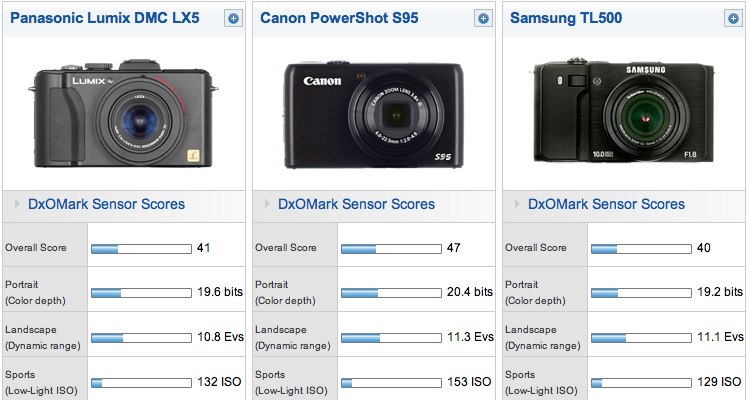
DxOmark tested the [shoplink 16886]Panasonic LX5[shoplink 14796] sensor which is also the heart of the Olympus XZ-1. As you can see the LX5 is on par with the Samsung EX1/TL500 and behind the Canon S95 sensor.
P.S.: Olympus XZ-1 preorders at Amazon, Adorama, Amazon Deutschland, Amazon France and Amazon UK.
20 Responses
But looking at sample pictures, I think the ZX-1 lens is sharper than at least my S90.
Are you talking RAW? Because DxOMArk is all about RAW.
Well I was just making a general comment. I meant even though the S95 sensor might be better DxO wise, in practice XZ-1 pictures might be the better of two because of the better lens design (based on the few samples I’ve seen).
Overall score 47 vs. 41 – that’s not slightly.
+1 😉
A 5-point difference corresponds to about 1/3 stop, so the difference is just a hair more than that. Seems pretty slight to me. It also means that if you’re light-limited and using the lens wide-open, then you’re going to do better with the S95 up to about 35mm, the two will be about equal between 35mm and 45mm, and beyond 45mm the LX5 will have the advantage.
-> the Canon G10 (37) is only slightly less good as the LX5? And most or at least some of the cams with the same Sony sensor are also only slightly less good as the LX5?
You’re talking about noise performance in your reply, right? As far as I see the main advantage of the S95 is dynamic range.
At the sensor level, yes, the G10 is only slightly worse. Of course, the lens is a full stop slower than the S95 or LX5 at the wide end.
Concerning the S95 vs LX5, yes, the difference in the score is mostly from the dynamic range. If you’re using them both at base ISO, then the S95 has 1/2 stop advantage in DR. If you can’t use them at base ISO because of shutter speed limitations, then you’re back in the “it depends on the focal length” category.
… and given that both lenses perform optical on the same level wide open at the longer end.
But I see what you mean.
The interesting bit (or not) is how similar the sensor is to the the LX3 (except for low light) where it is about 1/3EV stop better.
All in all the big advantage of the LX5 is merely a good show by the JPEG engine.
A camera’s lens sharpness, image processing engine, white balance, focus, and exposure accuracies are going to overshadow the differences between these sensors. But, all things being equal, yeah, the Canon sensor seems better. I really wish that Olympus would get out from whatever agreement they have with Panasonic that seems to keep them bound to use Panny sensors.
I may be wrong but I’m pretty sure that this sensor is not from Pana but from Sony…
And with the 1.8 at the wide end, the Olympus will be like the Canon in low light.
I thought Canon is the only major player (besides Panasonic) who produces their own sensor for their own cameras. Why would they buy from Sony if they produces their own stuff?
Anyways, the final performance depends on the whole package. If you have a nice sensor, but a lousy lens, you’re going to produce fussy images with lots of chromatic aberration. Having a good sensor is just going to make you see those defects better….
cL, we were talking about Olympus and LX5… They both have the same sensor and I think it is a Sony one.
No, it’s a Panasonic one.
Canon makes sensors for APSC and Fullframe. For point and shoot, they use Sony sensors. And there is no doubt S95/S90/G11/G12 all use Sony’s sensor
In real life, the LX5 is better than the S95. The S95 pics looks so unrealistic. The main advantage of the S95 is that it is quite a bit more compact and has an OLED screen, but the LX5 is no slouch with a 3″ LED screen. The LX5 is bigger, and in this case, I guess bigger is better!
That’s the main criticism toward Canon cameras… (P&S and DSLR alike). They look plasticky because of the processing they use for NR. I suggest you shoot RAW, if a Canon camera is used. I also shoot RAW with my LX3 (obviously no match with a DSLR), as you’ll get a less smudged photo then in-camera JPEG. It’s a small sensor P&S, so don’t expect too much (and it’s already as good as it gets). If ZX-1’s real-world photo looks anything like the ones posted on DPreview, then it may be the best P&S I’ve seen yet. It has the Zuiko branded lens, right?
I think it is a Zuiko, which I love, especially my 50 mm f2.0, but as far as point and shoots, I think I still prefer my LX5 over the ZX-1, the ZX-1 images look very, very similar, but to my eye they seem just a tad less glowing than the LX5, which I think is a result of the Leica optics and Leica jpeg software….and I agree, the LX5 RAW images look significantly better if shot in RAW — still I find myself being lazy and shooting JPEGs with it….. I should shoot RAW for my LX5, but for my Oly DSLR, it is hard to produce a better image with RAW, than with JPEG, but then again I don’t always see a huge difference –maybe because I have the noise reduction set to off????
Finding the superiority of the S95’s sensor hard to swallow: The LX-5 packs a sensor that’s 20 percent bigger.