









[shoplink 16258]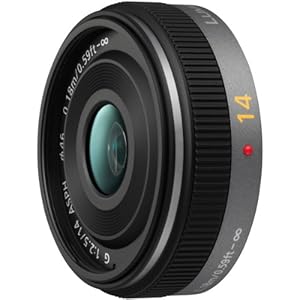 [/shoplink]
Stop reading those boring studio tests and reviews! Forget charts and comparisons! Read a real “human” world review of the new [shoplink 16258]Panasonic 14mm f/2.5 lens[/shoplink]. The reviewer…ops NO!…The photographer is Craig Mod: “This is a discussion of seeing (and by extension, photography) under the pretense of a lens review. If you want to read about what it feels like to use this lens, this is your place.”
I do totally agree with his prime lens philosophie: “By using a prime, you train both your brain and your eyes to think in their space. A zoom lens allows you to shift the lens-space to your brain-space. But with primes you’re stuck in their world. You become intimate with life within their frame until composition becomes second nature.”
And what does he say about the lens? “It’s a lovely, sharp, whisper quiet, quick to focus, unbelievably tiny, beautiful little prime lens. I highly recommend it.”
I soo enjoyed it to read that article. Thanks Craig for your awesome work. We want to see more of it 😉
You want to order the lens? Here you have a few direct links:
Amazon US


43 Responses
I’ve been a huge prime proponent for years. I cut my teeth on a Leica R4E with a 35-70/3.5 Vario Elmar, but the biggest improvement came when I saved up for that 50 ‘cron R. Boy, what a lens, I still wish I had it today.
It was Craig’s Himalayas GF1 shoot that sold me on the GF1+20. Today, my most used lenses on the GF1 are the 20/1.7, ME45/2.8 and a M42 Asahi SMC Takumar 50/1.4 that I bust out for portraits.
For a lot of people who came into digital photography via a compact or a DSLR + kit zoom, shooting with a prime can be a liberating experience. I highly recommend trying it.
He says “…whisper quiet, quick to focus..” about the 14mm lens. I think Panasonic should redesign the 20mm f/1.7 lens, which is both noisy and slow to focus.
I probably lack the technical understanding as to why it’s so difficult to construct fast, small primes that are still cheap. But almost 400 Euro for a 28mm view angle (based on 35mm) f2.5 prime lens seems a bit out of the way as many compact P&S already start at 28mm equivalent and f/2.0 and faster, costing even less than just the lens. Is the optical quality of that lens really that good to justify the price tag?
what compact p&s starts at brighter than 2.5? and less that 400 euro?
lets see… hmm.. for starters just by looking at Amazon UK (400EUR=340GBP)
Both LX5 and S95 fall under that price! Start at f2.0.. Or even a used LX3.
At least their 100-300mm will be reasonably priced.
This is a not a fair comparison. LX5 and S95 Both have a much smaller image circle.
f/2.0 for the S95 lens: 3mm aperture opening
f/2.0 for a 14mm lens: 8mm aperture opening
You need a larger aperture opening, which means larger glass and greater chance for aberrations which degrade image quality, which you would need to correct.
Not to mention that the flange focal distance of m43 is 20mm, which is longer than the 14mm actual focal length. This means you need to use a retrofocal design, which adds complexity to the design process (you can’t, for instance, just use the simple but dependable double-gauss design that makes the fast 50’s on 35mm SLRs so great) and, ultimately, adds size and weight (compare a 24mm Canon lens to a 24mm Leica M-mount lens, for example).
Agree with Tobias. Panasonic lens prices are out of whack. Similar 28mm lenses from Sony, Canon and Nikon are in the $240-260 range. 28mm DSLR lenses in the $400 range are usually 1 stop faster than the Panny.
As to P&S comparisons, they are in a whole other league. But even when restricted to DSLR alternatives, the Panny is too expensive.
I believe different crop factor leads to different construction. So lenses with equivalent focal length are not really comparable in terms of price.
Take a hint. Wide focal lengths require glass that need more effort to grind to precision. And in case no one has noticed, even Leica’s wide angle lenses are more expensive than the 50mm lenses. So get over the cost. Comparing 28mm SLR lenses to a 14mm lens on M4/3 is simply comparing apples and oranges.
And in any case, size = cost. Accept this and life gets easier.
Yes, it’s apple to orange comparison. I’ll leave P&S asides, but DSLR wides should be *more* expensive, because of the retrofocus design. So yes, panny is too expensive (how much the apple-to-apple Sony 24mm-equivalent cost? just $249)
There are lots of cheap 10-12mm C-mount lenses. And not all are shoddy either (Angenieux, Pentax, Schneider) – although some of those Schneiders are pretty expensive.
How about the Sony NEX 16/2.8? It’s a lot closer to the 14mm in focal length and is *also* $240, just like every other damned DSLR wide prime. Admittedly, the IQ is not as good as the 14/2.5, but the 14 is also not worth twice as much.
Panny, come down to earth. Wanna know why you’re not selling? It’s because you’re overcharging.
If you understand the relationship between aperture, shutterspeed, and ISO…
Then you can understand the relationship between small, fast, and cheap.
(Hint: you only get to pick two.) 😉
e.g. samsung ex1
I dont really know it as a fact but I find it hard to believe that the ex1 lens will be better than this one.
Anyway I wouldn’t want to get stuck with such a small sensor even if it was half the price.
Probably they know that and they price accordingly.
The 14 mm lens is quiet. Too shame that gf2/gh2 shutter is so noisy.
Still?
The reason why the Lumix 20 focuses slower is that it has a completely different focus assembly.
The 14mm has internal focusing, while the 20mm moves the entire lens assembly back and forth when focusing. The latter is slower, makes more noise, and is more prone to malfunctioning.
I think that probably, the 20mm focus mechanism is better in keeping the field of view stable while focusing. Internal focus can lead to focus breathing, change of “zoom” while focusing.
But internal focusing is much more solid. No moving parts on the outside of the lens.
You mean the focusing of 14mm is worse than 20mm?
Panny is not cheap, but it is good value. The slr lenses are made to lower tolerances- it is harder to make a small lens than a large one for a similar spec. Some people think panny lenses should be cheaper because they are small, but the real cost is the manufacturing to fine tolerances. The panny is quite sophisticated with 3 asph lenses and ultrasonic focus (and most importantly with good results), yet it is the smallest interchangeable lens in the world. I would expect it to cost more. PS I also strongly disagree with people who want metal everything. The plastic construction of panasonic lenses is excellent and lightweight and appropriate for small cams. Maybe we should revert to metal F1 cars or metal Boeings? Modern plastic tech rules – metal is for snobs. Rant over!
Compact cams will be cheaper as they are produced in higher volume and are lower quality.
They don’t make F1 cars or Boeings out of plastic. They’re made out of composites. If they made Panny lenses out of CFRP instead of plastic, I’m sure nobody would complain.
The way Panny charges for their lenses, you’d think they were made out of solid gold.
Panny is ultrasonic focus? 20mm is both noisy and slow to focus.
nice review, i like the people shots.
if the olympus 12mm won’t be released mid 2011, i will get this one.
Didnt read the review, but his statement:“By using a prime, you train both your brain and your eyes……composition becomes second nature.” is extremely accurate…congrats to him….
I think primes train “feet” at most due to extensive walking to frame.
Panasonic also makes televisions… you might like to sit on the couch all day and just take photos of what comes on the TV. 😀
Primes = “extensive walking”! LOL!
🙂
I wholeheartedly agree that quality plastic is a superior material for lens chassis construction. It feels nice that the mount is in metal, for better wear properties. But perhaps even the mount can be made solidly with the proper plastic material.
I for one would not wish for use of plastic lens mounts or give excuses for manufacturing for using the cheaper plastic mounts for several reasons. First just go to any camera or lens repair shop and ask or see how many broken plastic lens mounts they have found in comparison to the much more durable stainless steel ones. Maybe OK for light lenses which are not interchanged frequently but make no mistake this plastic is nowhere near the tough plastics used in airplanes?
Aside from greater wear an often overlooked factor is the big difference in the coefficient of expansion or contraction of the plastic lens mount to the stainless steel camera lens flange or mount. In hot weather the plantic lens mount inside the camera will expand and get tighter making it much more difficult to mount or remove requiring more pressure or force more likely to damage or break as plastic has little tensile strength even though it can be tough. While I prefer my only durable all metal lenses used in my old SLRs, I ruined a new plastic bodied zoom lens by accidental drop to well carpeted floor before I even used it once so I am a bit opinionated on this subject. In contrast I have accidentally dropped my metal bodied lenses to concrete or rock with little damage other than smashed lens filter over the course of 30 years use.
I think aside from the lower manufacturing cost the camera makers do not want the lens mounts to last forever as they want you to move up to their more expensive and profitable metal mount lenses.
to be honest even on my few zoom lenses I tend to move forward instead of zooming in, primes are the way to go 😀
@ voldenuit
CFRP = carbon fibre reinforced plastic ie NOT METAL. Plastics are the future whether they include CF or not. Another example is that the front wings/bonnets/boots of many cars are now plastic as it can be made as strong but is lighter and absorbs impact better.
Duh. Where did I say they were metal? The point is that f1 cars and airplanes replaced (much of) their structure with a material that was more expensive and had superior physical qualities. To equate plastic with CFRP is like saying coal is like diamond because they both have carbon in them.
Plastic lenses on cameras is a cost saving measure. Anyone saying otherwise is seriously deluding themselves.
One small mistake that should be looked into – The difference between f/2.5 and f/1.7 is just 1.1 stops, not ‘a couple of stops’ as the article suggests.
While an interesting read I don’t think one could call this a lens review. You could substitute the Panasonic 14MM with any other wide angle and leave the most part of the text unchanged 🙂
Well, IS there ANY other wide angle prime in MFT? 😉
not really, in this sense you are of course right. for the sake of argument you could replace both 14mm and MFT with any other 28mm equivalent and keep the text unchanged.
i’m totally ok with it, as long as one does not call it a (such and such) lens review because as such it is completely worthless.
agreed
for example, replace GF1 + 20mm with Sigma DP2, GF1 + 14mm with Sigma DP1 and keep the text intact (except for the fast and silent AF comment).
Safaridon
Fair point re. Lens mounts. Metal has it’s uses! Panny has had the sense to use metal mounts for all its lenses Inc the 14mm f2.5 (other than the poor 14-42). I was just pre-emptying the common whinges about plastic lenses being cheap. There are quite a few nasty cheap lenses made of metal!
There is nothing wrong with plastic mounts on M43 lenses. Modern engineering plastics are almost as tough as steel, but lighter and dont corrode (except SST316). The design properties of these modern plastics is, tough, stable in cold or heat, strong, excellent wear resistance, low coefficient of friction by adding Teflon to the mix.
I work with these types of plastics and although they are not indestructable they are very tough but will break if dropped form a height. Metal is dead because of weight and plastic is here to stay, long live the lightweight lens.
Thought the review could have been about any lens, just one persons opinion, but interesting reading all the same.
Maybe we should just use the lenses and forget the reviews, maybe not though.
Waiting for the Oly 12mm better be F2 or faster though.
Cheers
I couldn’t bear reading that review. Pretentious trash.
Just like the 20mm, give it about a year and the price will drop to realistic levels–around $300 for sure.
It may be overpriced, but it’s not as expensive as the Ricoh GXR A12 28mm lens I just ordered at 610 euro’s. 😉
Imo… M43 sensor and IQ, low light performance doesn’t justify buying such expensive glass. Be it panasonic or what not.
M43 was supposed to be a cheaper popular entry to great photogear. Not needing to buy $400 basic pirimes…