









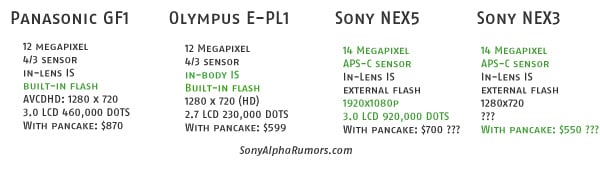
According to very reliable informations on SonyAlphaRumors the Sony NEX cameras will not have in-body stabilization. I guess they wanted to make the camera as small as possible. They will not have built-in flash and no electronic viewfinder (only an optional optical viewfinder). Sony NEX lenses will be bigger than MicroFourThirds lenses. Even the Sony 16mm f/2.8 pancake is bigger than the Olympus 17mm f/2.8 Lens

It sounds like the real killer-feature will be the cheap price (and 1080p with the NEX5).
21 Responses
No Flash no deal…..sorry.
No flash kills it for me… very bad plan.
Every manufacturer is really on the hunt for the lower bottom of the market.
A shame really. There is still very little for me in any mirrorless system to date (except for the GH1 perhaps).
Larger, possibly heavier lens’s than micro 4/3rds with a smaller form factor body than micro 4/3rds. How practical is this gonna be for use!
@Duarte Bruno:
If G2 had the sensor from GH1 it would be easier a midrange camera.
Built in flash are most of the time totaly useless. Did anyone ever hear somebody sa the Leica M does not havet a built in flash so i am not going to buy one.
One thing that I would add to that is if it has a larger sensor and still accepts adapters for older M lenses.. suddenly the 2x crop factor isn’t as annoying for that VC 35mm 1.4 in VM mount. It would be great to have a compact that can produce shallow depth of field and reasonably good ISO 1600…
Can’t wait to see sony &samsung M43 competitors. Late 2010 is going to be great !
No IBIS, no flash, bigger lenses … With the Olympus AF speed increase m43 looks like the top mirrorless system for some time. Maybe Nikon can change that when it presents its LIVE/EVIL cameras …
I would not expect to much from Nikon.
@Duarte Bruno
It is obvious because mirrorless systems are aiming for entry-market, designed primarily to be compact in size, rather than designed to be replace DSLR due to the limited choices of lenses, midrange DSLRs are get cheaper and entry-level DSLRs are getting more advanced in features nowaday (you see even Canon Rebel T2i/550D which deliver good photo quality, can also provide more frame-rate and constant audio level options, 24/25/30fps & 50/60fps switchability but to be more competitive in entry-price, and much more third-party options than GH1 now).
I like the idea of the APS-C sensor in a small mirrorless body, but I’ll wait and see how the images turn out. Sure, the 4/3 sensor is small, but it produced impressive results!
An APS-C camera will always be at a disadvantage for size and weight. But also for AF speed, as the larger lens elements will be heavier and thus slower to focus.
So, in Sony’s mind they looked at all the features which made the m4/3 format such a success, and decided to implement… none of them. Sweet! Instead take all the features that people don’t like – larger lenses, no flash, no EVF, etc. and implement those. That’s some smart engineering/marketing…
Seriously, Sony?!? Why even bother? Could’ve spent your time and resources by not coming up with anything and instead joining the m4/3 standard. You’re not Canon or Nikon, so you can’t really afford to come up with a proprietary format on your own (are you listening, Samsung?).
I could care less about a built in flash. I almost never use them. These are very exciting cameras.
@kesztió:
“If G2 had the sensor from GH1 it would be easier a midrange camera.”
If it did I wouldn’t think twice. The extended video abilities + GH1 sensor + Touch Interface would be enough for me to weight down the inexistence of IBIS.
@at:
Únfortunately no DSLR will help me in focusing legacy glass and the answer to that lies only in mirrorless systems. m43 is just too far ahead of anything that Samsung or Sony will come up with in usefull time…
Not much to repeat from my comments on SonyAlpharumors. Anyway, the best option for using manual lens is M4/3, while we still cannot tell whether Sony can deliver something that outperforms M4/3 before the actual products are being released, so just wait to see the feedback from the market. Just forget about Samsung anyway, who knows what the company will be doing next on their proprietary system with the strong competitors of Sony and M4/3-group of companies.
The range of lenses for m4/3 is much better.
I was looking at the Samsung NX lens range/roadmap and there is no ultra wide lens. There only seem to be three lenses for the Sony, again with no ultra-wide. Presumably you could mount an APS-C lens on an adaptor, but that negates the size advantage.
I’m curious how thin the NEX cams will be. If Sony’s able to put an APS-C sensor into a body that is thinner than MFT bodies, why Pana is not giving me a MFT sensor with the LX3 successor. THAT WOULD BE AWESOME,….. thin, ultra-portable, stylish, low profile photography and VIDEOGRAPHY, FullHD, manual focus (via touchscreen), F2.8, 26 – 130, lens cover, ……… c’mon
@LX4: A MFT sensor in a camera with a 26 – 130 (equivalent, I presume) lens at f/2.8 would not be thin and ultra-portable. Sorry. You’d need a wide image circle to cover the MFT sensor, and aperture is a function of of diaphragm opening divided by focal length.
@LX4
It is obvious LX3 successor will be continued to be a compact DC, because only CCD sensor can produce the rich color and contrast of LX3. MOS sensor tend to have both color and contrast being washed out like their MFT cameras. It is also no way to compare the size and weight with a MFT-sensor equipped with a wide and zoom lens of fast aperture.