









Global shutter is one of the most requested features of MicroFourThirds user. K-rumors has got some evidence that Samsung
“The present invention relates to solid-state imaging apparatus having a concurrent shutter (hereinafter referred to as global shutter) function, and more particularly relates to a solid-state imaging apparatus having a global shutter function so as to be capable of obtaining imaging data having a high image quality.”
For those interested to read more about it go here: http://www.freepatentsonline.com/7689113.html
Oh! And if you really want to know everything read the complete patent list with all Sony-Canon-Samsung-Olympus related global shutter patents!
UPDATE: What is a global shutter?
“With Global/Synchronous Shutter, all rows in the ROI are reset then exposed simultaneously for a specified time. At the end of the exposure/integration time, each pixel value is transferred immediately to an adjacent storage area to await read-out. The pixel values are then read out row-by-row from storage, building the frame. This use of intermediate storage reduces the gradual overexposure that can occur down the image when the rows are read out directly from the active area.
Because all rows are exposed simultaneously, Global Shutter avoids jagged or blurred affect produced by Rolling Shutter for fact action images. However, because it stops exposure to perform read-out, it does not provide the fastest possible sequence of frames. ”
source: Pixelink
For our Samsung readers: Now you have your Samsung NX10 in Stock on amazon
8 Responses
Actually, film cameras don’t really have a global shutter, but instead a very fast rotary disc shutter. Cameras like the RED will have a digital shutter with the same speed a rotary disc shutter. Films done with a global shutter will still look different than real movies.
This is cool and all but what does this global shutter actually do?
like what are its benifits and functions as far as photography go?
Benefits can include: lighter weight (no mechanical shutter parts), more accurate shutter speeds, “stepless” shutter speeds (ie. if the scene meters a quarter-stop brighter than your current aperture and shutter speed, it’ll be able to shoo at 1/1250 instead of just 1/1000), less camera shake due to shutter movement, faster shutter response time (for m43, the shutter doesn’t have to close then open then close for the shot).
i thought m43 didnt have a shutter already ?
This is all very interesting but patent registering looks a lot like dog’s piss: They are just limiting their territory!
From the latest Panasonic interview I reckon it will be at least another 18 months before this hit’s the shelves.
@jeff: “i thought m43 didnt have a shutter already ?”
No, what it doesn’t have is a mirror. There is no slap but the mechanical shutter is still there and you can perfectly hear it’s noise when it actuates.
When M4/3 users say a “global shutter” is one of their most requested features, I think what they really want is the elimination of the mechanical shutter.
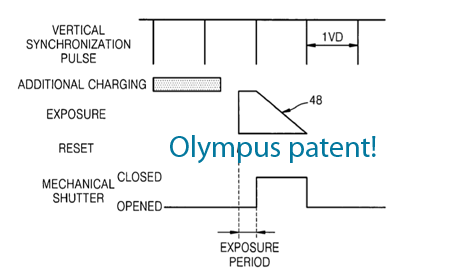
And yet it’s clear from the Olympus patent diagram that a mechanical shutter still is needed because the sensor-based “shutter” tails off too slowly. The sensor-based shutter initiates exposure, but the mechanical shutter is used to terminate it abruptly. The patent seems to relate to a method of synchronizing the two.
While this type of shutter might improve response time (“shutter lag”), it wouldn’t eliminate mechanical parts and noise or reduce camera shake due to shutter movement. (Current mechanical shutters already offer stepless control of speeds; the fixed fractional speeds seen on the camera controls are just a convention to make it easier for the user.)
Um. No more jello?
yay! 🙂