The OM System E‑M10 Mark IV is a 2020 model that’s become an excellent budget mirrorless option—often priced under $700 (~£700) on Amazon.
It checks three big-hit boxes: small, retro, and cheap—and it beats even some premium compacts like the X100VI for value
Key Highlights:
– 20 MP Four Thirds sensor delivers crisp stills, outperforming smartphones and compact cameras
– 5-axis in-body stabilization (approx. 4.5 stops) keeps handheld shots sharp
– Flip-down 3″ touchscreen enables easy vlogging and selfies
– 4K video capture and live-light tools like Live Composite mode add creative flair
Pros:
– Compact, well-built retro design with tactile controls
– Excellent for beginners thanks to intuitive layout and IBIS
– Strong value for travel, street, and everyday photography
Cons:
– No weather sealing (unlike higher-tier OM‑5 Mark II)
– Contrast-detect AF only (no phase-detect), not ideal for fast-moving subjects
– Lacks mic input and USB‑C (limits serious hybrid video use)
Bottom Line:
The E‑M10 Mark IV offers a rare combination: retro looks, strong stills/stabilization performance, and compact size—all at a budget-friendly price. It’s a compelling entry point into OM System’s ecosystem—but shoot fast action or video? You might prefer stepping up to the OM‑5 or OM‑1 series
Photographer Robin Wong discusses 10 lenses that are missing from the Micro Four Thirds ecosystem. He aims to inspire Panasonic and OM Digital Solutions to fill these gaps in 2025 and beyond:
Need for High-Magnification Budget Macro Lens
Despite having options like the Olympus 60mm f/2.8 and 30mm f/2.8, there’s a gap in budget-friendly, high-magnification macro lenses. Robin proposes a 50mm f/3.5 lens offering 2x magnification at a lower price point.
Bright Super Telephoto Zoom Lens Wish
Current lenses like Olympus 40–150mm f/2.8 and Panasonic 50–200mm f/2.8–f/4 are great but lack consistent brightness and range. A 50–250mm f/2.8 constant aperture lens would greatly benefit event and sports photographers.
Standard Zoom with f/2 Constant Aperture
Existing 12–40mm f/2.8 and 12–35mm f/2.8 lenses are excellent, but Robin suggests an even brighter standard zoom lens (f/2 constant) to improve low-light performance and reduce reliance on prime lenses.
Call for Bright Telephoto Prime Lenses
A 100mm, 135mm, or 150mm f/1.8–f/2 would fill the gap between 75mm and 200mm lenses. These would aid indoor sports and event photography with superior low-light capabilities.
Refreshing Budget Super Telephoto Lenses
The Olympus 75–300mm lens is over a decade old and due for an update. Improvements in weather sealing, image stabilization, and durability would make it more appealing to budget wildlife photographers.
Pushing Limits of Super Long Prime Lenses
Leveraging the small sensor size, Robin proposes extreme telephoto lenses like 800mm f/5.6 or 1,000mm f/6.3. These would be compact yet powerful for wildlife photography, especially fitting for OM System’s direction.
More Compact Pancake Lenses Needed
While there are some ultra-compact options, he calls for more pancake primes like a 25mm f/2.8 or a 12mm f/3.5. These would be ideal for minimalist street photographers.
Better Built Kit Lenses
Existing Panasonic 12–32mm and Olympus 14–42mm EZ lenses are fragile and prone to flex cable issues. Updated versions with improved durability and slightly better specs would enhance entry-level setups.
F1.4 Prime Lens Segment
A balance between size, cost, and performance, f/1.4 primes would bridge the gap between bulky f/1.2s and basic f/1.8s. Robin emphasizes that dedicated Micro Four Thirds designs (not adapted APS-C lenses) are key.
Upgrade F1.8 Prime Lineups
Many existing f/1.8 lenses need upgrades in weather sealing, build quality, and autofocus performance. Olympus has begun this process, but more models need attention.
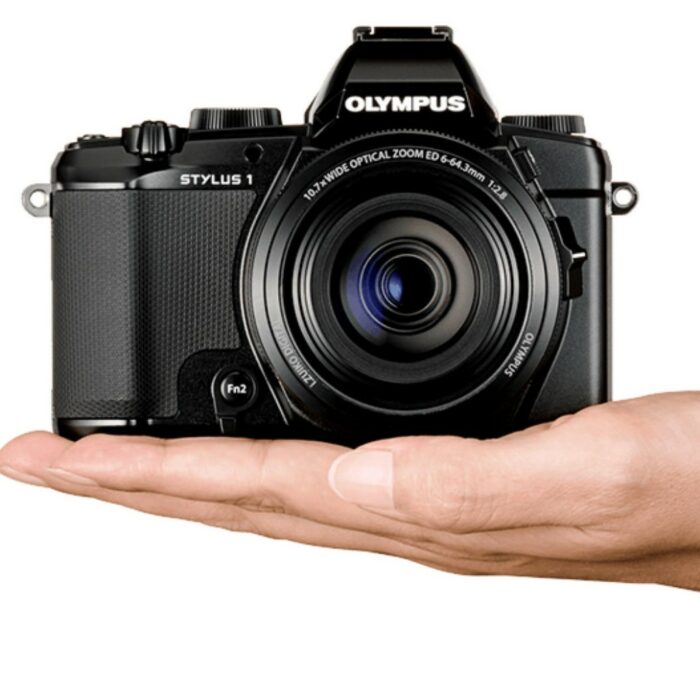
In a world where smartphones dominate casual photography, there’s still a strong demand for compact cameras that offer serious performance. The Olympus Stylus 1 was one of those rare gems: lightweight, beautifully designed, and featuring a constant f/2.8 zoom lens equivalent to 28–300mm. Now, more than ever, OM Digital has a perfect opportunity to bring it back—with modern tech.
1. Compact Superzoom = Untapped Niche
Unlike bulky superzooms like the Sony RX10 IV, the original Stylus 1 was truly compact. It combined reach with portability, something still highly valued by travel photographers, vloggers, and street shooters.
2. Constant f/2.8: Still Rare and Relevant
Very few cameras today offer a constant f/2.8 lens across such a long zoom range. A modern version with a Four Thirds sensor and an updated lens—perhaps borrowing tech from the M.Zuiko 12-100mm f/4 or 12-45mm f/4 PRO—could be the compact zoom every enthusiast dreams of.
3. Aligns with OM Digital’s DNA
OM System already caters to outdoor and travel photographers with the OM System OM-1 and TG-7. A modern Stylus would fit right in—compact, weather-resistant, fast, and reliable.
4. Perfect Platform for Innovation
Imagine a new Stylus X with:
– A 20MP Four Thirds sensor like in the OM-5
– A 3–4M-dot OLED EVF
– TruePic X processor from the OM-1
– Built-in ND filters, live composite, and Pro Capture
– Compact body design similar to the PEN-F
5. Growing Demand for Hybrid Compacts
With more creators looking for all-in-one cameras that shoot both high-quality stills and video, a rebooted Stylus 1 would fill the void between smartphones and high-end ILCs. OM Digital could add 4K/60p, microphone input, and full articulating LCD to position it as the ultimate portable content creation tool.
6. Revive the Legend, Set a New Standard
OM Digital has a legacy worth building on. With modern tech and smart design, a next-generation Stylus could be the **ultimate hybrid travel camera**—something no smartphone can match.
Aiarty Video Enhancer has just rolled out a major update—bringing expanded GPU support across more devices, faster performance, and smarter denoising. It is easy to upscale, deblur, denoise, and enhance your footage with natural, texture-preserving cleanups and pro-level results — all processed locally, offline.
Key Updates:
Expanded GPU Acceleration –Supports more hardware for faster AI-powered processing
Turbo Mode Upgrade – New adaptive multi-resolution mode speeds up export times
Multi-Audio Track Export – Great for interviews and complex video workflows
Limited-Time Offer Claim a free license to test Aiarty—no watermark, no credit card needed. Own it forever: Get 30% off the Lifetime License, which supports up to 3 PCs or Macs. One-time payment, free lifetime updates, and a 30-day money-back guarantee.
What Creators Are Saying
“Aiarty Video Enhancer is the best-in-class tool for wildlife videographers—superior at low-light denoise, texture recovery, fast rendering, integrated slow-mo, and clean audio. It’s a desktop solution perfectly suited for pro-level field footage, and in many ways, it outperforms legacy products which cost twice as much.“ — A wildlife photographer after hands-on testing with Aiarty.
What Is Aiarty Video Enhancer For?
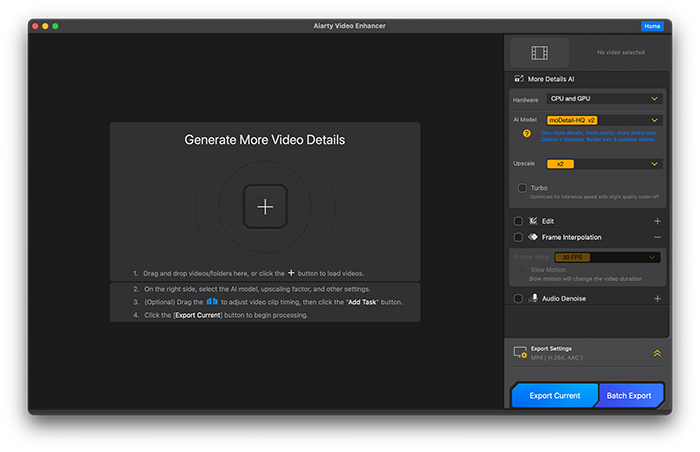
Three Smart AI Models – No Complex Settings
moDetail – Ideal for skin, hair, fabric, and natural textures. Brings out fine details without over-processing.
Smooth-HQ – A versatile model that balances deblurring and denoising while preserving accurate colors across general footage.
superVideo – Best for grainy, compressed, or low-light clips. While slightly slower, it delivers the highest-quality output—great for indoor or nighttime shoots.
Optimized AI for Speed and GPU Efficiency
Aiarty’s models are engineered to make full use of your GPU, ensuring faster processing without compromising quality. For time-sensitive projects, a Turbo Mode is also available, offering quicker exports with a slight trade-off in precision.
Offline and Secure – No Internet Required
All video enhancement is performed locally on your device. This means your footage never gets uploaded to the cloud—ideal for sensitive content, remote work, or creators who prefer to keep their data private.
Excellent Denoising and Deblurring
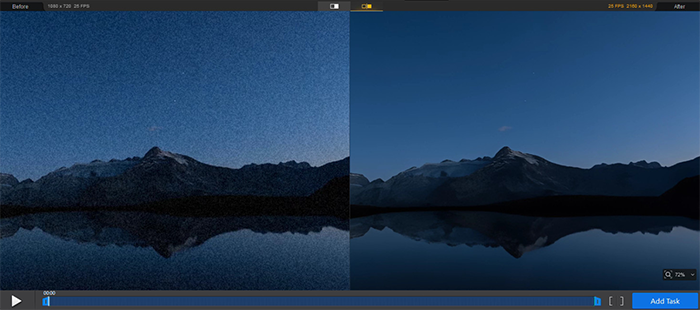
Aiarty uses advanced AI to remove luminance and chroma noise while preserving fine textures and edges. It’s particularly effective for low-light smartphone clips, grainy VHS footage, action cam or drone videos, and blurry dashcam recordings. Unlike traditional filters that blur details, Aiarty restores true texture and clarity—from sharper hair strands to cleaner backgrounds and smoother motion.
AI Frame Interpolation up to 120FPS
Turn choppy or low-frame-rate footage into smooth, cinematic playback. Aiarty can generate new frames using AI, boosting video up to 90fps, 120fps, or even higher—perfect for creating slow-motion sequences or enhancing older 30fps videos.
Audio Enhancement
Remove wind noise, microphone hums, and background disturbances. Enhance vocals for clearer and more professional-sounding audio.
Quick Edits Before Enhancement
Trim video length, rotate, crop, or flip footage before enhancing. Easily prep clips for YouTube, Instagram, or TikTok with built-in aspect ratio presets.
Example Use Cases
Low-Light Footage Denoising
Sharpen Video and Improve Clairty
Upscale AI Generated Video
Create Cinematic Slow Motion
Who is Aiarty for?
Whether you’re:
A videographer working in challenging conditions
A creator restoring noisy or legacy outdoor footage
A mirrorless camera user refining Sony/Canon/Olympus footage from the field
Enhancing AI-generated or mobile-shot clips
Aiarty gives you pro-grade results with no steep learning curve.
L